
Close Menu
    Facebook X (Twitter) Instagram
    SciTechDaily
    • Biology
    • Chemistry
    • Earth
    • Health
    • Physics
    • Science
    • Space
    • Technology
    Facebook X (Twitter) Pinterest YouTube RSS
    SciTechDaily
    Home»Biology»Sugar Code in Protein: Paving the Way for Development of Biopharmaceuticals
    Biology

    Sugar Code in Protein: Paving the Way for Development of Biopharmaceuticals

    By Nagoya City UniversityJuly 13, 2022No Comments2 Mins Read
    Facebook Twitter Pinterest Telegram LinkedIn WhatsApp Email Reddit
    Share
    Facebook Twitter LinkedIn Pinterest Telegram Email Reddit
    Sequence From LAMP-1 Lewis X Code
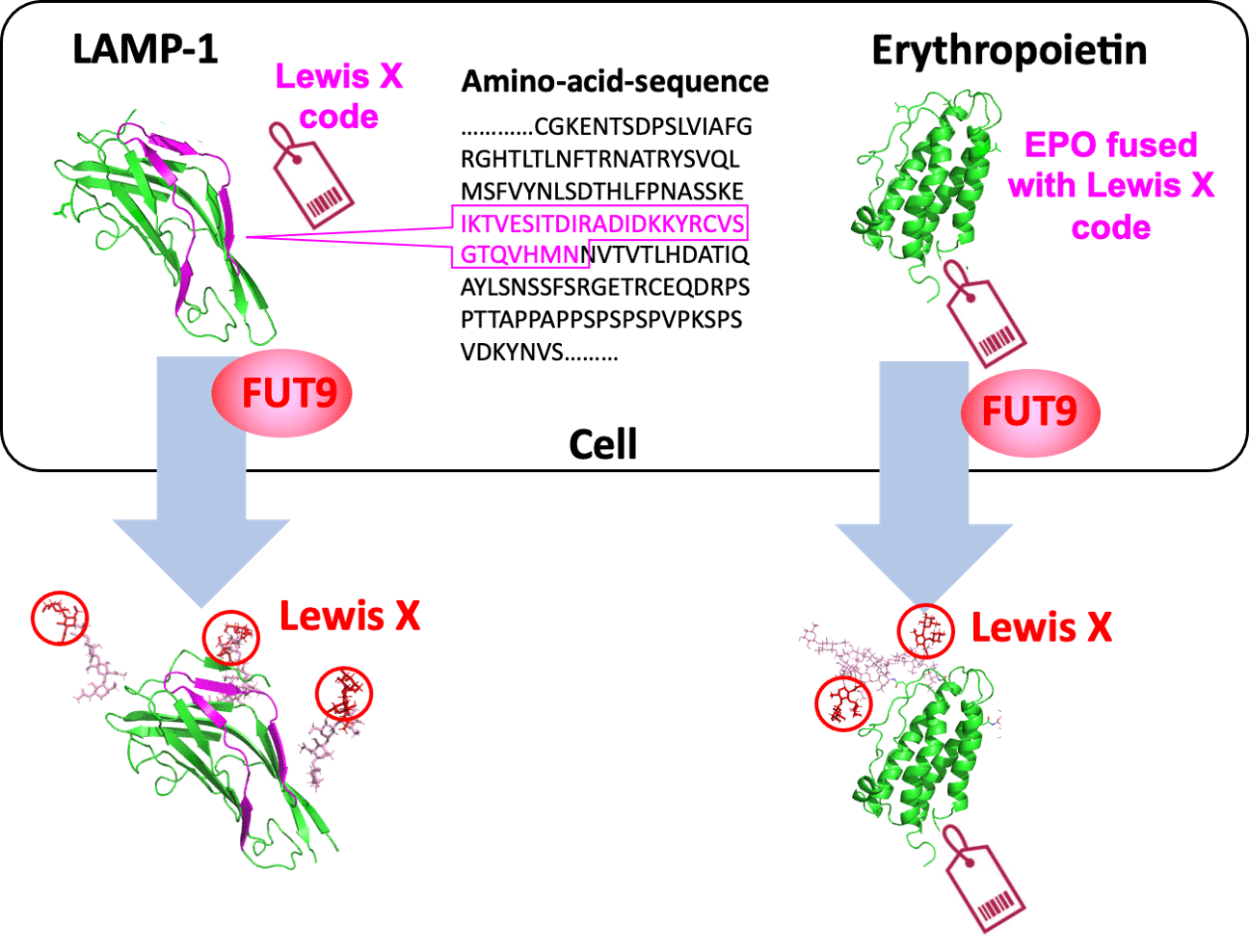
    Specific 29-amino-acid sequence from LAMP-1 serves as a “Lewis X code,” which is deciphered by FUT9, and it can be embedded into erythropoietin to evoke Lewis X modification. Credit: Nagoya City University Graduate School of Pharmaceutical Sciences

    Identification of a Molecular Code Embedded in Protein for Regulating Its Glycosylation

    Many proteins in nature exist as glycoproteins, which are molecules comprised of protein (polypeptide chain) and glycan (sugar chain). While the protein structure is determined on the basis of its genetic blueprint, the information on glycans is not directly encoded by the genome. Therefore, it is quite challenging to control protein glycosylation. Under these circumstances, a collaborative research group, including scientists at Nagoya City University, National Institutes of Natural Sciences, and Academia Sinica, has found a specific amino acid sequence in a polypeptide that induces a specific glycan structure called Lewis X.

    The group of scientists in Japan has previously shown that Lewis X specifically modifies the protein LAMP-1 in mouse neural stem cells through the enzymatic action of fucosyltransferase 9 (FUT9). In this recent research, they have shown that Lewis X modification specific for LAMP-1 occurs not only in neural stem cells but also in several cultured mammalian cells. Furthermore, they also discovered that a sequence consisting of 29 amino-acid residues in LAMP-1 promotes Lewis X modification catalyzed by the enzyme, and this sequence induces Lewis X modification when fused to other proteins used as biopharmaceuticals. This means that, in glycoprotein molecules, a specific amino-acid sequence can determine their glycan structures.

    Most biopharmaceuticals are actually glycoproteins, as best exemplified by therapeutic antibodies.  Their glycan structures are critical for their efficacy and safety. Therefore, the control of glycosylation is an important issue in the development of biopharmaceuticals. Their findings on a regulatory code of protein glycosylation are expected to pave the way for controlling glycosylation of biopharmaceuticals.

    Reference: “An embeddable molecular code for Lewis X modification through interaction with fucosyltransferase 9” by Taiki Saito, Hirokazu Yagi, Chu-Wei Kuo, Kay-Hooi Khoo and Koichi Kato, 13 July 2022, Communications Biology.
    DOI: 10.1038/s42003-022-03616-1

    Funding: Japan Science and Technology Agency, Grants-in-Aid for Scientific Research

    Never miss a breakthrough: Join the SciTechDaily newsletter.
    Follow us on Google and Google News.

    Biochemistry Pharmaceuticals Protein
    Share. Facebook Twitter Pinterest LinkedIn Email Reddit

    Related Articles

    COVID-19: Achilles’ Heel of SARS-CoV-2 Viral RNA Identified

    Protein’s ‘Silent Code’ Affects How Cells Move – “On a Global, Philosophical Level, This Expands Our Understanding of Genetic Code”

    Advanced New Artificial Intelligence Software Can Compute Protein Structures in 10 Minutes

    Tool Encoded in Coronaviruses Provides a Potential Drug Target for COVID-19

    Aiming to to Form Biological Patterns, Scientists Dissect and Redesign Protein-Based Pattern Formation

    Key Enzyme From Plants Could Guide Development of New Medicines

    ‘NoBody’ – A Microprotein on a Mission

    Yale Researchers Create a 21st Amino Acid

    p65 Protein and Its Interaction With Telomerase RNA

    Leave A Reply Cancel Reply

    • Facebook
    • Twitter
    • Pinterest
    • YouTube

    Don't Miss a Discovery

    Subscribe for the Latest in Science & Tech!

    Trending News

    Largest-Ever Study Finds Medicinal Cannabis Ineffective for Anxiety, Depression, PTSD

    250-Million-Year-Old Egg Solves One of Evolution’s Biggest Mysteries

    Living With Roommates Might Be Changing Your Gut Microbiome Without You Knowing

    Century-Old Cleaning Chemical Linked to 500% Increased Risk of Parkinson’s Disease

    What if Your Memories Never Happened? Physicists Take a New Look at the Boltzmann Brain Paradox

    One of the Universe’s Largest Stars May Be Getting Ready To Explode

    Scientists Discover Enzyme That Could Supercharge Ozempic-Like Weight Loss Drugs

    Popular Sweetener Linked to DNA Damage – “It’s Something You Should Not Be Eating”

    Follow SciTechDaily
    • Facebook
    • Twitter
    • YouTube
    • Pinterest
    • Newsletter
    • RSS
    SciTech News
    • Biology News
    • Chemistry News
    • Earth News
    • Health News
    • Physics News
    • Science News
    • Space News
    • Technology News
    Recent Posts
    • Want Less Stress? Landmark Study Points to a Simple Habit
    • Scientists Reveal Eating Fruits and Vegetables May Increase Your Risk of Lung Cancer
    • AI Reveals Explosive Growth of Floating Algae Across the World’s Oceans
    • 5.5 Million Bees Discovered Living Beneath a New York Cemetery
    • Scientists Reverse Brain Aging With Simple Nasal Spray
    Copyright © 1998 - 2026 SciTechDaily. All Rights Reserved.
    • Science News
    • About
    • Contact
    • Editorial Board
    • Privacy Policy
    • Terms of Use

    Type above and press Enter to search. Press Esc to cancel.