
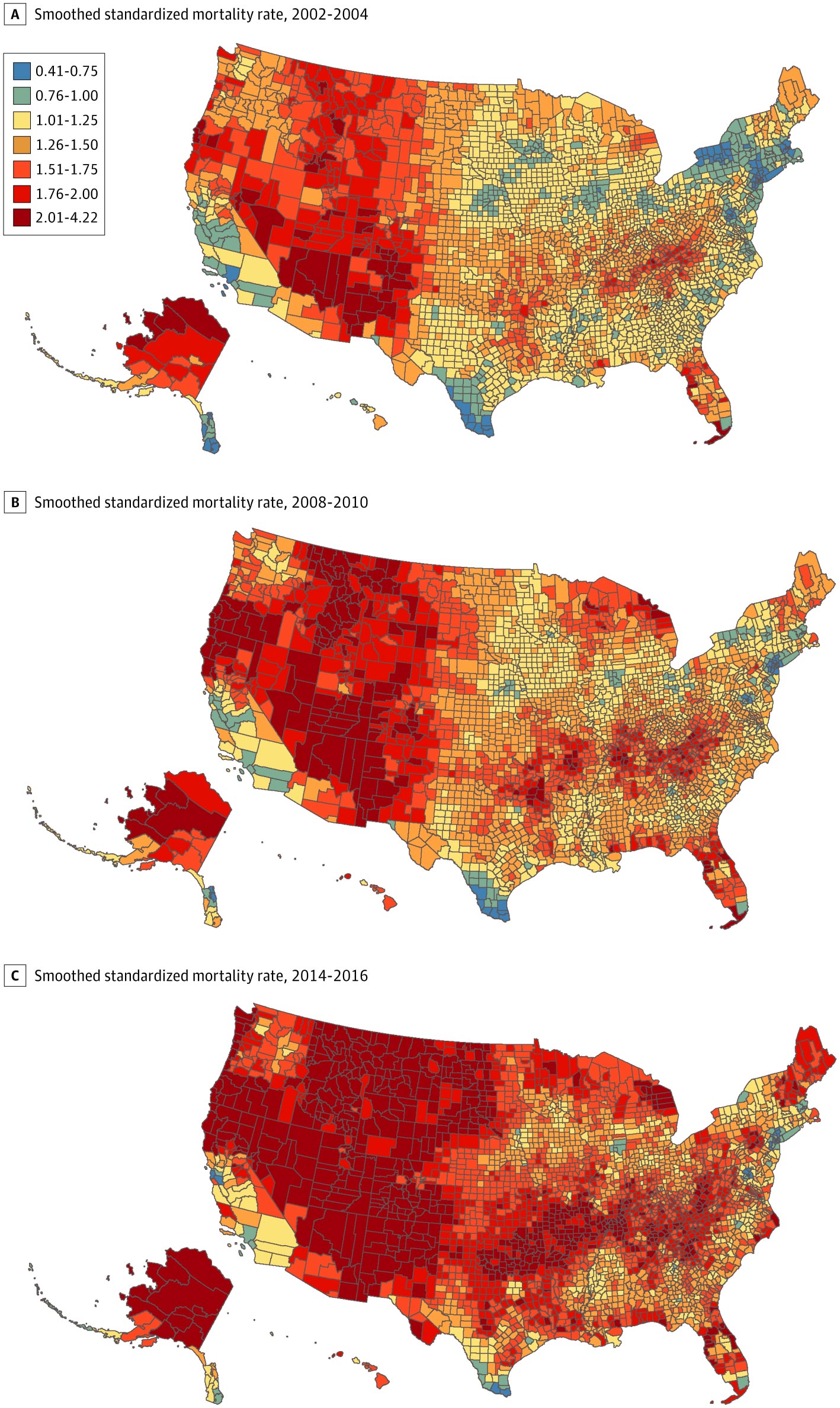
Suicide is becoming more common in America, an increase most pronounced in rural areas, new research has found.
The study, which was published on September 6, 2019, in the journal JAMA Network Open, also highlights a cluster of factors, including lack of insurance and the prevalence of gun shops, that are associated with high suicide rates.
Researchers at The Ohio State University evaluated national suicide data from 1999 to 2016, and provided a county-by-county national picture of the suicide toll among adults. Suicide rates jumped 41 percent, from a median of 15 per 100,000 county residents in the first part of the study to 21.2 per 100,000 in the last three years of the analysis. Suicide rates were highest in less-populous counties and in areas where people have lower incomes and fewer resources. From 2014 through 2016, suicide rates were 17.6 per 100,000 in large metropolitan counties compared with 22 per 100,000 in rural counties.
In urban areas, counties with more gun shops tended to have higher suicide rates. Counties with the highest suicide rates were mostly in Western states, including Colorado, New Mexico, Utah, and Wyoming; in Appalachian states including Kentucky, Virginia and West Virginia; and in the Ozarks, including Arkansas, and Missouri.
“While our findings are disheartening, we’re hopeful that they will help guide efforts to support Americans who are struggling, especially in rural areas where suicide has increased the most and the fastest,” said lead researcher Danielle Steelesmith, a postdoctoral fellow at Ohio State’s Wexner Medical Center.
“Suicide is so complex, and many factors contribute, but this research helps us understand the toll and some of the potential contributing influences based on geography, and that could drive better efforts to prevent these deaths.”
Suicide rates are trending higher despite a national prevention effort that kicked off in 2015 with the goal of reducing suicide rates by 20 percent by 2025. Another recent analysis found that suicide rates in almost 90 percent of U.S. counties increased by more than 20 percent from 2005 to 2015.
The new study included 453,577 suicides by adults 25 to 64 years old from 1996 to 2016. Suicides were most common among men and those 45 to 54 years old.
Suicide prevention can be bolstered with this new information about trends and patterns of suicide, said Cynthia Fontanella, a study co-author and associate professor of psychiatry and behavioral health at Ohio State.
“For example, all communities might benefit from strategies that enhance coping and problem-solving skills, strengthen economic support and identify and support those who are at risk for suicide,” Fontanella said.
“The data showing that suicides were higher in counties with more gun shops – specifically in urban areas – highlights the potential to reduce access to methods of suicide that can increase the chances an at-risk person will die.”
Another factor related to increased suicide rates, particularly in rural areas, was “deprivation,” a cluster of factors including underemployment, poverty, and low educational attainment.
Long-term and persistent poverty may be more entrenched and the economic opportunities for individuals more limited in rural areas, Steelesmith said, adding that many rural Americans rely on jobs in agriculture and industries including coal mining.
“In cities, you have a core of services that are much easier to get to in many cases. You may have better access to job assistance, food banks, and nonprofits that might all contribute to less desperation among residents,” Steelesmith said.
High social fragmentation – which factors in levels of single-person households, unmarried residents, and the impermanence of residents – was associated with higher suicide rates, as was low social capital, a measure of the interconnectedness of people in an area. Both of these were particularly pronounced in rural America.
Other factors associated with higher suicide rates included high percentages of veterans in a county and lower rates of insurance coverage.
Fontanella said that people who live in rural America might particularly benefit from strategies to promote social connections through community engagement activities that offer opportunities for residents to interact and become familiar with supportive resources in their area.
Steelesmith said it’s important to note that county-by-county geographical information on suicide doesn’t tell the whole story. Some states, particularly in the West, have large counties with great variability in terms of resident life experiences, for instance. This work also excludes data on suicides by young and elderly Americans.
Ohio State researchers John Campo (now of West Virginia University), Keith Warren, and Elisabeth Root also worked on the study. Jeffrey Bridge of Nationwide Children’s Hospital also was a collaborator.
For help, contact the National Suicide Prevention Lifeline at 1-800-273-8255/TALK (or 1-888-628-9454 for Spanish speakers). To reach someone at Ohio’s 24/7 Crisis Text Line, send 4HOPE to 741741.
Reference: “Contextual Factors Associated With County-Level Suicide Rates in the United States, 1999 to 2016” by Danielle L. Steelesmith, PhD; Cynthia A. Fontanella, PhD; John V. Campo, MD; Jeffrey A. Bridge, PhD; Keith L. Warren, PhD; and Elisabeth D. Root, PhD, September 6, 2019, JAMA Network Open.
DOI:
Never miss a breakthrough: Join the SciTechDaily newsletter.
Follow us on Google and Google News.
2 Comments
I didn’t see it mentioned here that the increase is all male suicides
Was there ever a supply chain for related studies of cannabis use in psychiatric health that was vetted more than typical 3rd party lab testing? I immediately use the movie “Law Abiding Citizen” as a model of logistical tracking. It’s shows that with the right skillset , a supply of cannabis ( I know this wasn’t a vault like controlled study to gather this much data. Please excuse my layman’s ignorance but do share my morale ) used for my fictional model I built with the movie reference could easily intercepted and altered or the MOST likely scenario. The above collection of data ( that goes far beyond my level of education) was likely drawn from cannabis users obtaining different products- potentially laced yes, but more likely it was grown to turn over a profit. A quick profit. There was no genetic testing/control on the street level of growing and distributing cannabis. In the manner of growing modern genetically modified strains after detecting, isolating, and eventually producing highly concentrated amounts of specifics , such as terpenes, as if cannabis and its compounds were able to stop serotonin reuptake as efficiently as an SSRI. Coming from someone who was thought to have major depressive disorder and recently diagnosed as ADHD. The same as most anyone who reads this now also knows about the adhd. It’s all in good humor. I’ve seen a lot of recent information online between contaminated social media and very few published medical studies showing cannabis with a potential to restore and grow new neural connections. Disclaimer, I’m interested in the efficacy of cannabis and its compounds strictly related to neurological regeneration. I’ve even seen things about certain cellular regeneration, maybe fringe maybe hype. I’ve had an older highly educated private psychiatrist tell me that with my potential for being in a certain 15 % of humans with specific genetic markers that any use , psychoactive or medicinal , would only increase my depression. My intent with communication is for research about how to achieve better physiological health to support better brain function. I will not now , or at any point in the future , take any response as medical advice. Any information attained that I intend to act on would be first consulted with my behavioral health care team and my primary care physician. I’m not on social media and would never publish any response. No need to even relate the website/company to the providers. This is only for personal medical research for my own benefit. Again thanks for anyone who made it through with my layman’s terms and maintained friendly morale lol