
Close Menu
    Facebook X (Twitter) Instagram
    SciTechDaily
    • Biology
    • Chemistry
    • Earth
    • Health
    • Physics
    • Science
    • Space
    • Technology
    Facebook X (Twitter) Pinterest YouTube RSS
    SciTechDaily
    Home»Space»Sun Releases a Powerful Burst of Radiation – An X1-Class Solar Flare
    Space

    Sun Releases a Powerful Burst of Radiation – An X1-Class Solar Flare

    By NASAOctober 30, 20211 Comment2 Mins Read
    Facebook Twitter Pinterest Telegram LinkedIn WhatsApp Email Reddit
    Share
    Facebook Twitter LinkedIn Pinterest Telegram Email Reddit
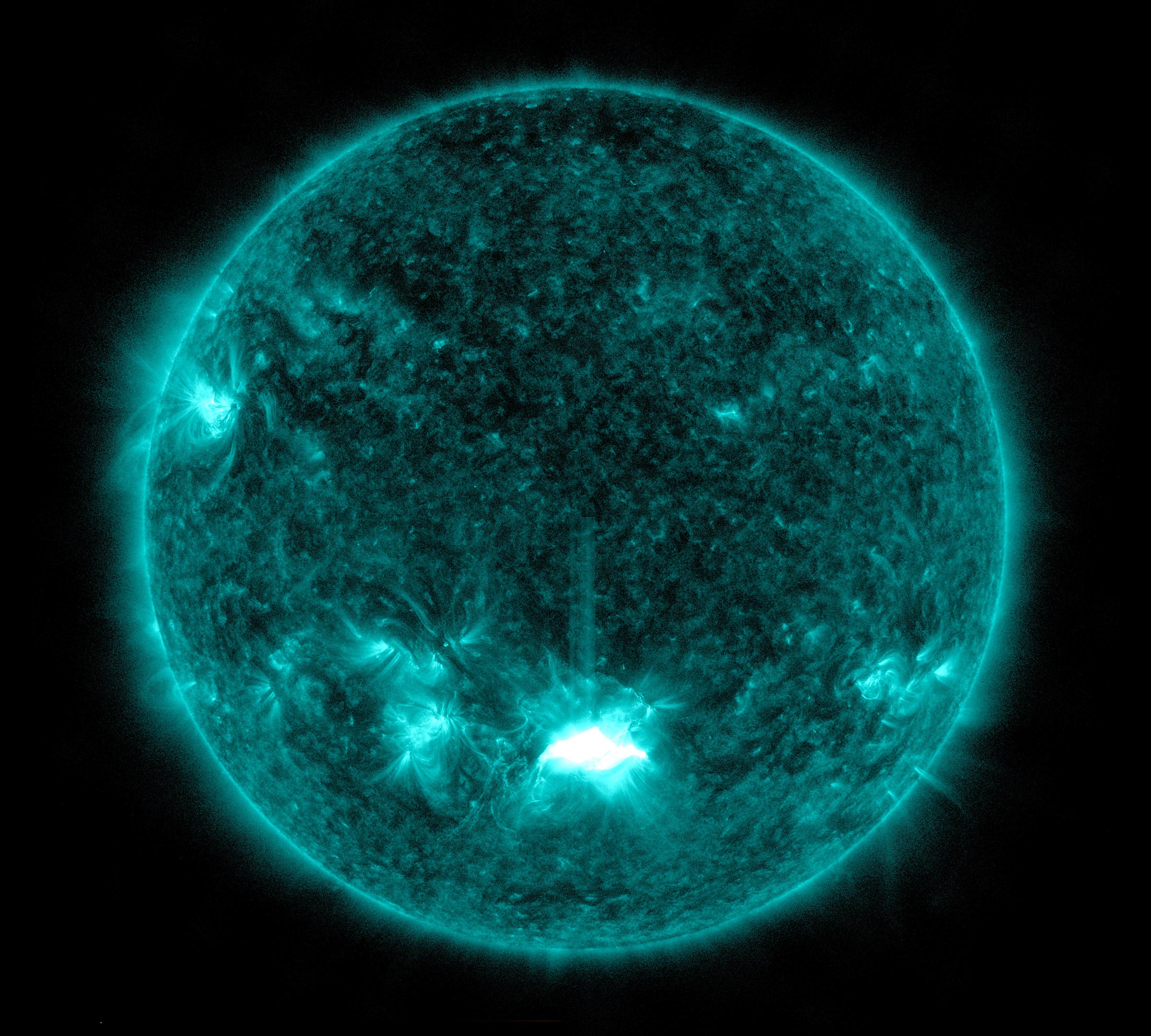
    SDO Solar Flare October 28, 2021
    NASA’s Solar Dynamics Observatory captured this image of a solar flare — as seen in the bright flash at the Sun’s lower center — on October 28, 2021. The image shows a subset of extreme ultraviolet light that highlights the extremely hot material in flares and which is colorized here in teal. Credit: NASA/SDO

    NASA Captures a Major Solar Flare

    The Sun emitted a significant solar flare peaking at 11:35 a.m. EDT on October 28, 2021. NASA’s Solar Dynamics Observatory, which watches the Sun constantly, captured an image of the event.

    Solar flares are powerful bursts of radiation. Harmful radiation from a flare cannot pass through Earth’s atmosphere to physically affect humans on the ground, however — when intense enough — they can disturb the atmosphere in the layer where GPS and communications signals travel.

    This flare is classified as an X1-class flare.

    X-class denotes the most intense flares, while the number provides more information about its strength. An X2 is twice as intense as an X1, an X3 is three times as intense, etc. Flares that are classified X10 or stronger are considered unusually intense.

    The classification system for solar flares uses the letters A, B, C, M or X, according to the peak flux in watts per square meter (W/m2) of X-rays with wavelengths 100 to 800 picometers (1 to 8 ångströms), as measured by the GOES spacecraft at the Sun-Earth distance from the Sun of 2.7×10¹⁷ km.

    ClassificationApproximate peak flux range at 100–800 picometer
    (watts/square meter)
    A< 10−7
    B10−7 – 10−6
    C10−6 – 10−5
    M10−5 – 10−4
    X> 10−4

    The strength of an event within a class is noted by a numerical suffix ranging from 1 up to, but excluding, 10, which is also the factor for that event within the class. Hence, an X2 flare is twice the strength of an X1 flare, an X3 flare is three times as powerful as an X1, and only 50% more powerful than an X2. An X2 is four times more powerful than an M5 flare. X-class flares with a peak flux that exceeds 10−3 W/m2 may be noted with a numerical suffix equal to or greater than 10.

    Never miss a breakthrough: Join the SciTechDaily newsletter.
    Follow us on Google and Google News.

    NASA Popular Solar Dynamics Observatory Solar Flares Sun
    Share. Facebook Twitter Pinterest LinkedIn Email Reddit

    Related Articles

    Sun Ignites: Unleashing a Powerful X4.5 Solar Flare

    NASA Captures Triple X-Class Solar Eruptions – Including a Powerful X8.7 Flare

    Fury Unleashed: Sun Emits Monumental X6.3 Flare, the Strongest in 6 Years

    Sun Unleashes X3.3 Fury – NASA’s SDO Captures Powerful Solar Flare

    NASA Captures Sun’s Fury: Strongest Solar Flare Since 2017

    Intensely Powerful X1.0 Solar Flare Witnessed by NASA’s Solar Dynamics Observatory

    Radiant Fury: Sun Unleashes Powerful X1.0 Class Solar Flare

    Powerful X-Class Solar Flare Erupts From Sun – Captured by NASA’s Solar Dynamics Observatory

    Sun Blasts Out 3 Powerful Bursts of Energy in Last 24 Hours

    1 Comment

    1. mullach abu on October 30, 2021 12:42 pm

      the bright flash at the Sun’s lower center — on October 28, 2021.
      oh to be so low
      i now have to travel an extra 500,000 kilometres to get to the blue ball out there
      so lets go and see how the magnetic force 40,000 kilometres out from earth will deal will my class xi force
      but will i be out of breath by the time i get there to buffet u

      Reply
    Leave A Reply Cancel Reply

    • Facebook
    • Twitter
    • Pinterest
    • YouTube

    Don't Miss a Discovery

    Subscribe for the Latest in Science & Tech!

    Trending News

    Tea or Coffee? Your Daily Choice Could Affect Osteoporosis Risk

    Vitamin C May Fight Cancer in a Surprising Way

    Hidden Earthquake Threat: Oregon’s Fault May Be Closer to the Surface Than Scientists Thought

    Scientists Discover Hidden Sleep Switch That Boosts Brainpower, Builds Muscle, and Burns Fat

    Ancient Mega-Floods Once Ripped Across Mars and Left This Giant Scar

    Scientists Discover Cheap, Natural Remedy for High Blood Pressure

    Earth’s Upper Atmosphere Is Cooling Fast and Scientists Finally Know Why

    32,000 Olympic Pools of Magma Nearly Erupted Beneath Atlantic Island

    Follow SciTechDaily
    • Facebook
    • Twitter
    • YouTube
    • Pinterest
    • Newsletter
    • RSS
    SciTech News
    • Biology News
    • Chemistry News
    • Earth News
    • Health News
    • Physics News
    • Science News
    • Space News
    • Technology News
    Recent Posts
    • The Type of Alcohol You Drink Could Affect How Long You Live
    • 19-Year Study Reveals the Surprising Truth About Sitting and Dementia
    • This Common Vitamin May Help Stop Prediabetes From Turning Into Diabetes
    • Canada’s Billion-Year-Old Rocks Could Hold the Future of Clean Energy
    • Climate Change Is Quietly Choking Rivers Across the Planet
    Copyright © 1998 - 2026 SciTechDaily. All Rights Reserved.
    • Science News
    • About
    • Contact
    • Editorial Board
    • Privacy Policy
    • Terms of Use

    Type above and press Enter to search. Press Esc to cancel.