
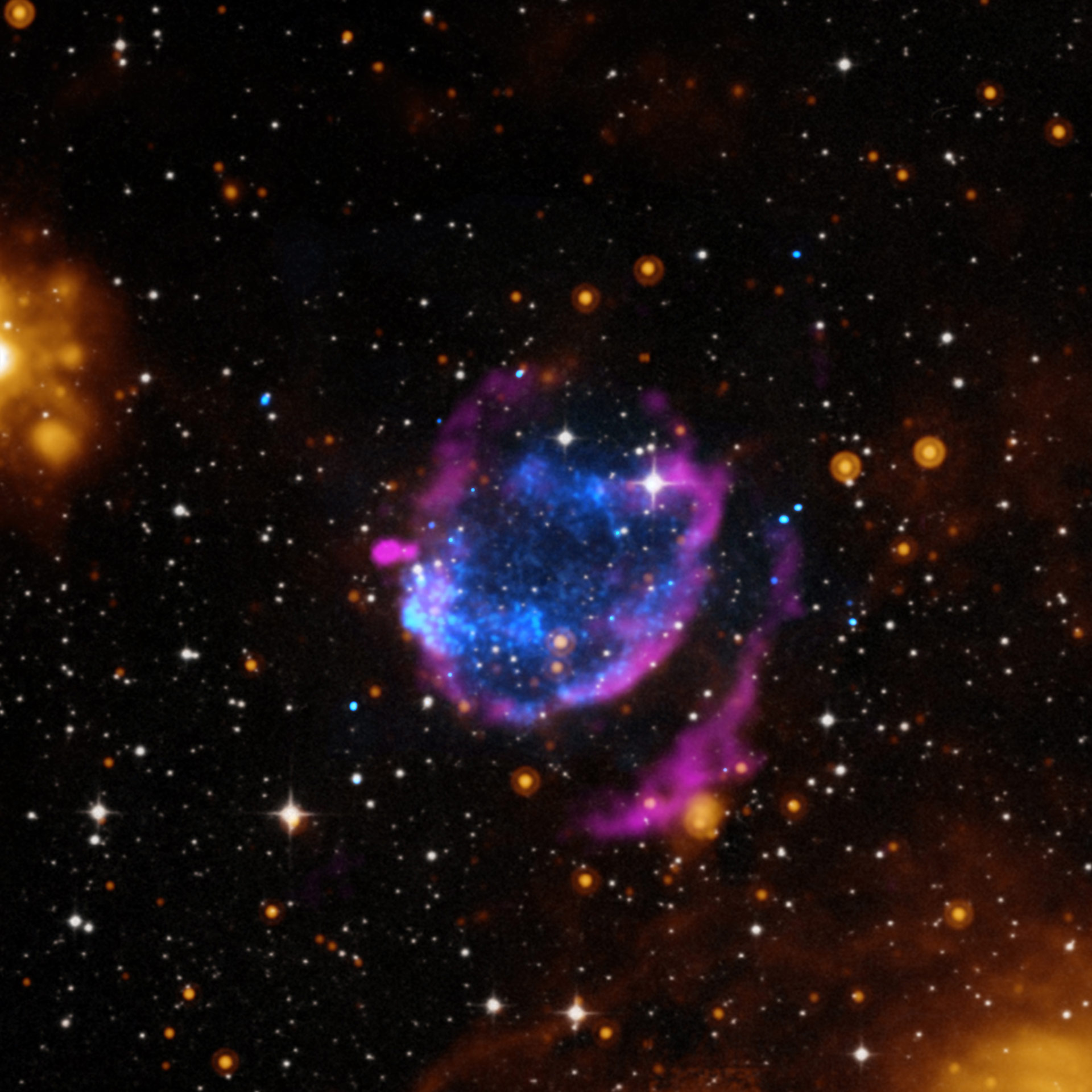
Astronomers have discovered that supernova remnant G352.7-0.1 is sweeping up a remarkable amount of material as it expands, an amount equivalent to about 45 times the mass of the Sun.
Supernovas are the spectacular ends to the lives of many massive stars. These explosions, which occur on average twice a century in the Milky Way, can produce enormous amounts of energy and be as bright as an entire galaxy. These events are also important because the remains of the shattered star are hurled into space. As this debris field – called a supernova remnant – expands, it carries the material it encounters along with it.
Astronomers have identified a supernova remnant that has several unusual properties. First, they found that this supernova remnant — known as G352.7-0.1 (or, G352 for short) — has swept up a remarkable amount of material, equivalent to about 45 times the mass of the Sun.
Another atypical trait of G352 is that it has a very different shape in radio data compared to that in X-rays. Most of the radio emission is shaped like an ellipse, contrasting with the X-ray emission that fills in the center of the radio ellipse. This is seen in a new composite image of G352 that contains X-rays from NASA’s Chandra X-ray Observatory in blue and radio data from the National Science Foundation’s Karl G. Jansky Very Large Array in pink. These data have also been combined with infrared data from the Spitzer Space Telescope in orange, and optical data from the Digitized Sky Survey in white. (The infrared emission to the upper left and lower right are not directly related to the supernova remnant.)
A recent study suggests that, surprisingly, the X-ray emission in G352 is dominated by the hotter (about 30 million degrees Celsius) debris from the explosion, rather than cooler (about 2 million degrees) emission from surrounding material that has been swept up by the expanding shock wave. This is curious because astronomers estimate that G352 exploded about 2,200 years ago, and supernova remnants of this age usually produce X-rays that are dominated by swept-up material. Scientists are still trying to come up with an explanation for this behavior.
Supernovas are the spectacular ends to the lives of many massive stars. These explosions, which occur on average twice a century in the Milky Way, can produce enormous amounts of energy and be as bright as an entire galaxy. These events are also important because the remains of the shattered star are hurled into space. As this debris field – called a supernova remnant – expands, it carries the material it encounters along with it. Astronomers have found a supernova remnant that is sweeping up a remarkable amount of material – equivalent to 45 times the mass of the Sun. This may indicate that a special type of stellar evolution has occurred, involving a giant star that ran into unusually dense material before exploding to form a supernova remnant. This supernova – which is called G352.7-0.1 — has other interesting traits that scientists are still looking to explain. G352.7-0.1 is found about 24,000 light-years from Earth in the Milky Way galaxy. (Credit: NASA/CXC/A. Hobart)
Although it does not produce a lot of X-ray emission, the amount of material – the aforementioned 45 times the Sun’s mass – swept up by G352 is remarkably high for a supernova remnant located in our Galaxy. This may indicate that a special type of evolution has occurred, in which the massive star that exploded to create G352 interacted with an extraordinary amount of dense surrounding material.
Astronomers also conducted a search for a neutron star that may have been produced by the supernova explosion. They did not find any hints of a neutron star in G352, another astronomical puzzle involved with this system. One possibility is simply that the neutron star is too faint to be detected or that the supernova created a black hole instead.
G352 is found about 24,000 light-years from Earth in the Milky Way galaxy. A paper describing these enigmatic results was published in the February 20, 2014 issue of The Astrophysical Journal. The first author of this paper is Thomas Pannuti from Morehead State University in Morehead, Kentucky, with co-authors Oleg Kargaltsev (George Washington University), Jared Napier (Morehead State), and Derek Brehm (George Washington).
Reference: “XMM-Newton and Chandra Observations of the Ejecta-dominated Mixed-morphology Galactic Supernova Remnant G352.7–0.1” by Thomas G. Pannuti, Oleg Kargaltsev, Jared P. Napier and Derek Brehm, 4 February 2014, The Astrophysical Journal.
DOI: 10.1088/0004-637X/782/2/102
Never miss a breakthrough: Join the SciTechDaily newsletter.
Follow us on Google and Google News.