
Close Menu
    Facebook X (Twitter) Instagram
    SciTechDaily
    • Biology
    • Chemistry
    • Earth
    • Health
    • Physics
    • Science
    • Space
    • Technology
    Facebook X (Twitter) Pinterest YouTube RSS
    SciTechDaily
    Home»Space»Supernova Remnant HBH 3 -The Fading Ghost of a Long-Dead Star
    Space

    Supernova Remnant HBH 3 -The Fading Ghost of a Long-Dead Star

    By Calla Cofield, Jet Propulsion LaboratoryAugust 3, 2018No Comments3 Mins Read
    Facebook Twitter Pinterest Telegram LinkedIn WhatsApp Email Reddit
    Share
    Facebook Twitter LinkedIn Pinterest Telegram Email Reddit
    Spitzer Views the Fading Ghost of a Long Dead Star
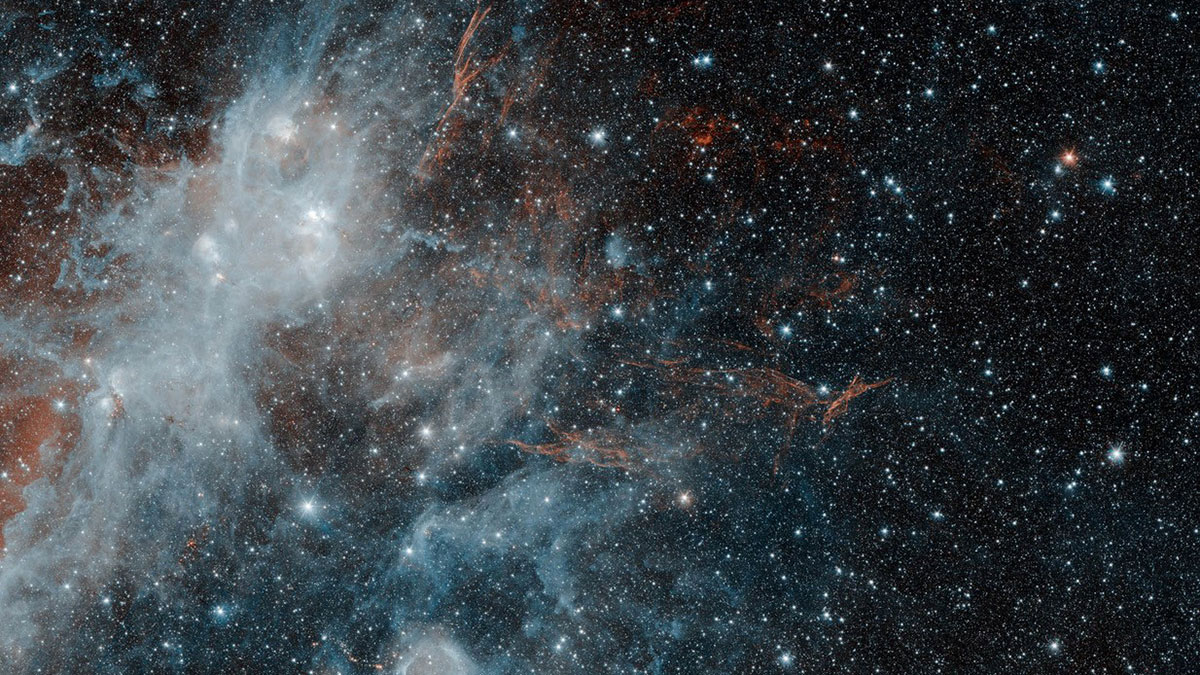
    Thin, red veins of energized gas mark the location of the supernova remnant HBH3 in this image from NASA’s Spitzer Space Telescope. The puffy, white feature in the image is a portion of the star forming regions W3, W4, and W5. Infrared wavelengths of 3.6 microns have been mapped to blue, and 4.5 microns to red. The white color of the star-forming region is a combination of both wavelengths, while the HBH3 filaments radiate only at the longer 4.5 micron wavelength. Credit: NASA/JPL-Caltech/IPAC

    Thin, red veins of energized gas mark the location of one of the larger supernova remnants in the Milky Way galaxy in this image from NASA’s Spitzer Space Telescope.

    A supernova “remnant” refers to the collective, leftover signs of an exploded star, or supernova. The red filaments in this image belong to a supernova remnant known as HBH 3 that was first observed in 1966 using radio telescopes. Traces of the remnant also radiate optical light. The branches of glowing material are most likely molecular gas that was pummeled by a shockwave generated by the supernova. The energy from the explosion energized the molecules and caused them to radiate infrared light.

    The white, cloud-like formation also visible in the image is part of a complex of star-forming regions, simply named W3, W4, and W5. However, those regions extend far beyond the edge of this image. Both the white star-forming regions and the red filaments are approximately 6,400 light-years away and lie inside our Milky Way galaxy.

    HBH 3 is about 150 light-years in diameter, ranking it amongst the largest known supernova remnants. It is also possibly one of the oldest: Astronomers estimate the original explosion may have happened anywhere from 80,000 to one million years ago.

    In 2016, NASA’s Fermi Gamma-Ray Telescope detected very high-energy light – called gamma rays – coming from the region near HBH 3. This emission may be coming from gas in one of the neighboring star-forming regions, excited by powerful particles emitted by the supernova blast.

    The Spitzer Space Telescope is one of NASA’s four Great Observatories – along with the Hubble Space Telescope, the Chandra X-ray Observatory, and the Compton Gamma-Ray Observatory – and will celebrate its 15th birthday in space on August 25. Spitzer sees the universe in infrared light, which is slightly less energetic than the optical light we can see with our eyes. In this image, taken in March 2010, infrared wavelengths of 3.6 microns have been mapped to blue, and 4.5 microns to red. The white color of the star-forming region is a combination of both wavelengths, while the HBH3 filaments radiate only at the longer 4.5-micron wavelength.

    JPL manages the Spitzer Space Telescope mission for NASA’s Science Mission Directorate, Washington. Science operations are conducted at the Spitzer Science Center at Caltech in Pasadena, California. Spacecraft operations are based at Lockheed Martin Space Systems, Littleton, Colorado. Data are archived at the Infrared Science Archive housed at IPAC at Caltech. Caltech manages JPL for NASA.

    Never miss a breakthrough: Join the SciTechDaily newsletter.
    Follow us on Google and Google News.

    Astronomy Spitzer Space Telescope Supernova
    Share. Facebook Twitter Pinterest LinkedIn Email Reddit

    Related Articles

    A Cosmic Powder Keg: When a Stable Star Explodes

    Hidden Supernova: Stars Are Exploding in Dusty Galaxies – We Just Can’t Always See Them

    Astronomers Watch as Collapsing Star Turns Into a Black Hole

    The Destructive Results of a Mighty Supernova Explosion

    Spitzer Discovers a Rare Supernova Where a Dead Star “Fed” Off an Aging Star

    New Spitzer Image of the Supernova in M82

    3D Viewer Offers a New Look at Cassiopeia A

    Lasers Mimic Supernova to Explain Cosmic Magnetic Fields

    SN Primo Is Farthest Type Ia Supernova Discovered

    Leave A Reply Cancel Reply

    • Facebook
    • Twitter
    • Pinterest
    • YouTube

    Don't Miss a Discovery

    Subscribe for the Latest in Science & Tech!

    Trending News

    Giant Plasma Waves May Be Stripping Away Mars’ Atmosphere

    Scientists Thought SuperAgers Had Lucky Genes. They Were Wrong

    Astronomers Find Ancient Black Holes Shining With the Power of a Trillion Suns

    Researchers Solve Mystery Behind Contradictory Weight-Loss Drug Paradox

    Long-Lost Megalodon Fossils Found Hiding on a Museum Shelf

    Experimental Eye Drops Restore Sight in Blind Mice

    Scientists Discover the Brain May Enter a New Biological Phase Between 50 and 75

    New Research Reveals Autistic Brains Process Faces Differently

    Follow SciTechDaily
    • Facebook
    • Twitter
    • YouTube
    • Pinterest
    • Newsletter
    • RSS
    SciTech News
    • Biology News
    • Chemistry News
    • Earth News
    • Health News
    • Physics News
    • Science News
    • Space News
    • Technology News
    Recent Posts
    • Pesticide Exposure May Carry a Serious Neurological Risk Years Later
    • Ozempic Could Fight Addiction Too – Scientists Finally Know How
    • Spain’s Largest Wildfire on Record Burned an Area the Size of New York City
    • Meet the 30-Million-Year-Old Dog That Climbed Trees Instead of Chasing Sticks
    • Two Mysterious ‘Ghost’ Ancestors Are Hiding in Our DNA
    Copyright © 1998 - 2026 SciTechDaily. All Rights Reserved.
    • Science News
    • About
    • Contact
    • Editorial Board
    • Privacy Policy
    • Terms of Use

    Type above and press Enter to search. Press Esc to cancel.