

A study shows that genetically engineered pig livers can sustain essential liver functions in humans.
A groundbreaking study published in the Journal of Hepatology has documented the first successful auxiliary liver xenotransplant from a genetically engineered pig to a living human. The patient lived for 171 days after the procedure, providing crucial evidence that modified pig livers can perform essential metabolic and synthetic roles in humans. At the same time, the case highlights ongoing medical challenges that must be addressed before long-term success can be achieved.
Each year, thousands of people die while waiting for organ transplants because of the global shortage of human donors, according to the World Health Organization. In China, hundreds of thousands of individuals develop liver failure annually, yet only about 6,000 received liver transplants in 2022. This case represents a potential step toward narrowing the gap between the demand for organs and their availability.
From Gene Editing to Surgery
The patient was a 71-year-old man diagnosed with hepatitis B-related cirrhosis and hepatocellular carcinoma who was not eligible for liver resection or a human liver transplant. Surgeons implanted an auxiliary graft taken from a genetically modified Diannan miniature pig that carried 10 targeted gene edits. These modifications included the removal of xenoantigens and the addition of human genes to improve immune and coagulation system compatibility.
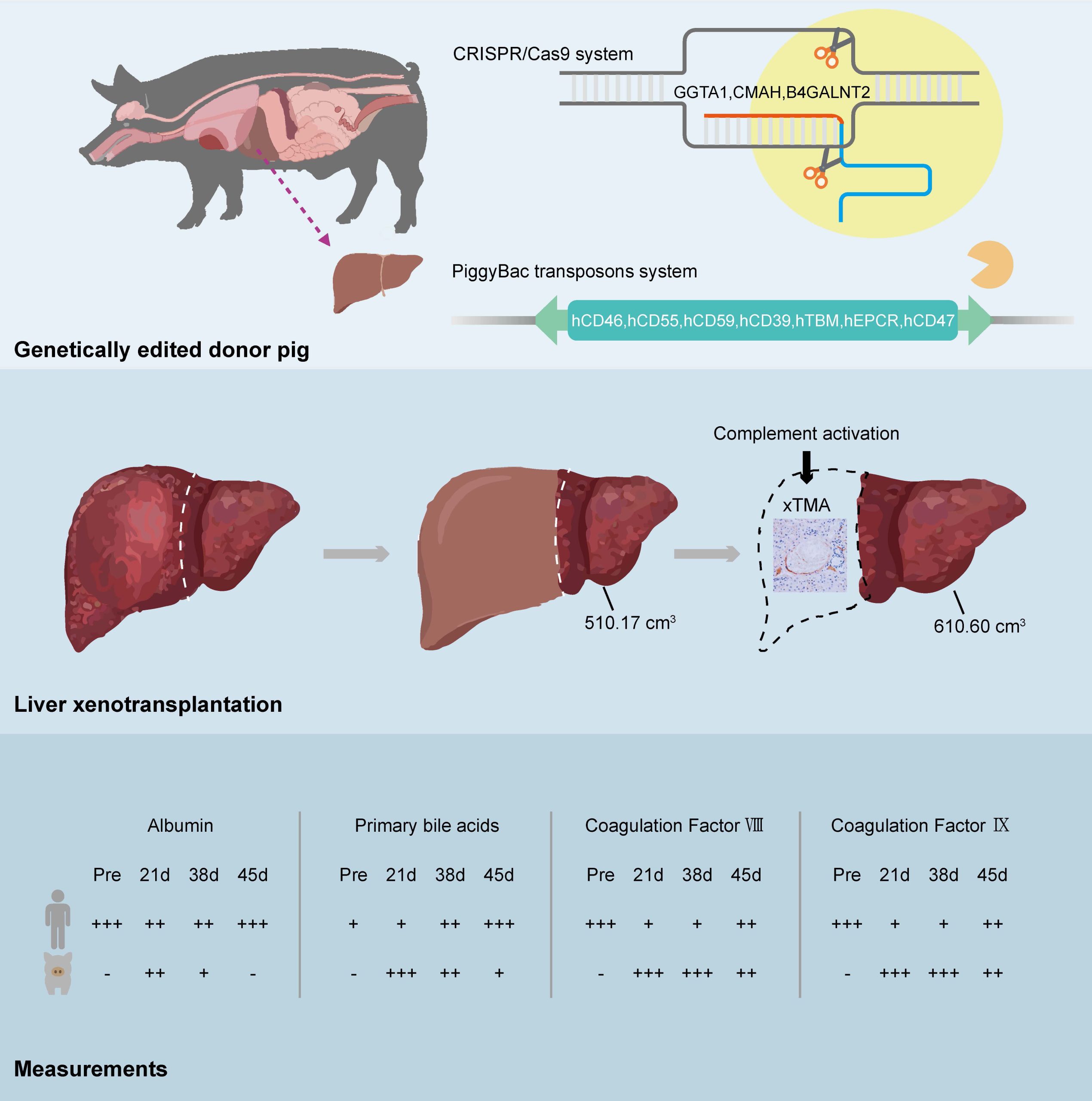
For the first month after surgery, the graft functioned effectively, producing bile and synthesizing coagulation factors, with no evidence of hyperacute or acute rejection. However, on day 38, the graft was removed following the development of xenotransplantation-associated thrombotic microangiopathy (xTMA), a serious complication related to complement activation and endothelial injury.
Treatment with the complement inhibitor eculizumab and plasma exchange successfully resolved the xTMA. Despite this, the patient later experienced repeated episodes of upper gastrointestinal hemorrhage and passed away on day 171.
A Landmark in Hepatology
“This case proves that a genetically engineered pig liver can function in a human for an extended period,” explained lead investigator Beicheng Sun, MD, PhD, Department of Hepatobiliary Surgery, and President of the First Affiliated Hospital of Anhui Medical University, Hefei, Anhui Province, China. “It is a pivotal step forward, demonstrating both the promise and the remaining hurdles, particularly regarding coagulation dysregulation and immune complications, that must be overcome.”
“This report is a landmark in hepatology,” commented Heiner Wedemeyer, MD, Co-Editor, Journal of Hepatology, and Department of Gastroenterology, Hepatology, Infectious Diseases and Endocrinology, Hannover Medical School, Hannover, Germany, in an accompanying editorial. “It shows that a genetically modified porcine liver can engraft and deliver key hepatic functions in a human recipient. At the same time, it highlights the biological and ethical challenges that remain before such approaches can be translated into wider clinical use. Xenotransplantation may open completely new paths for patients with acute liver failure, acute-on-chronic liver failure, and hepatocellular carcinoma. A new era of transplant hepatology has started.”
“The publication of this case reaffirms the Journal of Hepatology as the world’s leading liver journal. We are committed to presenting cutting-edge translational discoveries that redefine what is possible in hepatology,” added Vlad Ratziu, MD, PhD, Editor in Chief, Journal of Hepatology, and Institute for Cardiometabolism and Nutrition, Sorbonne Université and Hospital Pitié Salpêtrière, Paris, France.
Reference: “Genetically engineered pig-to-human liver xenotransplantation” by Wenjie Zhang, Qingxiang Xu, Kaixiang Xu, Runqiu Jiang, Shouyu Wang, Meijuan Zheng, Nian Liu, Deling Jiao, Zhangding Wang, Jian Ge, Xianfu Lu, Guoqiang Li, Fan Huang, Lei Liu, Yin Yin, Yang Liu, Jianxiong Guo, Kai Liu, Hong-Jiang Wei and Beicheng Sun, 9 October 2025, Journal of Hepatology.
DOI: 10.1016/j.jhep.2025.08.044
Never miss a breakthrough: Join the SciTechDaily newsletter.
Follow us on Google and Google News.
2 Comments
Breeding and using animals for spare parts is so unbelievably unethical that I don’t even have the words for it. Absolutely disgusting that this is being done. Humans need to accept their own mortality and stop killing animals who have just as much a right to exist as humans. Killing healthy individuals in order to keep sick individuals alive makes no sense. It simply increases the overall misery and death and injustice in the world.
Breeding pigs for both meat and life-saving human organ transplantation (skin, liver, …) does not seem co-existent unethical to me. If I eat the bacon and pork chops/roasts, why shouldn’t someone also benefit from a life-saving transplant? Really.