
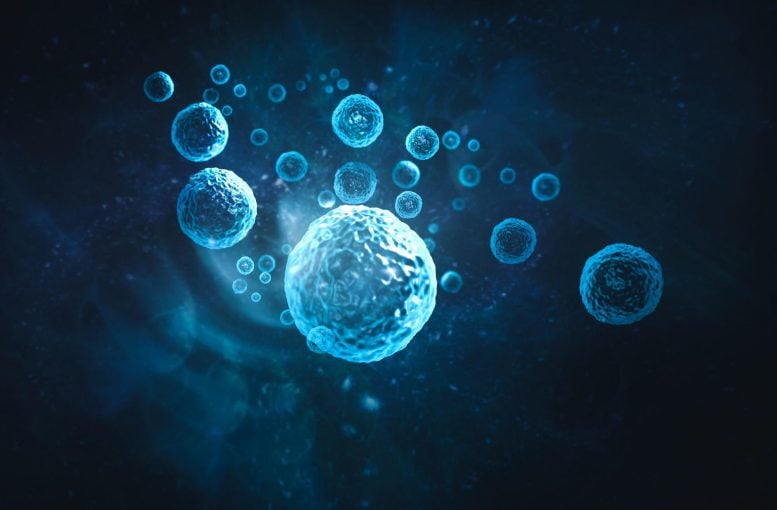
Crowded rooms: How Carnegie Mellon University and the University of Pittsburgh researchers solved a cell mystery.
A surreal video of stressed cells under a microscope inspired a group of kidney physiologists and biologists from the University of Pittsburgh and Carnegie Mellon University to investigate a mystery: how do cells control their volume?
Their research, which was recently published in the journal Cell, shows how the researchers connected the dots on a conundrum that was initially presented three decades ago with a little bit of luck.
“We were doing live fluorescence imaging experiments that were unrelated to this study, and when we added a salt solution to the cells, the internal cytoplasmic material rapidly turned into a fluorescent lava lamp,” said Daniel Shiwarski, Ph.D., a postdoctoral research fellow at Carnegie Mellon University, describing how he and his wife, co-lead author Cary Boyd-Shiwarski, M.D., Ph.D., turned a fortuitous bit of experimentation into an unexpected finding.
In this video, WNK kinases (a type of enzyme) are fluorescent and diffuse throughout the cell. When exposed to a salt solution, they coalesce into larger droplets, looking like the bright green goo in a lava lamp. This process, called “phase separation,” is how the cell knows it needs to bring both water and ions back in, returning to its original state within seconds. Credit: Boyd-Shiwarski, et al., Cell (2022)
“I looked at her, and she asked me what was going on, like I was supposed to know,” he said. “And I said, ‘I have no idea, but I think it’s probably something important!’”
The Mystery of Cell Volume Regulation
When cells are abruptly exposed to an outside stressor, such as elevated salt or sugar levels, their volume can decrease. Early in the 1990s, scientists believed that cells regain their volume by somehow keeping track of their protein concentration, or how “crowded” the cell was. However, they were unaware of how the cell sensed crowding.
Then, in the early 2000s, With-No-Lysine Kinases, or “WNKs,” were identified as a new type of enzyme. For years, scientists theorized that WNK kinases reversed cell shrinkage, but how they did so was unexplained.
The new study solves both puzzles by revealing how WNK kinases activate the “switch” that restores cell volume to equilibrium through a process known as phase separation.
Cytosol Dynamics and the Role of Phase Separation
“The inside of a cell contains cytosol, and generally people think that this cytosol is diffuse, with all kinds of molecules floating around in a perfectly mixed solution,” said senior author Arohan R. Subramanya, M.D., associate professor in the Renal-Electrolyte Division at Pitt’s School of Medicine and staff physician at the VA Pittsburgh Healthcare System. “But there has been this paradigm shift in our thinking of how cytosol works. It’s really like an emulsion with a bunch of little, tiny protein clusters and droplets, and then when a stress such as overcrowding happens, they come together into big droplets that you can often see with a microscope.”
Those liquid-like droplets were the “lava lamp” that Shiwarski and Boyd-Shiwarski were seeing that fateful day when they experimented with adding a salt solution to the cells. They had fluorescently tagged the WNKs, which were diffused throughout the cytosol, causing the whole cell to glow. When salt was added, the WNKs came together, forming large neon-green globules that oozed about the cell like the goo in a lava lamp.
The team characterized what they were seeing as phase separation, which is when WNKs condense into droplets along with the molecules that activate the cell’s salt transporters. This step allows the cell to import both ions and water, returning the cell’s volume to its original state within seconds.
Phase separation is an emerging area of interest, but whether or not this process was an important part of cell function has been controversial.
“There’s a lot of people out there who don’t believe phase separation is physiologically relevant,” explained Boyd-Shiwarski, assistant professor in the Renal-Electrolyte Division at Pitt’s School of Medicine. “They think it’s something that happens in a test tube when you overexpress proteins or occurs as a pathological process but doesn’t really happen in normal healthy cells.”
But over the past six years, the team conducted multiple studies using stressors similar to the fluctuations that occur within the human body to show that phase separation of the WNKs is a functional response to crowding.
Cell volume recovery has implications for human health as well, Subramanya explained: “One of the reasons why we’re so excited is that the next step for us is to take this back into the kidney.”
Exploring WNKs in Kidney Health and Disease
Other WNKs activate salt transport within kidney tubule cells when potassium levels are low by forming specialized condensates through phase separation, called WNK bodies. Modern Western diets are often low in potassium, so while attempting to regulate cell volume, WNK bodies may contribute to salt-sensitive hypertension.
While the new discovery won’t have immediate clinical applications, the team is excited to take what they’ve learned and explore the connections between WNKs, phase separation, and human health. Eventually, their work may lead to a better understanding of how to prevent strokes, high blood pressure, and potassium balance disorders.
Reference: “WNK kinases sense molecular crowding and rescue cell volume via phase separation” by Cary R. Boyd-Shiwarski, Daniel J. Shiwarski, Shawn E. Griffiths, Rebecca T. Beacham, Logan Norrell, Daryl E. Morrison, Jun Wang, Jacob Mann, William Tennant, Eric N. Anderson, Jonathan Franks, Michael Calderon, Kelly A. Connolly, Muhammad Umar Cheema, Claire J. Weaver, Lubika J. Nkashama, Claire C. Weckerly, Katherine E. Querry, Udai Bhan Pandey, Christopher J. Donnelly, Dandan Sun, Aylin R. Rodan and Arohan R. Subramanya, 31 October 2022, Cell.
DOI: 10.1016/j.cell.2022.09.042
The study was funded by the National Institutes of Health and the U.S. Department of Veterans Affairs.
Never miss a breakthrough: Join the SciTechDaily newsletter.
Follow us on Google and Google News.