
Close Menu
    Facebook X (Twitter) Instagram
    SciTechDaily
    • Biology
    • Chemistry
    • Earth
    • Health
    • Physics
    • Science
    • Space
    • Technology
    Facebook X (Twitter) Pinterest YouTube RSS
    SciTechDaily
    Home»Space»SUV-Size Space Rock Buzzes by Earth – The Closest Asteroid Flyby Ever Recorded by NASA
    Space

    SUV-Size Space Rock Buzzes by Earth – The Closest Asteroid Flyby Ever Recorded by NASA

    By Jet Propulsion LaboratoryAugust 18, 2020No Comments4 Mins Read
    Facebook Twitter Pinterest Telegram LinkedIn WhatsApp Email Reddit
    Share
    Facebook Twitter LinkedIn Pinterest Telegram Email Reddit
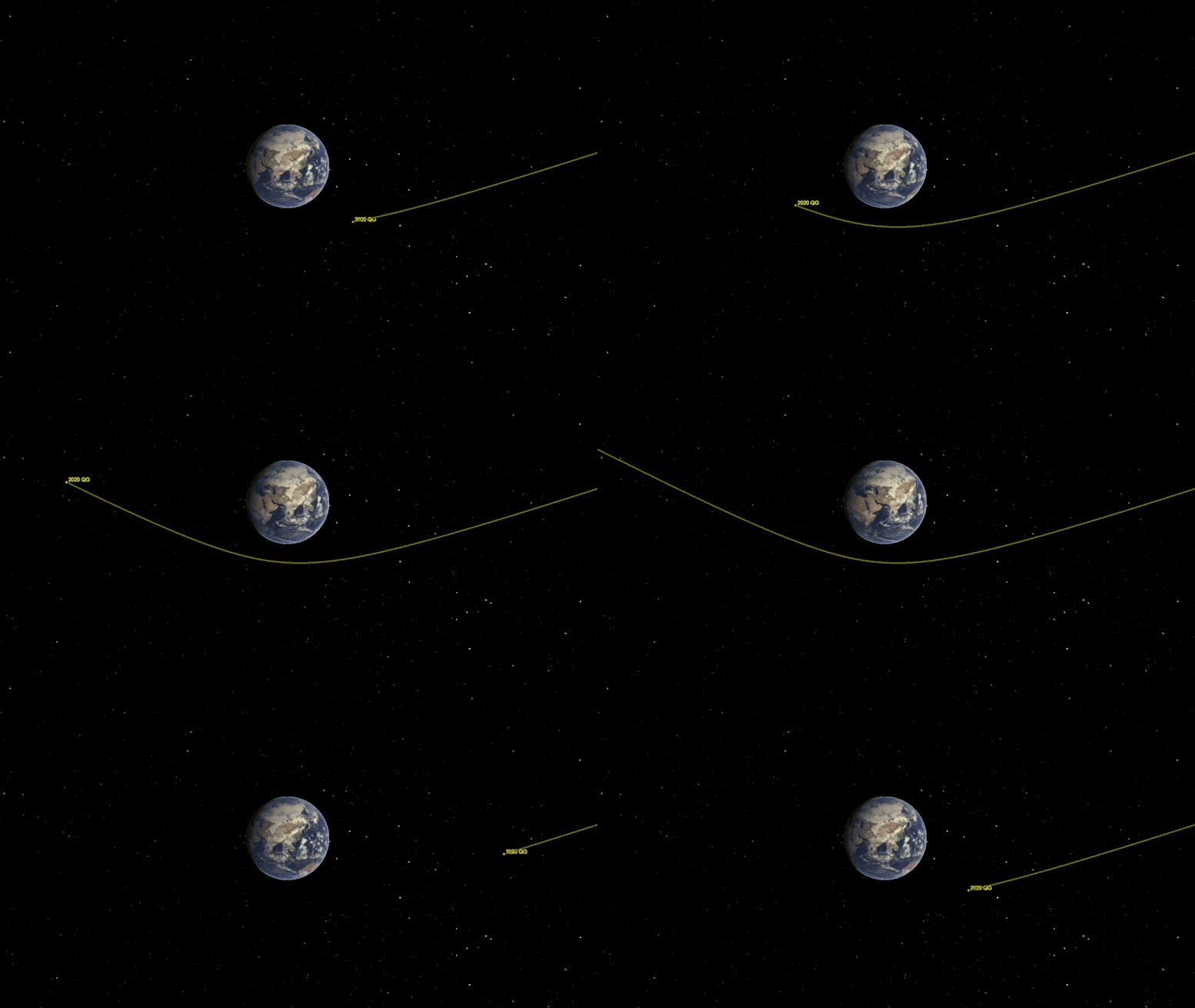
    Asteroid 2020 QG
    This illustration shows asteroid 2020 QG’s trajectory bending during its close approach to Earth. The asteroid is the closest known nonimpacting asteroid ever detected. Credit: NASA/JPL-Caltech

    An tiny aseroid flew past our planet over the weekend and was detected by a NASA-funded asteroid survey as it departed.

    Near Earth Asteroids, or NEAs, pass by our home planet all the time. But an SUV-size asteroid set the record this past weekend for coming closer to Earth than any other known NEA: It passed 1,830 miles (2,950 kilometers) above the southern Indian Ocean on Sunday, August 16 at 12:08 a.m. EDT (Saturday, August 15 at 9:08 p.m. PDT).

    At roughly 10 to 20 feet (3 to 6 meters) across, asteroid 2020 QG is very small by asteroid standards: If it had actually been on an impact trajectory, it would likely have become a fireball as it broke up in Earth’s atmosphere, which happens several times a year.

    By some estimates, there are hundreds of millions of small asteroids the size of 2020 QG, but they are extremely hard to discover until they get very close to Earth. The vast majority of NEAs pass by safely at much greater distances — usually much farther away than the Moon.
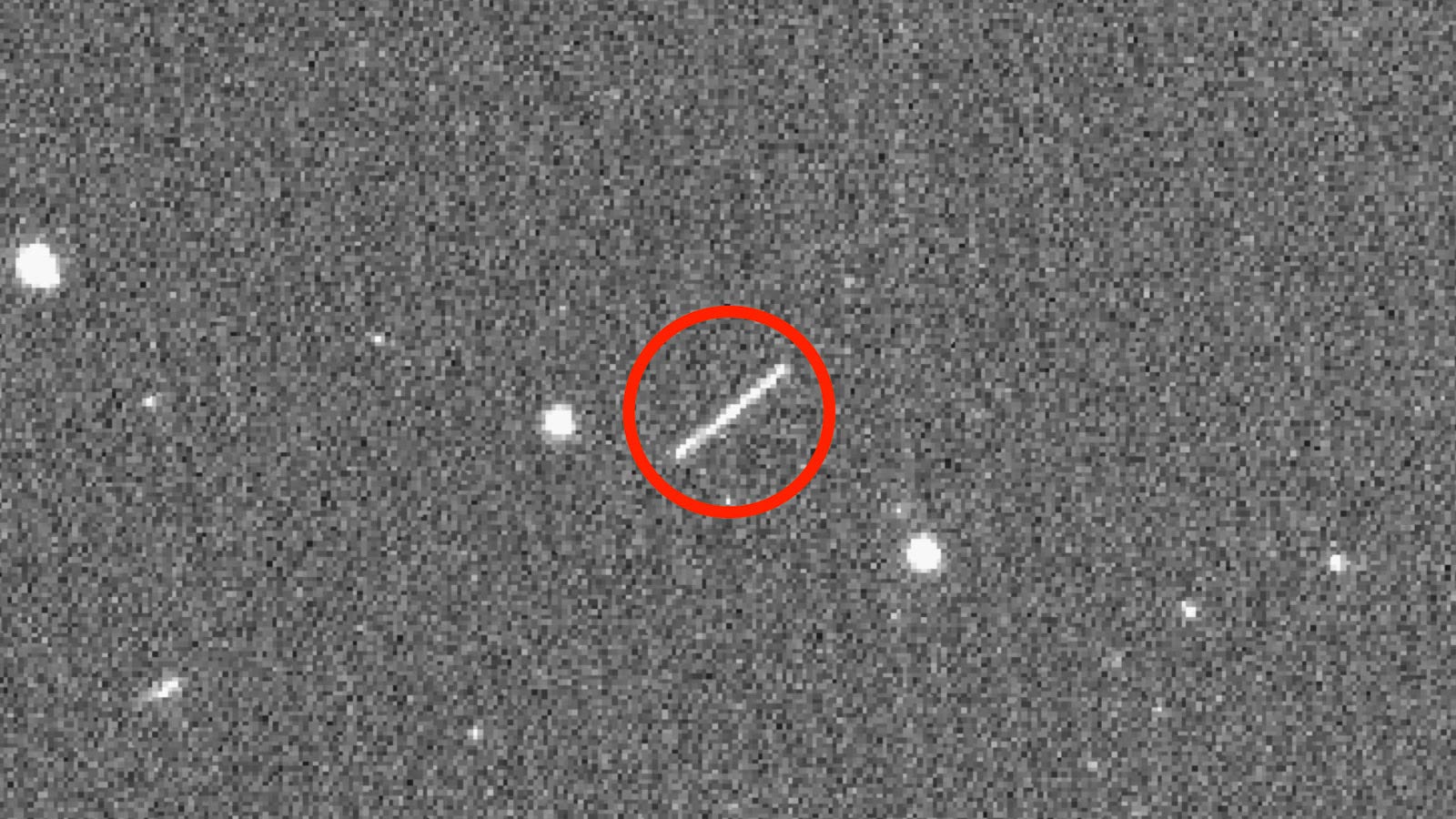
    Asteroid 2020 QG
    The circled streak in the center of this image is asteroid 2020 QG, which came closer to Earth than any other nonimpacting asteroid on record. It was detected by the Zwicky Transient Facility on Sunday, August 16 at 12:08 a.m. EDT (Saturday, August 15 at 9:08 p.m. PDT). Credit: ZTF/Caltech Optical Observatories

    “It’s really cool to see a small asteroid come by this close, because we can see the Earth’s gravity dramatically bend its trajectory,” said Paul Chodas, director of the Center for Near-Earth Object Studies (CNEOS) at NASA’s Jet Propulsion Laboratory in Southern California. “Our calculations show that this asteroid got turned by 45 degrees or so as it swung by our planet.”

    Zipping along at almost 8 miles per second (12.3 kilometers per second) — a little slower than average, Chodas noted — 2020 QG was first recorded as just a long streak in a wide-field camera image taken by the Zwicky Transient Facility. The image was taken six hours after the closest point of approach as the asteroid was heading away from Earth. A sky-scanning survey telescope funded by the National Science Foundation and NASA, the Zwicky Transient Facility is based at Caltech’s Palomar Observatory in San Diego County. NASA’s Near-Earth Object Observations Program funds data processing for NEO detections.

    Asteroid 2020 QG enters the record books as the closest known nonimpacting asteroid; many very small asteroids impact our planet every year, but only a few have actually been detected in space a few hours before impacting Earth. On average, an asteroid the size of 2020 QG passes this closely only a few times a year.

    In 2005, Congress assigned NASA the goal of finding 90% of the near-Earth asteroids that are about 460 feet (140 meters) or larger in size. These larger asteroids pose a much greater threat if they were to impact, and they can be detected much farther away from Earth, because their rate of motion across the sky is typically much smaller at that distance.

    “It’s quite an accomplishment to find these tiny close-in asteroids in the first place, because they pass by so fast,” Chodas said. “There’s typically only a short window of a couple of days before or after close approach when this small of an asteroid is close enough to Earth to be bright enough but not so close that it moves too fast in the sky to be detected by a telescope.”

    A division of Caltech in Pasadena, JPL hosts CNEOS for NASA’s Near-Earth Object Observations Program in NASA’s Planetary Defense Coordination Office.

    Never miss a breakthrough: Join the SciTechDaily newsletter.
    Follow us on Google and Google News.

    Asteroid JPL NASA Popular
    Share. Facebook Twitter Pinterest LinkedIn Email Reddit

    Related Articles

    NASA’s DART Impact Changed Asteroid’s Shape and Orbit

    Unexpected Surprises Revealed: NASA’s Planetary Radar Images Asteroid As It Approaches Earth

    Three Hours Before Impact: Small Asteroid Detected on an Imminent Collision Course With Earth

    6 Fast Facts: NASA’s Asteroid-Exploring Psyche Mission

    Destination Psyche: NASA Spacecraft Prepares for Epic 2.5-Billion-Mile Voyage

    NASA’s Psyche Asteroid Mission Back on Stellar Track – Extraordinary Turnaround Wows Review Board

    NASA’s Planetary Radar Captures Empire State Building-Sized Asteroid As It Flew Past Earth

    NASA’s Planetary Defense Test: DART About To Impact an Asteroid

    Planetary Defense Exercise Uses Apophis as Hazardous Asteroid Stand-In

    Leave A Reply Cancel Reply

    • Facebook
    • Twitter
    • Pinterest
    • YouTube

    Don't Miss a Discovery

    Subscribe for the Latest in Science & Tech!

    Trending News

    289-Million-Year-Old Reptile Mummy Reveals Origin of Human Breathing System

    New Brain Discovery Challenges Long-Held Theory of Teenage Brain Development

    Scientists Discover Plants “Scream” – We Just Couldn’t Hear Them Until Now

    Scientists Discover a Surprising Reason Intermittent Fasting Extends Life

    This Simple Fruit Wash Could Make Produce Safer and Last Days Longer

    Scientists Say Adding This Unusual Seafood to Your Diet Could Reverse Signs of Aging

    Scientists Say a Hidden Structure May Exist Inside Earth’s Core

    Doctors Surprised by the Power of a Simple Drug Against Colon Cancer

    Follow SciTechDaily
    • Facebook
    • Twitter
    • YouTube
    • Pinterest
    • Newsletter
    • RSS
    SciTech News
    • Biology News
    • Chemistry News
    • Earth News
    • Health News
    • Physics News
    • Science News
    • Space News
    • Technology News
    Recent Posts
    • Scientists Propose Radical New Way To Detect Alien Life – Without Traditional Biosignatures
    • Scientists Just Discovered Light Can Actually Slow Plant Growth
    • Scientists Finally Solved One of Water’s Biggest Mysteries
    • 7,000-Year-Old DNA Rewrites the Story of the “Neolithic Revolution”
    • Missing Medieval Relic of Legendary English King Found After Being Missing for 40 Years
    Copyright © 1998 - 2026 SciTechDaily. All Rights Reserved.
    • Science News
    • About
    • Contact
    • Editorial Board
    • Privacy Policy
    • Terms of Use

    Type above and press Enter to search. Press Esc to cancel.