

T. rex evolved in North America from Asian ancestors. Climate shifts and extinction events helped tyrannosaurids and megaraptors grow in size and spread globally, with different adaptations to their environments.
Tyrannosaurus rex evolved in North America, but a new study led by UCL researchers suggests its direct ancestor originated in Asia. Over 70 million years ago, it crossed a land bridge that once connected the two continents.
Published in Royal Society Open Science, the study also found that tyrannosaurids, a group that includes T. rex, and a related group known as megaraptors rapidly increased in size during a period of global cooling that followed a temperature peak 92 million years ago.
The findings indicate that T. rex and its close relatives may have been better adapted to cooler climates than other dinosaurs, possibly because they had feathers or a physiology more similar to that of warm-blooded animals.
The international team involved researchers
The international team involved researchers from the universities of Oxford, Pittsburgh, Aberdeen, Arizona, Anglia Ruskin, Oklahoma, and Wyoming.
Lead author Cassius Morrison, a PhD student at UCL Earth Sciences, said: “The geographic origin of T. rex is the subject of fierce debate. Paleontologists have been divided over whether its ancestor came from Asia or North America. Our modelling suggests the ‘grandparents’ of T. rex likely came to North America from Asia, crossing the Bering Strait between what is now Siberia and Alaska.
He continues, “This is in line with past research finding that the T. rex was more closely related to Asian cousins such as the Tarbosaurus than to North American relatives such as Daspletosaurus. Dozens of T. rex fossils have been unearthed in North America but our findings indicate that the fossils of T. rex’s direct ancestor may lie undiscovered still in Asia.”
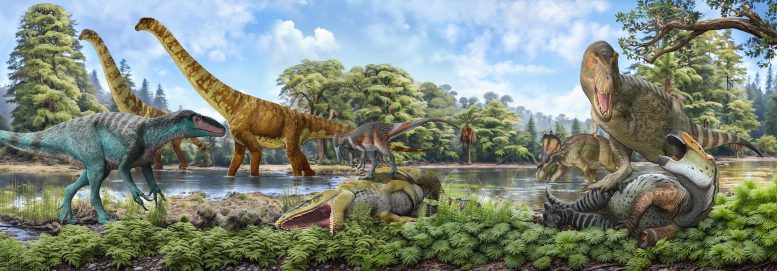
The research team concluded that T rex. itself evolved in North America, specifically in Laramidia, the western half of the continent, where it was widely distributed.
They disagreed with conclusions published last year that a T. rex relative, Tyrannosaurus mcraeensis, found in New Mexico, predated T. rex by three to five million years – a finding that pointed to T. rex having North American ancestry. The team argued that this T. mcraeensis fossil was not reliably dated.
For the new study, the researchers explored
For the new study, the researchers explored how tyrannosaurids and their cousins the megaraptors moved around the globe. They used mathematical models drawing on fossils, dinosaurs’ evolutionary trees and the geography and climate of the time. Importantly, the models account for gaps in the fossil record, incorporating uncertainty into the calculations.
Megaraptors are regarded as the most mysterious of the large, meat-eating dinosaurs, as few megaraptor fossils have been found. In contrast to the T. rex, they evolved slender heads and arms as long as a person is tall, with claws up to 35cm (14in) long.
The researchers concluded that megaraptors were more widely distributed across the globe than previously thought, likely originating in Asia about 120 million years ago and spreading to Europe and then throughout the large southern landmass of Gondwana (including present-day Africa, South America, and Antarctica).
This would mean megaraptors lived in parts of the world (Europe and Africa) where no megaraptor fossils have been found so far.
It may be that they evolved differently
It may be that they evolved differently from their tyrannosaurid cousins, with killing claws rather than a powerful bite, because they hunted different prey. In southern Gondwana, they may have preyed on (juvenile) sauropods, whereas T. rex hunted Laramidian species such as Triceratops, Edmontosaurus, and Ankylosaurus.
Both tyrannosaurids and megaraptors grew to gigantic sizes at broadly the same time, as the climate cooled following a peak in global temperatures known as the Cretaceous Thermal Maximum 92 million years ago. This rapid growth followed the extinction of other giant meat-eaters, carcharodontosaurids, which left a vacuum at the top of the food chain.
The researchers suggested that tyrannosaurs – both tyrannosaurids and megaraptors – may have been able to better exploit cooler temperatures than rival dinosaur groups.
At the end of the age
At the end of the age of the dinosaurs, T. rex weighed up to nine tons (about the same as a very large African elephant or a light tank), while megaraptors reached lengths of 10 meters.
Co-author Charlie Scherer, an MSci Earth Sciences graduate and soon to be PhD student at UCL, and founder of UCL’s Paleontology Society, said: “Our findings have shined a light on how the largest tyrannosaurs appeared in North and South America during the Cretaceous and how and why they grew so large by the end of the age of dinosaurs.
“They likely grew to such gigantic sizes to replace the equally giant carcharodontosaurid theropods that went extinct about 90 million years ago. This extinction likely removed the ecological barrier that prevented tyrannosaurs from growing to such sizes.”
Co-author Dr Mauro Aranciaga Rolando, from the Bernardino Rivadavia Natural Sciences Argentine Museum, Buenos Aires, Argentina, said: “At the beginning of their evolutionary history, around 120 million years ago, megaraptors were part of a widespread and diverse dinosaur fauna.
“As the Cretaceous period progressed and the continents that once formed Gondwana began to drift apart, these predators became increasingly specialised. This evolutionary shift led them to inhabit more specific environments.
“While in regions like Asia megaraptors were eventually replaced by tyrannosaurs, in areas such as Australia and Patagonia they evolved to become apex predators, dominating their ecosystems.”
Reference: “Rise of the king: Gondwanan origins and evolution of megaraptoran dinosaurs” by Cassius Morrison, Charlie Roger Scherer, Ezekiel V. O’Callaghan, Collin Layton, Colin Boisvert, Mauro Aranciaga Rolando, Leroy Durrant, Pedro Salas, Steven J. R. Allain and Samuel J. L. Gascoigne, 31 December 2024, Royal Society Open Science.
DOI: 10.1098/rsos.242238
Never miss a breakthrough: Join the SciTechDaily newsletter.
Follow us on Google and Google News.
1 Comment
Rather interesting, because even more recent evidence points to the migration being in the exact opposite direction using the same land bridge.