
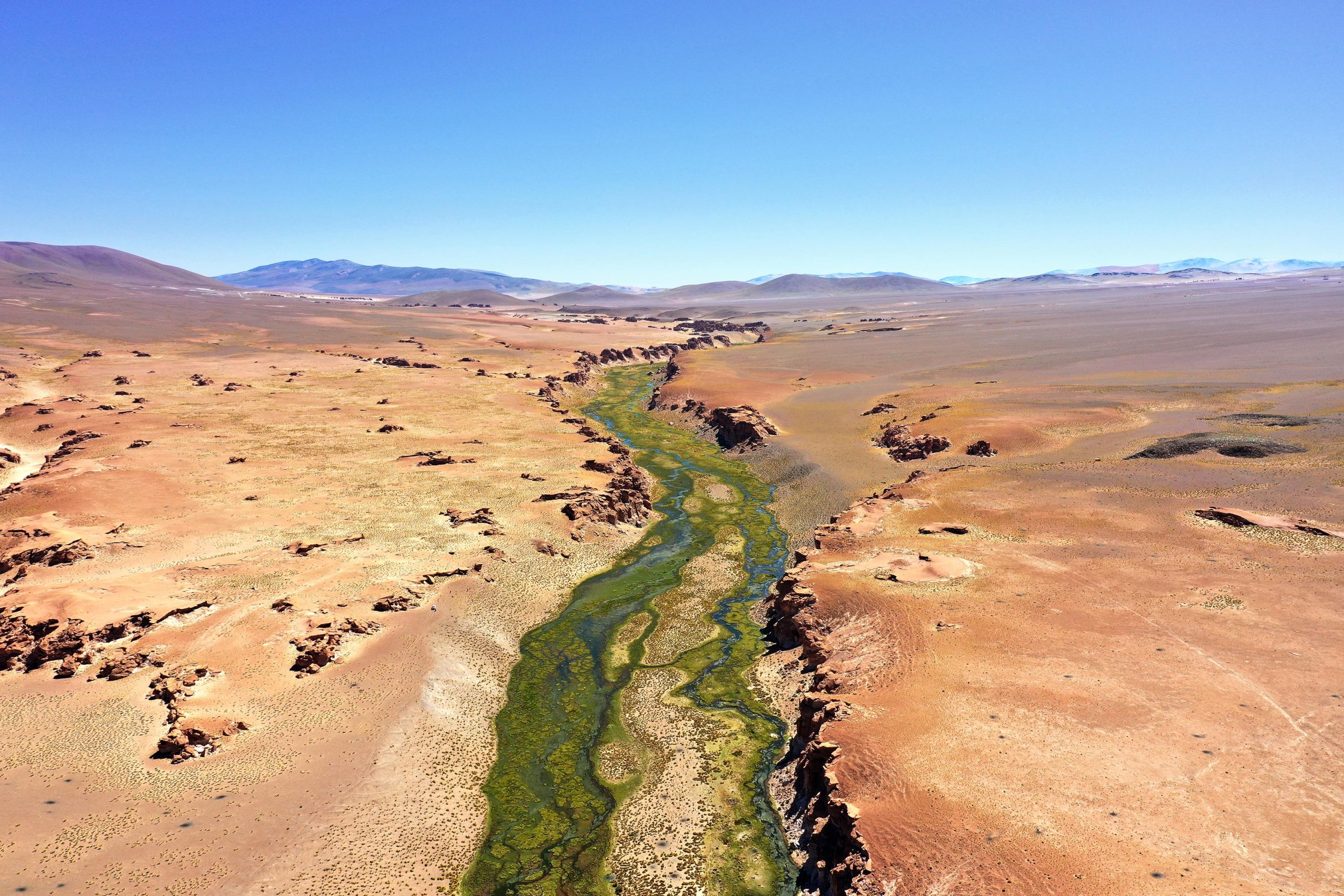
New research reveals that current global water models dramatically overestimate the amount of freshwater available for lithium mining in South America’s Lithium Triangle, a critical hub for the world’s battery supply.
Using a custom-built model, scientists found that freshwater inflows are 10 times lower than previously believed, putting local ecosystems and indigenous communities at high risk. As demand for lithium skyrockets, so does the urgency for the industry, governments, and communities to collaborate on sustainable water management, especially with new mining methods consuming even more water.
Lithium Triangle Water Models Under Fire
New research on lithium mining in South America’s “Lithium Triangle” – a region spanning Chile, Argentina, and Bolivia that holds over half of the world’s lithium resources – shows that current models used to estimate water availability and environmental impact are significantly flawed.
According to a study published today (March 26) in Communications Earth & Environment, these models overestimate available freshwater by more than an order of magnitude. In reality, there is far less water in these basins than previously believed. With demand for lithium – an essential component of batteries powering the clean energy transition – expected to grow 40-fold in the coming decades, the findings highlight an urgent need for collaboration between local communities, regulators, and the mining industry to ensure sustainable water use.

How Lithium Behaves Underground
Lithium, explains David Boutt, a geosciences professor at UMass Amherst and the study’s senior author, is an unusual element. It’s the lightest metal, yet it resists staying in solid form.
In the Lithium Triangle, lithium is commonly found in layers of volcanic ash, where it reacts readily with water. As rain or snowmelt percolates through these layers, lithium is carried into the groundwater and flows downhill, eventually pooling in flat desert basins. There, it remains in solution as a dense, lithium-rich brine. Because this brine is heavier than freshwater, it sinks beneath surface water pockets, forming layered lagoons that are home to delicate ecosystems.

Fragile Ecosystems and Indigenous Lifeways at Risk
These lagoons often become havens for unique and fragile ecosystems and iconic species such as flamingos, and are crucial for local communities, including the indigenous peoples who have long called the Lithium Triangle home. Any use of freshwater runs the risk of disturbing both the ecological health of the region and the indigenous ways of life — and that’s where Boutt and his team, who have previously published on the age and lifecycle of water in the Triangle, come in.
How Much Water Is Really There?
“We looked at 28 different basins in the Lithium Triangle,” says lead author Alexander Kirshen, who completed the study as a research assistant at UMass Amherst, “and we wanted to understand how scarce the freshwater is.”
This is not an easy task, because these basins are located in very high, extremely arid, and relatively remote regions nestled within the Andes mountains. The Lithium Triangle is more than 160,000 miles square, and there are few sensors and monitoring stations with which to track factors like streamflow and precipitation.

Global Models Fall Short
“The climate and hydrology of the Lithium Triangle are very difficult to understand,” says Boutt, so scientists and engineers have relied on global water models to best estimate water availability and environmental impacts of lithium mining within the Triangle.
The two most commonly used global water models suggest that the freshwater flowing into the Lithium Triangle’s basins is approximately 90 and 230 mm per year. “But after an initial assessment,” says Kirshen, “we suspected it was going to be too inaccurate for our purposes.”
A New Model Reveals a Harsh Reality
So the team built its own model, called the Lithium Closed Basin Water Availability model, or LiCBWA — and what they found was a sharp divergence from the conventional understanding.
“There’s not much new freshwater at all coming into these systems,” says Boutt. While global models estimate an average of 90 and 230 mm per year of inflow, LiCBWA estimates from 2 to 33 mm, depending on the particular basin, with an average of just 11 mm per year for the 28 basins in their study. “The conventional wisdom is overestimating the amount of water by at least an order of magnitude,” says Boutt, “and we found that all but one of the 28 basins in our study should be classified as ‘critically water scarce,’ even without incorporating current, to say nothing of future, demands on the water supply.”
DLE: The Water-Hungry Future of Lithium Mining
At the same time, the processes for mining lithium are changing. The older method, called evaporative concentration, is being supplanted by direct lithium extraction (DLE) — and 56% of the DLE sites in the Triangle use more water than the older, evaporative process. Nearly one-third of the DLE facilities (31%) used 10 times more water than evaporative concentration.
“Because lithium mining is a reality in the Lithium Triangle,” the authors conclude, “scientists, local communities, regulators, and producers must collaborate to reduce water use,” as well as commit to better monitoring precipitation, streamflow, and groundwater levels for an even more precise hydrological picture.
Reference: “Freshwater inflows to closed basins of the Andean plateau in Chile, Argentina, and Bolivia” by Alexander B. Kirshen, Brendan J. Moran, Lee Ann Munk, Aeon A. Russo, Sarah V. McKnight, Jordan Jenckes, Daniel B. Corkran, Magdalen Bresee and David F. Boutt, 26 March 2025, Communications Earth & Environment.
DOI: 10.1038/s43247-025-02130-6
Researchers from the University of Alaska Fairbanks, University of Alaska Anchorage and the University of Dayton contributed to this study, and funding was provided by BMW Group and BASF.
Never miss a breakthrough: Join the SciTechDaily newsletter.
Follow us on Google and Google News.
1 Comment
“Green” transition, ladies and gentlemen.