
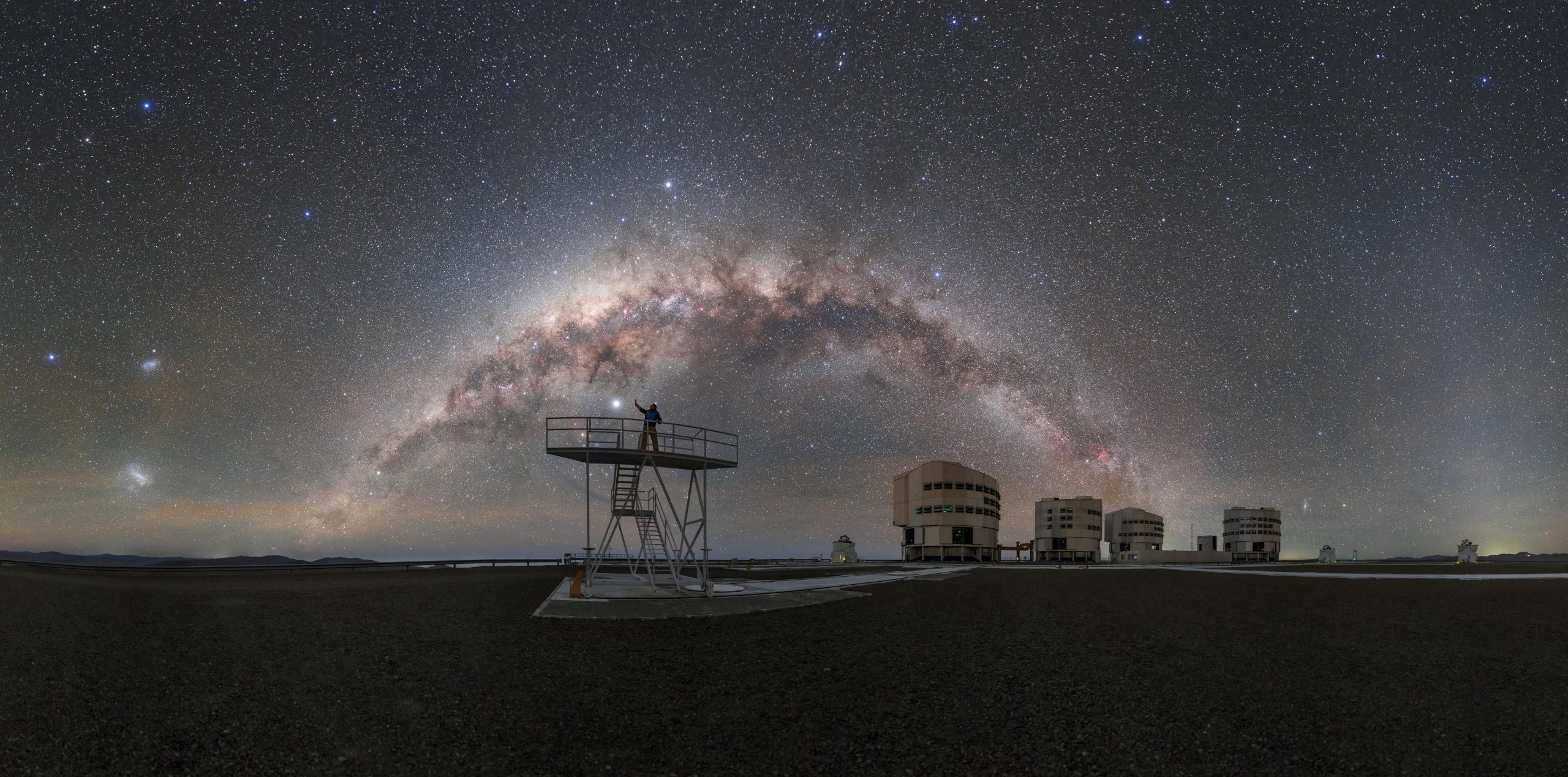
A proposed industrial complex by AES Andes near the Paranal Observatory in Chile’s Atacama Desert could devastate the area’s world-renowned dark skies.
Celebrated for its vital role in major astronomical discoveries, the observatory’s unique conditions are under threat from potential light pollution and other environmental impacts. Relocating the complex could prevent irreparable harm and preserve this astronomical haven.
Threat to Astronomical Heritage
On December 24th, AES Andes, a subsidiary of the U.S.-based AES Corporation, submitted a proposal for an industrial megaproject to undergo environmental impact assessment. This massive development poses a significant threat to the pristine skies above ESO’s Paranal Observatory in Chile’s Atacama Desert, home to the darkest and clearest night skies of any astronomical site in the world.
The proposed complex would be located just 5 to 11 kilometers from Paranal’s telescopes, risking irreparable harm to astronomical research, particularly from light pollution generated during its operation. Relocating the project is essential to preserving one of the last truly pristine dark skies on Earth.

An irreplaceable heritage for humanity
Since its inauguration in 1999, Paranal Observatory, built and operated by the European Southern Observatory (ESO), has led to significant astronomy breakthroughs, such as the first image of an exoplanet and confirming the accelerated expansion of the Universe. The Nobel Prize in Physics in 2020 was awarded for research on the supermassive black hole at the center of the Milky Way, in which Paranal telescopes were instrumental. The observatory is a key asset for astronomers worldwide, including those in Chile, which has seen its astronomical community grow substantially in the last decades. Additionally, the nearby Cerro Armazones hosts the construction of ESO’s Extremely Large Telescope (ELT), the world’s biggest telescope of its kind — a revolutionary facility that will dramatically change what we know about our Universe.
Dangers of Light Pollution and Construction
“The proximity of the AES Andes industrial megaproject to Paranal poses a critical risk to the most pristine night skies on the planet,” highlighted ESO Director General, Xavier Barcons. “Dust emissions during construction, increased atmospheric turbulence, and especially light pollution will irreparably impact the capabilities for astronomical observation, which have thus far attracted multi-billion-Euro investments by the governments of the ESO Member States.”
The beauty of the night sky is revealed above Cerro Paranal, home to the Very Large Telescope (VLT). The Small and Large Magellanic Clouds can be seen towards the horizon as meteors shoot across sky. All captured in this time-lapse during the ESO Ultra High Definition Expedition. Credit: ESO/B. Tafreshi
Preserving a Unique Scientific Resource
The project encompasses an industrial complex of more than 3000 hectares, which is close to the size of a city, or district, such as Valparaiso, Chile or Garching near Munich, Germany. It includes constructing a port, ammonia and hydrogen production plants and thousands of electricity generation units near Paranal.
Thanks to its atmospheric stability and lack of light pollution, the Atacama Desert is a unique natural laboratory for astronomical research. These attributes are essential for scientific projects that aim to address fundamental questions, such as the origin and evolution of the Universe or the quest for life and the habitability of other planets.
Urgent Need for Relocation
“Chile, and in particular Paranal, is a truly special place for astronomy — its dark skies are a natural heritage that transcends its borders and benefits all humanity,” said Itziar de Gregorio, ESO’s Representative in Chile. “It is crucial to consider alternative locations for this megaproject that do not endanger one of the world’s most important astronomical treasures.”
The relocation of this project remains the only effective way to prevent irreversible damage to Paranal’s unique skies. This measure will not only safeguard the future of astronomy but also preserve one of the last truly pristine dark skies on Earth.
Notes
- A study by Falchi and collaborators, published in 2023 in Monthly Notices of the Royal Astronomical Society, compared light pollution at all 28 major astronomical observatories, finding Paranal to be the darkest site among them.
Never miss a breakthrough: Join the SciTechDaily newsletter.
Follow us on Google and Google News.