
Close Menu
    Facebook X (Twitter) Instagram
    SciTechDaily
    • Biology
    • Chemistry
    • Earth
    • Health
    • Physics
    • Science
    • Space
    • Technology
    Facebook X (Twitter) Pinterest YouTube RSS
    SciTechDaily
    Home»Space»The Canarias Einstein Ring – A Newly Discovered Einstein Ring
    Space

    The Canarias Einstein Ring – A Newly Discovered Einstein Ring

    By Royal Astronomical SocietyJune 3, 2016No Comments3 Mins Read
    Facebook Twitter Pinterest Telegram LinkedIn WhatsApp Email Reddit
    Share
    Facebook Twitter LinkedIn Pinterest Telegram Email Reddit
    Astronomers Discover a New Einstein Ring
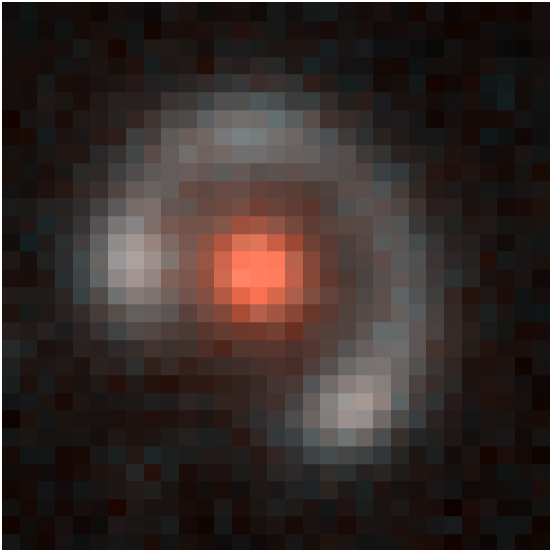
    In this color composite image, the central lensing galaxy is shown in red and the blue Einstein ring, the distorted image of a distant galaxy, is visible all around it. Credit: Bettinelli et al., DECam (Blanco 4-m telescope at CTIO)

    A newly published study details the discovery of a new Einstein Ring, a rare image of a distant galaxy lensed by gravity.

    In his seminal general theory of relativity published a century ago, Albert Einstein predicted that gravity would distort the fabric of spacetime, and that light would follow curved paths as a result. Astronomers first observed this effect in 1919, by measuring the position of stars near the Sun during the 1919 total solar eclipse, and noting a slight shift resulting from the gravitational field of our nearest star. On a larger scale, light from distant galaxies is bent by black holes and massive galaxies that lie between them and the Earth. The intervening objects act as lenses, creating arcs and ‘Einstein rings’ of light.

    These rings are still comparatively rare and usually appear as small features in the sky. This makes them hard to see clearly, and most are observed with radio telescopes, or with the Hubble Space Telescope. Their rarity derives from the huge distances involved, and the low probability of our Galaxy, the lens galaxy, and the distant galaxy all being almost exactly in line.

    The newly discovered ring lies in the direction of the constellation of Sculptor in the southern sky. Margherita Bettinelli, a Ph.D. student at the Instituto de Astrofisica de Canarias, found it while looking at archive images from the Dark Energy Camera (DECam) mounted on the Victor Blanco 4-m (13-ft) telescope at the Cerro Tololo Inter-American Observatory in Chile. Margherita and her team named the ring ‘Canarias’, in homage to the work carried out by astronomers on La Palma and Tenerife.

    Light arriving at the Earth today left the Einstein ring 8 billion years ago, so we see the ring as it was 5 billion years after the Big Bang. Despite its relatively small apparent size (it stretches across an angle on the sky of 4.5 arcseconds or about 1/800th of a degree), it is larger than most of the other rings found to date. Follow up work with the 10.4-m (34-ft) Gran Telescopio Canarias (GTC) confirms its distance and shows that the intervening lens galaxy has a mass equivalent to around a trillion (million million) Suns.

    Reference: “The Canarias Einstein Ring: a Newly Discovered Optical Einstein Ring” by M. Bettinelli, M. Simioni, A. Aparicio, S. L. Hidalgo, S. Cassisi, A. R. Walker, G. Piotto and F. Valdes, 16 May 2016, MNRAS.
    DOI: 10.1093/mnrasl/slw097

    Never miss a breakthrough: Join the SciTechDaily newsletter.
    Follow us on Google and Google News.

    Astronomy Astrophysics Cosmology Royal Astronomical Society
    Share. Facebook Twitter Pinterest LinkedIn Email Reddit

    Related Articles

    Star Vanishes for 200 Days in One of the Longest Cosmic Dimming Events Ever Recorded

    Is the Universe Slowing Down? Stunning New Evidence Says Yes

    Dark Energy May Be an Illusion: Scientists Uncover a “Lumpy” Universe

    Planet 2MASS J2126 is 1 Trillion Kilometers Away from Its Parent Star

    Astronomers Discover an Oversized Black Hole That is 350 Million Times the Mass of Our Sun

    Two Massive Stars with Magnetic Fields Discovered in Binary System Epsilon Lupi

    A New Catalog of the Visible Milky Way

    Interactions between Cold Dark Matter and Radiation Leads to a Dramatic Reduction in Satellite Galaxies

    Dark Energy Survey Reveals a Rare Superluminous Supernova

    Leave A Reply Cancel Reply

    • Facebook
    • Twitter
    • Pinterest
    • YouTube

    Don't Miss a Discovery

    Subscribe for the Latest in Science & Tech!

    Trending News

    Could Low Vitamin D Be Making Your Pain Worse?

    Scientists Discover Once-Weekly Workout That Melts Belly Fat Surprisingly Effectively

    Scientists Just Tested a Thruster Powerful Enough for Human Missions to Mars

    Doctors Say Your Ice Pack Might Be Making Injuries Worse

    Scientists Discover 43-Foot Sea Reptile Twice the Size of a Great White Shark

    Bees and Birds Are Drinking Alcohol From Flowers

    Scientists Discover How Obesity May Trigger Alzheimer’s Disease

    Scientists Confirm Alcohol Causes Widespread Health Damage

    Follow SciTechDaily
    • Facebook
    • Twitter
    • YouTube
    • Pinterest
    • Newsletter
    • RSS
    SciTech News
    • Biology News
    • Chemistry News
    • Earth News
    • Health News
    • Physics News
    • Science News
    • Space News
    • Technology News
    Recent Posts
    • Just Minutes of Intense Exercise Could Slash Disease Risk by 50%
    • People Who Stop Ozempic Often Don’t Gain the Weight Back
    • Why More People in Their 30s Are Suddenly Getting Colon Cancer
    • Scientists Discover Sperm Seem To Bypass a Fundamental Law of Physics
    • The Secret Behind Indigenous Andeans’ “Digestive Superpower” May Be Potatoes
    Copyright © 1998 - 2026 SciTechDaily. All Rights Reserved.
    • Science News
    • About
    • Contact
    • Editorial Board
    • Privacy Policy
    • Terms of Use

    Type above and press Enter to search. Press Esc to cancel.