
Close Menu
    Facebook X (Twitter) Instagram
    SciTechDaily
    • Biology
    • Chemistry
    • Earth
    • Health
    • Physics
    • Science
    • Space
    • Technology
    Facebook X (Twitter) Pinterest YouTube RSS
    SciTechDaily
    Home»Space»The Chemical Cauldron of Creation: JWST’s Insights Into Protoplanetary Disks
    Space

    The Chemical Cauldron of Creation: JWST’s Insights Into Protoplanetary Disks

    By American Association for the Advancement of Science (AAAS)June 20, 2024No Comments3 Mins Read
    Facebook Twitter Pinterest Telegram LinkedIn WhatsApp Email Reddit
    Share
    Facebook Twitter LinkedIn Pinterest Telegram Email Reddit
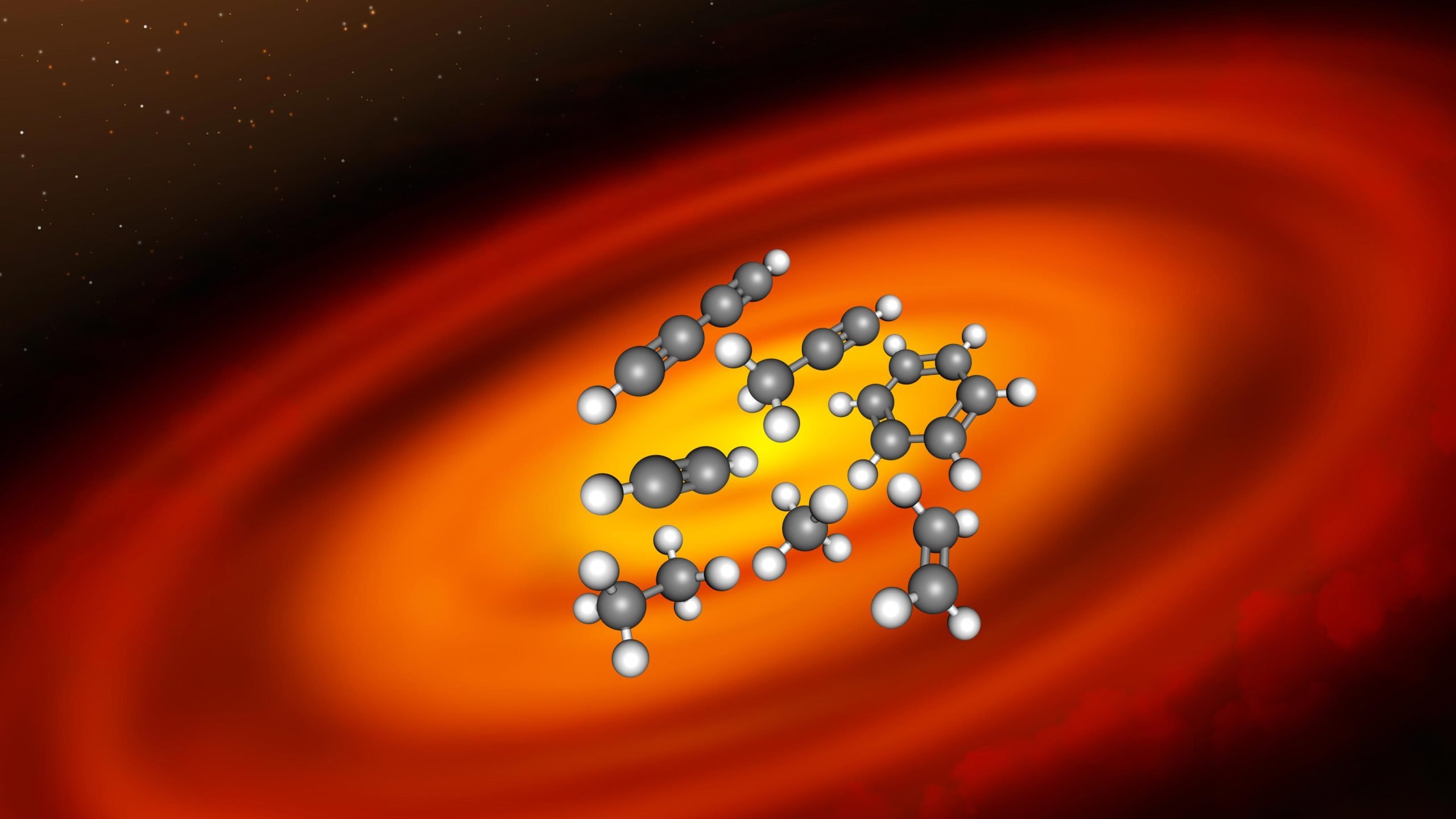
    Hydrocarbon Molecules Protoplanetary Disk Around a Very Low-Mass Star
    Artist’s impression of a protoplanetary disk around a very low-mass star. It depicts a selection of hydrocarbon molecules (Methane, CH4; Ethane, C2H6; Ethylene, C2H2; Diacetylene, C4H2; Propyne, C3H4; Benzene, C6H6) detected in the disk around ISO-ChaI 147. Credit: ALMA (ESO/NAOJ/NRAO) / MPIA

    Observations from the James Webb Space Telescope have revealed a high concentration of hydrocarbons in the protoplanetary disk of a young star with very low mass.

    James Webb Space Telescope (JWST) observations have revealed abundant hydrocarbons in the protoplanetary disk surrounding a young, very-low-mass star – findings that provide novel insights into the chemical environment from which many terrestrial planets, in particular, are born.

    Efficiency of Planet Formation Around VLMSs

    Planets form in disks of gas and dust that orbit young stars. Observations show that terrestrial planets form more efficiently than gas giant planets around very-low-mass stars (VLMSs) – those with less than 0.3 solar masses. Although the chemical compositions of the inner disk regions around higher mass stars have been previously studied, very few inner disk regions around VLMSs have been investigated.

    Protoplanetary Disc of SO-ChaI 147 (Webb MIRI Emission Spectrum)
    The spectrum revealed by Webb’s Mid-InfraRed Instrument (MIRI) shows the richest hydrocarbon chemistry seen to date in a protoplanetary disc, consisting of 13 carbon-bearing molecules up to benzene. This includes the first extrasolar detection of ethane (C2H6), the largest fully-saturated hydrocarbon detected outside our Solar System. Since fully-saturated hydrocarbons are expected to form from more basic molecules, detecting them here gives researchers clues about the chemical environment. The team also successfully detected ethylene (C2H4), propyne (C3H4), and the methyl radical CH3, for the first time in a protoplanetary disc. This graphic highlights the detections of ethane (C2H6), methane (CH4), propyne (C3H4), cyanoacetylene (HC3N), and the methyl radical CH3. Credit: NASA, ESA, CSA, R. Crawford (STScI)

    Mid-Infrared Spectroscopy Reveals Disk Chemistry

    Using the JWST’s mid-infrared spectroscopy instrument, Aditya Arabhavi and colleagues investigated the chemical composition of the planet-forming disk around ISO-ChaI 147, a young 0.11-solar-mass star in the Chameleon I star-forming region.

    Implications of a High Carbon/Oxygen Ratio

    The researchers found that the inner disk region surrounding this star has a carbon-rich chemistry featuring 13 carbon-bearing molecules, including ethane and benzine. This abundance in hydrocarbon molecules starkly contrasts the lack of observed oxygen-bearing molecules, suggesting that the region has a carbon to oxygen radio of >1.

    According to the research team, this high carbon/oxygen ratio indicates radial transport of material within the disk, likely affecting the bulk composition of any planets forming within the disk.

    For more on this discovery:

    • Webb Unmasks the Carbon-Rich Secrets of Protoplanetary Disks
    • Webb Uncovers a Mysterious Carbon Treasure Trove Around Young Star

    Reference: “Abundant hydrocarbons in the disk around a very-low-mass star” by A. M. Arabhavi, I. Kamp, Th. Henning, E. F. van Dishoeck, V. Christiaens, D. Gasman, A. Perrin, M. Güdel, B. Tabone, J. Kanwar, L. B. F. M. Waters, I. Pascucci, M. Samland, G. Perotti, G. Bettoni, S. L. Grant, P. O. Lagage, T. P. Ray, B. Vandenbussche, O. Absil, I. Argyriou, D. Barrado, A. Boccaletti, J. Bouwman, A. Caratti o Garatti, A. M. Glauser, F. Lahuis, M. Mueller, G. Olofsson, E. Pantin, S. Scheithauer, M. Morales-Calderón, R. Franceschi, H. Jang, N. Pawellek, D. Rodgers-Lee, J. Schreiber, K. Schwarz, M. Temmink, M. Vlasblom, G. Wright, L. Colina and G. Östlin, 6 June 2024, Science.
    DOI: 10.1126/science.adi8147

    Never miss a breakthrough: Join the SciTechDaily newsletter.
    Follow us on Google and Google News.

    American Association for the Advancement of Science Astronomy Astrophysics James Webb Space Telescope
    Share. Facebook Twitter Pinterest LinkedIn Email Reddit

    Related Articles

    A Wandering Black Hole Jet Is Draining a Galaxy of Star Fuel

    Webb Space Telescope Shows Ultraviolet “Winds” Eroding a Young Star’s Protoplanetary Disk in Orion Nebula

    Cosmic Time Travel: Webb Unveils Physical Properties of Compact Galaxy From the Early Universe

    Science’s 2022 Breakthrough of the Year: NASA’s Stellar New James Webb Space Telescope

    NASA’s Webb Telescope Will Be the World’s Premier Space Science Observatory – Here’s What Those Powerful Capabilities Mean for Astronomy

    Back to the Spectacular Firestorm of Star Birth at the Beginning of the Universe: Probing the First Galaxies With Webb

    New Measurement of the Hubble Constant – Rate of Expansion of the Universe – From Combined Observations of Neutron Stars

    The Cosmic Dust in Your Bones – NASA’s Webb Telescope Will Investigate the Intertwined Origins of Dust and Life

    Dazzling Array of Complex Shapes Found in Planetary Nebulae Generated by Stellar Winds Interaction With Binary Companions

    Leave A Reply Cancel Reply

    • Facebook
    • Twitter
    • Pinterest
    • YouTube

    Don't Miss a Discovery

    Subscribe for the Latest in Science & Tech!

    Trending News

    The Universe Is Expanding Too Fast and Scientists Can’t Explain Why

    “Like Liquid Metal”: Scientists Create Strange Shape-Shifting Material

    Early Warning Signals of Esophageal Cancer May Be Hiding in Plain Sight

    Common Blood Pressure Drug Shows Surprising Power Against Deadly Antibiotic-Resistant Superbug

    Scientists Uncover Dangerous Connection Between Serotonin and Heart Valve Disease

    Scientists Discover a “Protector” Protein That Could Help Reverse Hair Loss

    Bone-Strengthening Discovery Could Reverse Osteoporosis

    Scientists Uncover Hidden Trigger Behind Stem Cell Aging

    Follow SciTechDaily
    • Facebook
    • Twitter
    • YouTube
    • Pinterest
    • Newsletter
    • RSS
    SciTech News
    • Biology News
    • Chemistry News
    • Earth News
    • Health News
    • Physics News
    • Science News
    • Space News
    • Technology News
    Recent Posts
    • Scientists Overcome Major Quantum Bottleneck, Potentially Transforming Teleportation and Computing
    • Quantum Physics’ Strangest Problem May Hold the Key to Time Itself
    • Scientists Create “Liquid Gears” That Spin Without Touching
    • The Simple Habit That Could Help Prevent Cancer
    • Forgotten Medicinal Plant Shows Promise in Fighting Dangerous Superbugs
    Copyright © 1998 - 2026 SciTechDaily. All Rights Reserved.
    • Science News
    • About
    • Contact
    • Editorial Board
    • Privacy Policy
    • Terms of Use

    Type above and press Enter to search. Press Esc to cancel.