
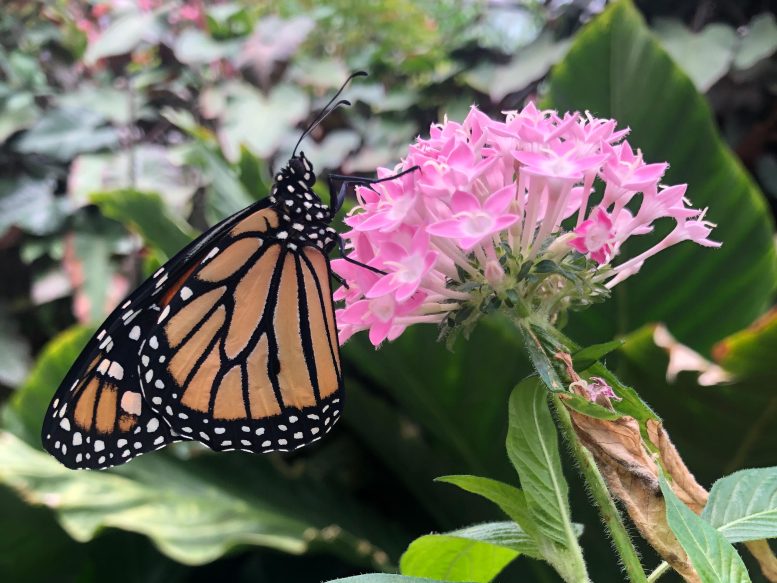
The Sequestration of Plant Toxins by Monarch Butterflies Results in Decreased Visibility of Warning Signals
Monarch butterflies (Danaus plexippus) feed on milkweeds from the genus Asclepias as caterpillars, storing the plant’s toxic cardenolide poisons in their bodies for self-defense. The combination of these toxins with the monarch’s distinctive orange and black wings creates a phenomenon known as aposematism (from the Greek words apo meaning “away” and sema meaning “signal”).
Investigating Toxins and Oxidative Stress
Hannah Rowland head of the Max Planck Research Group on Predators and Toxic Prey at the Max Planck Institute for Chemical Ecology explains: “aposematism works because predators learn that eye-catching prey are best avoided. Predators learn faster when the visual signal is always the same. Bright orange means “`’don’t eat me’. But other scientists and I have repeatedly found that aposematic animals can have varying degrees of warning signal strength, and we wondered what about pale orange, or deep orange? What does this mean, and what causes the difference?”
Rowland, together with her colleague Jonathan Blount from the University of Exeter, along with their international team of scientists, tested whether the storage of the plant’s toxins is costly to the butterfly’s body condition. Specifically, whether the storage of toxins causes oxidative stress, which happens when antioxidant levels are low. Because antioxidants can be used to make colorful pigments, they tested if the amount of toxins in the monarch is related to their conspicuousness and their oxidative state.
The researchers reared monarch caterpillars on four different milkweeds of the genus Asclepias that have different toxin levels. With this, they were able to manipulate the amount of toxins ingested to subsequently measure concentrations of cardenolides, determine oxidative state, and compare the resulting wing coloration.
“Monarch butterflies that sequestered higher concentrations of cardenolides experienced higher levels of oxidative damage than those that sequestered lower concentrations. Our results are among the first to show a potential physiological mechanism of oxidative damage as a cost of sequestration for these insects,” says Hannah Rowland.
The scientists also found that the color of the wings of male monarchs depended on how much cardenolides they sequestered, and how much oxidative damage this had resulted in. Males with the highest levels of oxidative damage showed decreasing color intensity with increased toxin uptake, while males with the least oxidative damage were the most toxic and color-intense.
Plant Toxins Are Even Costly for Specialized Herbivores
“It is conventional wisdom that specialists are less impacted by plant defenses than generalists, but our study provides compelling evidence that cardenolide sequestration is physiologically costly,” says Hannah Rowland. “Monarch butterflies are also often considered one of the main examples of aposematic animals, and our experiment shows that the conspicuousness of their warning signals depends to some extent on how much of the cardenolides they sequester and how costly this is for them. Together, this points to the fact that specialist herbivores must balance the benefits of toxic plant compounds as defenses against their enemies with the burden that these same compounds impose.”
Rowland plans to further investigate the role of predators in plant-herbivore-predator interactions. In particular, she is interested in investigating whether predators have an influence on the evolution of cardenolides.
Reference: “The price of defence: toxins, visual signals and oxidative state in an aposematic butterfly” by Jonathan D. Blount, Hannah M. Rowland, Christopher Mitchell, Michael P. Speed, Graeme D. Ruxton, John A. Endler and Lincoln P. Brower, 18 January 2023, Proceedings of the Royal Society B: Biological Sciences.
DOI: 10.1098/rspb.2022.2068
Never miss a breakthrough: Join the SciTechDaily newsletter.
Follow us on Google and Google News.
1 Comment
I was taking photographs of poisonous Belladonna Lilies at our Arboretum last Fall and noticed a high prevalence of garden snails tucked among the flowers and leaves. I rarely see them otherwise. I think they are using the lilies poisonous attributes somehow in their life cycle.