
Close Menu
    Facebook X (Twitter) Instagram
    SciTechDaily
    • Biology
    • Chemistry
    • Earth
    • Health
    • Physics
    • Science
    • Space
    • Technology
    Facebook X (Twitter) Pinterest YouTube RSS
    SciTechDaily
    Home»Space»The Devil’s in the Detail: Fascinating and Otherworldly Landscape on Mars
    Space

    The Devil’s in the Detail: Fascinating and Otherworldly Landscape on Mars

    By European Space Agency (ESA)February 20, 2022No Comments2 Mins Read
    Facebook Twitter Pinterest Telegram LinkedIn WhatsApp Email Reddit
    Share
    Facebook Twitter LinkedIn Pinterest Telegram Email Reddit
    Argyre Planitia
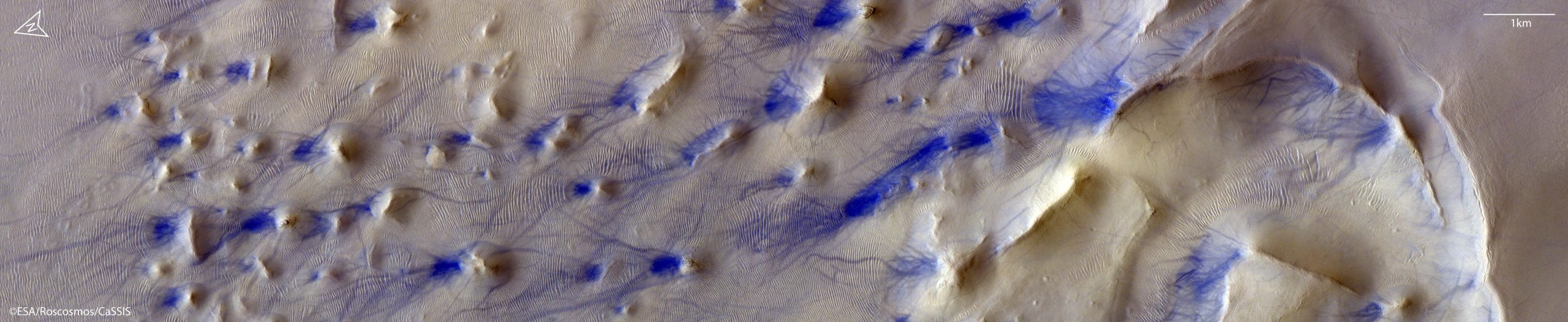
    Landscape near Hooke Crater in Mars’ southern highlands captured by the CaSSIS camera onboard the ExoMars Trace Gas Orbiter (TGO) on February 1, 2021. Credit: ESA/Roscosmos/CaSSIS, CC BY-SA 3.0 IGO

    The ExoMars Orbiter captured a chaotic Martian landscape near Hooke Crater, featuring dust devil tracks and wind-sculpted terrain.

    Chaotic mounds, wind-sculpted ripples, and dust devil tracks: this image shows a fascinating and otherworldly landscape near Hooke Crater in Mars’ southern highlands.

    The image was taken by the CaSSIS camera onboard the ESA/Roscosmos ExoMars Trace Gas Orbiter (TGO) on February 1, 2021, and shows part of Argyre Planitia, centered at 46.2°S/318.3°E.

    This type of scenery is similar to ‘chaotic terrain’: a kind of broken, disrupted terrain seen across Mars where haphazard groups of variously sized and shaped rocks – irregular knobs, conical mounds, ridges, flat-topped hills known as mesas – clump together, often enclosed within depressions. There are around 30 regions of chaotic terrain defined on Mars (see ESA Mars Express views of Ariadnes Colles, Pyrrhae Regio, and Iani Chaos for just a small sample); while this small patch has not been defined as one of these, its appearance is certainly chaotic.

    Dust Devil Tracks and Wind Patterns

    Perhaps the most striking feature here is the wispy, snaking tendrils stretching out across the frame. These dark traces of past activity were caused by dust devils, whirlwinds of dust that occur on both Mars and Earth when warm air rises quickly into cooler air. These devils leave tracks on a planet’s surface as they travel through dusty landscapes. The tracks here appear to have a north-south orientation, indicating a possible local wind pattern.

    The bluish tinge to the dust devil tracks seen here is a result of the three filters that were combined to create this image; while not representative of what an observer would see with the naked eye, these filters produce a color infrared image with greater sensitivity to variations in surface mineralogy.

    TGO arrived at Mars in 2016 and began its full science mission in 2018. The spacecraft is not only returning spectacular images like this one, but also providing the best-ever inventory of the planet’s atmospheric gases, and mapping the planet’s surface for water-rich locations. It will also provide data relay services for the second ExoMars mission, comprising the Rosalind Franklin rover and Kazachok platform, when it arrives on Mars in 2023.

    Never miss a breakthrough: Join the SciTechDaily newsletter.
    Follow us on Google and Google News.

    European Space Agency ExoMars Mars Planets
    Share. Facebook Twitter Pinterest LinkedIn Email Reddit

    Related Articles

    Mars Unveils Its Nighttime Secret: Mesmerizing Green Glow Discovered

    Rolling Stones on Mars: More Than Meets the Eye

    Red Velvet Mars – ExoMars Trace Gas Orbiter Captures Delightful Image

    ExoMars Discovers Hidden Water in Mars’ Grand Canyon – The Largest Canyon in the Solar System

    ExoMars Orbiter Captures Stunning Image of Volcanic Trenches on Mars

    Impact Crater Trio: ExoMars Trace Gas Orbiter Releases Stunning Image From Lunae Planum, Mars

    A New Chemistry: ExoMars Orbiter Discovers New Gas and Traces Water Loss on Mars

    Solis Dorsum, Mars – ExoMars Orbiter’s 20,000th Image

    “Puzzling and Surprising” New Gas Signatures Discovered by ExoMars Orbiter in the Martian Atmosphere

    Leave A Reply Cancel Reply

    • Facebook
    • Twitter
    • Pinterest
    • YouTube

    Don't Miss a Discovery

    Subscribe for the Latest in Science & Tech!

    Trending News

    Why Popular Diabetes Drugs Like Ozempic Don’t Work for Everyone: The “Genetic Glitch”

    Scientists Stunned After Finding Plant Thought Extinct for 60 Years

    Scientists Discover Tiny New Spider That Hunts Prey 6x Its Size

    Natural Component From Licorice Shows Promise for Treating Inflammatory Bowel Disease

    Scientists Warn: Popular Sweetener Linked to Dangerous Metabolic Effects

    Monster Storms on Jupiter Unleash Lightning Beyond Anything on Earth

    Scientists Create “Liquid Gears” That Spin Without Touching

    The Simple Habit That Could Help Prevent Cancer

    Follow SciTechDaily
    • Facebook
    • Twitter
    • YouTube
    • Pinterest
    • Newsletter
    • RSS
    SciTech News
    • Biology News
    • Chemistry News
    • Earth News
    • Health News
    • Physics News
    • Science News
    • Space News
    • Technology News
    Recent Posts
    • 100,000-Year-Old Neanderthal Fossils in Poland Reveal Unexpected Genetic Connections
    • Unexpected Hormone Discovery Could Change How We Treat Arthritis
    • Scientists Supercharge “Natural Killer” Cells To Break Through Cancer’s Defenses
    • Simple “Gut Reset” May Prevent Weight Gain After Ozempic or Wegovy
    • 2.8 Days to Disaster: Scientists Warn Low Earth Orbit Could Suddenly Collapse
    Copyright © 1998 - 2026 SciTechDaily. All Rights Reserved.
    • Science News
    • About
    • Contact
    • Editorial Board
    • Privacy Policy
    • Terms of Use

    Type above and press Enter to search. Press Esc to cancel.