

By using ultrafast lasers, researchers have observed electrons moving in perfect sync inside particles smaller than a nanometer. This breakthrough unlocks new ways to manipulate light and electrons, paving the way for next-generation technology.
It may be the tiniest and fastest synchronized movement ever recorded.
According to a study in Science Advances, an international team of researchers observed electrons moving in perfect unison around a particle smaller than a nanometer. Using ultrafast light pulses, they excited the electrons and measured their motion with unprecedented precision — marking the first-ever measurement at the sub-nanometer scale.
Breaking the Nanometer Barrier
This synchronized electron motion, known as plasmonic resonance, allows light to be temporarily trapped. This phenomenon has numerous applications, from converting light into chemical energy to enhancing light-sensitive devices and even generating electricity from sunlight. While plasmonic resonance has been extensively studied in systems as small as 10 nanometers, this breakthrough shatters previous limits by measuring it at an even smaller scale.
“These findings demonstrate, for the first time, that attosecond measurements can provide valuable insights into plasmonic resonances at scales smaller than a nanometer.”
Shubhadeep Biswas, Lead author on the paper and a SLAC project scientist
The study was conducted by researchers from the Department of Energy’s SLAC National Accelerator Laboratory and Stanford University in collaboration with Ludwig-Maximilians-Universität München, University of Hamburg, DESY, Northwest Missouri State University, Politecnico di Milano, and the Max Planck Institute for the Structure and Dynamics of Matter.
Pushing the Limits of Light Control
Early studies have indicated that when plasmonic resonances unfold at incredibly small scales, new phenomena emerge, allowing light to be confined and controlled with unprecedented precision. This characteristic makes understanding exactly how resonances play out at small scales a very interesting topic for researchers.
To better understand plasmonic resonance, researchers first excite electrons around a particle, then wait for them to release their excess energy by emitting an electron. By timing that interval, scientists can determine whether true resonance – with all electrons moving in unison – has occurred, or if just one or two electrons were affected. However, these resonances happen at ultrafast timescales – mere attoseconds, or billionths of a billionth of a second. Observation of these resonances in real time was beyond the reach of existing technologies.
Harnessing Laser Technology
Fortunately, advances in laser technology have enabled researchers to measure electron movements with attosecond precision.
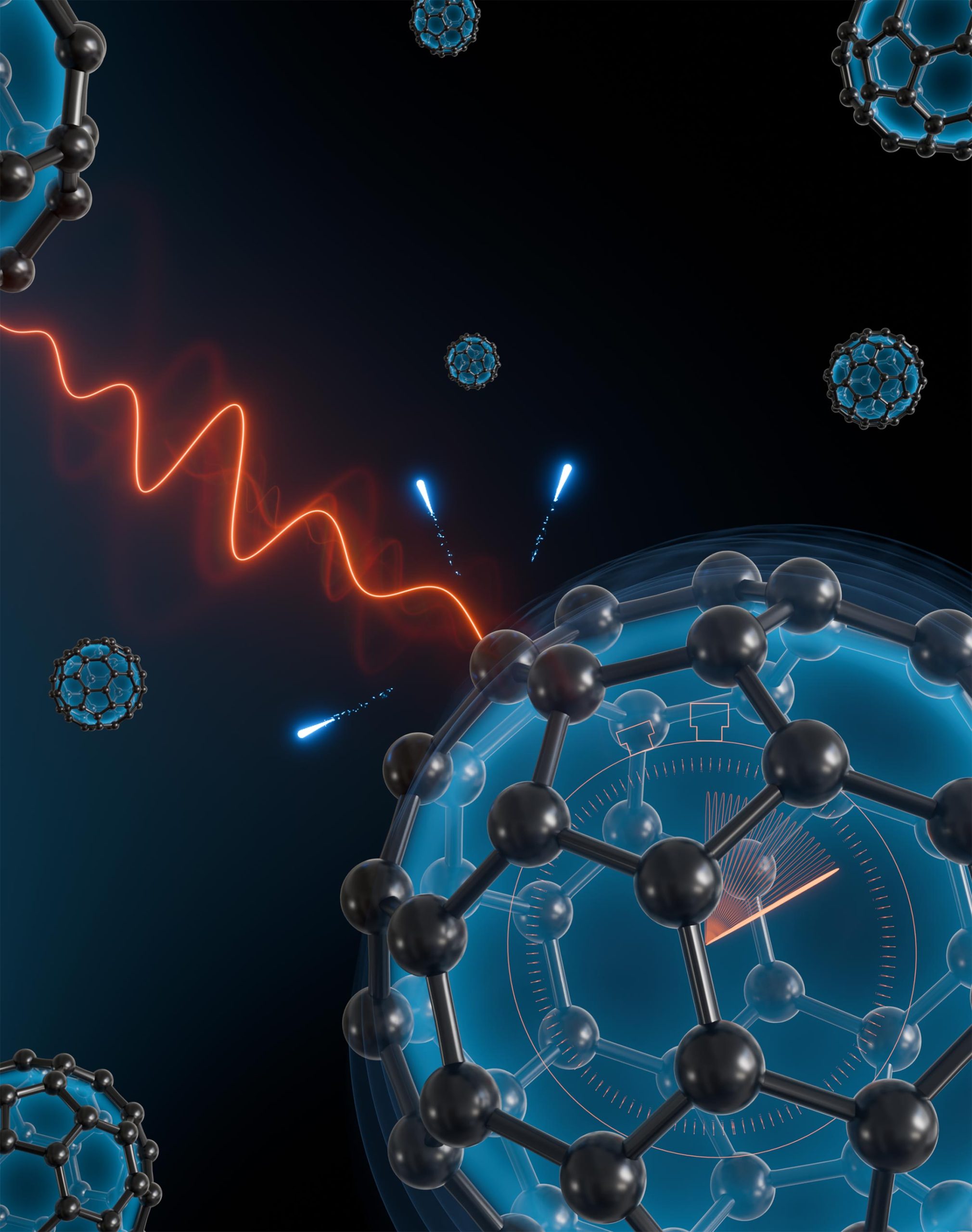
Using attosecond, extreme ultraviolet light pulses, the team triggered and recorded the behavior of electrons within soccer-ball-shaped carbon molecules, informally known as “buckyballs,” that measure just 0.7 nanometers in diameter. They precisely timed the process, from the instant light excited the electrons to the moment electrons were emitted, expelling excess energy and allowing the remaining electrons to relax into their usual orbits. Each cycle lasted between 50 to 300 attoseconds, and measurements indicated that the electrons were behaving with strong coherence, like disciplined dancers performing in unison.
“These findings demonstrate, for the first time, that attosecond measurements can provide valuable insights into plasmonic resonances at scales smaller than a nanometer,” said Shubhadeep Biswas, the lead author on the paper and a SLAC project scientist.
This breakthrough allows researchers to evaluate a new range of super-small particles, revealing plasmonic characteristics that could enhance the efficiency of existing technologies and lead to novel applications.
The Future of Ultrafast Electronics
“With this measurement, we are unlocking new insights into the interplay between electron coherence and light confinement at sub-nanometer scales,” said Matthias Kling, professor of photon science and applied physics at Stanford University and the director of the Science, Research and Development Division at SLAC’s Linac Coherent Light Source, a DOE Office of Science user facility. “This work demonstrates the power of attosecond techniques and opens the door to novel approaches in manipulating electrons in future ultrafast electronics, that could be operating at up to a million times higher frequencies than current technology.”
“This cutting-edge research is opening new avenues for the development of ultra-compact, high-performance platforms, where light-matter interactions can be controlled by taking advantage of quantum effects emerging at the nanoscale,” said Francesca Calegari, professor at the University of Hamburg, lead scientist at DESY.
Reference: “Correlation-driven attosecond photoemission delay in the plasmonic excitation of C60 fullerene” by Shubhadeep Biswas, Andrea Trabattoni, Philipp Rupp, Maia Magrakvelidze, Mohamed El-Amine Madjet, Umberto De Giovannini, Mattea C. Castrovilli, Mara Galli, Qingcao Liu, Erik P. Månsson, Johannes Schötz, Vincent Wanie, Pawel Wnuk, Lorenzo Colaizzi, Daniele Mocci, Maurizio Reduzzi, Matteo Lucchini, Mauro Nisoli, Angel Rubio, Himadri S. Chakraborty, Matthias F. Kling and Francesca Calegari, 12 February 2025, Science Advances.
DOI: 10.1126/sciadv.ads0494
This research at the Stanford PULSE Institute is part of the Ultrafast Chemical Sciences program supported by the DOE Office of Science.
Never miss a breakthrough: Join the SciTechDaily newsletter.
Follow us on Google and Google News.
2 Comments
This synchronized electron motion, known as plasmonic resonance, allows light to be temporarily trapped. These findings demonstrate, for the first time, that attosecond measurements can provide valuable insights into plasmonic resonances at scales smaller than a nanometer.
VERY GOOD.
Ask the researchers:
1. How do you understand the synchronization?
2. How do you understand the plasma?
3. Is the ’ The Blind and the Elephant ‘just a fable?
Scientific research guided by correct theories can enable researchers to think more. Can you get an Interpretation of Quantum Theory within the Framework of Topological Vortex Theory (TVT)? (https://scitechdaily.com/microscope-spacecrafts-most-precise-test-of-key-component-of-the-theory-of-general-relativity/#comment-875168). Can you get an Interpretation of Einstein’s Relativity within the Framework of Topological Vortex Theory (TVT)? (https://scitechdaily.com/microscope-spacecrafts-most-precise-test-of-key-component-of-the-theory-of-general-relativity/#comment-875170).
A topological vortex is a concept in physics that describes the natural gravitational field or the fluid-body coupled system. A topological vortex is formed by the interaction and balance of vortex and anti-vortex field pairs, which can be set into resonance by the body motion and interaction.
Topological Vortex Theory (TVT) treats space as an ideal fluid, posits that the topological vortex gravitational field is fundamental to the structure of the universe, and emphasizes the importance of topological phase transitions in understanding mass, inertia, and energy.
According to the Topological Vortex Theory (TVT), spins create everything, spins shape the world. There are substantial distinctions between Topological Vortex Theory (TVT) and traditional physical theories. Grounded in the inviscid, incompressible, and isotropic spaces, TVT introduces the concept of topological phase transitions and employs topological principles to elucidate the formation and evolution of matter in the universe, as well as the impact of interactions between topological vortices and anti-vortices on spacetime dynamics and thermodynamics.
Within TVT, low-dimensional spacetime matter serves as the foundation for high-dimensional spacetime matter, and the hierarchical structure of matter and its interaction mechanisms challenge conventional macroscopic and microscopic interpretations. The conflict between Quantum Physics and Classical Physics can be attributed to their differing focuses: Quantum Physics emphasizes low-dimensional spacetime matter, whereas Classical Physics centers on high-dimensional spacetime matter.
Subatomic particles in the quantum world often defy the familiar rules of the physical world. The fact repeatedly suggests that the familiar rules of the physical world are pseudoscience. In the familiar rules of the physical world, two sets of cobalt-60 can form the mirror image of each other by rotating in opposite directions, and should receive the Nobel Prize for physics.
Please witness the grand performance of some so-called peer review publications (including PRL, PNAS, Nature, Science, etc.). https://scitechdaily.com/microscope-spacecrafts-most-precise-test-of-key-component-of-the-theory-of-general-relativity/#comment-854286. Some so-called academic publications (including PRL, PNAS, Nature, Science, etc.) are addicted to their own small circles and have deviated from science for a long time.
As the background of various material interactions and movements, space exhibits inviscid, absolutely incompressible and isotropic physical characteristics. It may form various forms of spacetime vortices through topological phase transitions. Hence, vortex phenomena are ubiquitous in cosmic space, from vortices of quantum particles and living cells to tornados and black holes. Stars and radioactive elements are one of the most active topological nodes in spacetime. Utilizing them is more valuable and meaningful than simulating them. Small or micro power topology intelligent batteries may be the direction of future energy research and development for human society.
Under the topological vortex architecture, science and pseudoscience are clear at a glance. Topological Vortex Theory (TVT) can play a crucial role in elucidating the foundations of physics, establishing its principles, and combating pseudoscience. Therefore, TVT has been strongly opposed and boycotted by traditional so-called peer review publications (such as PRL, PNAS, Nature, Science, etc.).
These so-called peer review publications (including PRL, PNAS, Nature, Science, etc.) mislead the direction of science and are known for their various absurdities and wonders. They collude together, reference each other, and use so-called Impact Factor (IF) or the Nobel Prize to deceive people around.
Ask the so-called peer review publications (including PRL, PNAS, Nature, Science, etc.):
1. What are your criteria for distinguishing science from pseudoscience?
2. Is your Impact Factor (IF) the standard for distinguishing science from pseudoscience?
3. Is the Nobel Prize the standard for distinguishing science from pseudoscience?
4. What is the most important aspect of academic publications?
5. Is the most important aspect of academic publications being flashy and impractical articles?
Pseudo academic publications (including PRL, PNAS, Nature, Science, etc.) are neither inclusivity nor openness, nor transparency and fairness, and have already had a serious negative impact on the progress of science and technology. Some so-called peer review publications (including PRL, PNAS, Nature, Science, etc.) are addicted to their own small circle and no longer know what science is. They hardly know what is dirty and ugly.
Publications that mislead the public under the guise of scholarship are more reprehensible than ordinary publications. The field of physics faces an ongoing challenge in maintaining scientific rigor and integrity in the face of pervasive pseudoscientific claims. Fighting against rampant pseudoscience, physics still has a long way to go.
While my comments may be lengthy, they are necessary to combat the proliferation of rampant pseudoscience and to promote the advancement of science and technology, and also is all I can do.
Appreciate the SciTechDaily for its inclusivity, openness, transparency, and fairness. If the researchers are truly interested in cosmic matter, please read: A Brief History of the Evolution of Cosmic Matter (https://scitechdaily.com/microscope-spacecrafts-most-precise-test-of-key-component-of-the-theory-of-general-relativity/#comment-873523).
Topological Vortex Theory (TVT) is based on topology and fluid dynamics, which have solid mathematical and physical foundations. Under the topological vortex architecture, science and pseudoscience are clear at a glance. Topological Vortex Theory (TVT) can play a crucial role in elucidating the foundations of physics, establishing its principles, and combating pseudoscience.
However, some individuals, some AI (https://zhuanlan.zhihu.com/p/23079945169), and some so-called peer review publications (including PRL, PNAS, Nature, Science, etc.) stubbornly believe that two sets of cobalt-60 can form the mirror image of each other by rotating in opposite directions (https://scitechdaily.com/microscope-spacecrafts-most-precise-test-of-key-component-of-the-theory-of-general-relativity/#comment-854286), and stubbornly believe that the Topological Vortex Theory (TVT) currently lacks validation. This is because they have been misled by pseudoscientific information.
Vortex phenomena are ubiquitous in cosmic space, from vortices of quantum particles and living cells to tornados and black holes. The inviscid and incompressible spaces have been widely used in engineering simulation (https://scitechdaily.com/microscope-spacecrafts-most-precise-test-of-key-component-of-the-theory-of-general-relativity/#comment-870077). These all are the most powerful verification and validation.
Ask some so-called peer review publications (including PRL, PNAS, Nature, Science, etc.) again:
1. Does space not exist?
2. Does time not exist?
3. Does the ideal fluid not exist?
4. Do scientific experiments require time and space?
5. Do certain engineering simulations require ideal fluids?
6. If non-existent things are applied to scientific experiments and engineering simulations, and good results can be achieved. So, what is the difference between the non-existent thing and God?
Some individuals and some so-called peer review publications (including PRL, PNAS, Nature, Science, etc.) have been misleading the public with confusing concepts (https://pic2.zhimg.com/v2-4127b0b58fe8b88feb27c189fb705029_1440w.jpg?source=172ae18b), unscientific logic and reasoning, and self righteous Impact Factor (IF), hindering the progress of science and technology.
Fighting against rampant pseudoscience, physics still has a long way to go.