
Close Menu
    Facebook X (Twitter) Instagram
    SciTechDaily
    • Biology
    • Chemistry
    • Earth
    • Health
    • Physics
    • Science
    • Space
    • Technology
    Facebook X (Twitter) Pinterest YouTube RSS
    SciTechDaily
    Home»Biology»The Flower Clock: How a Small Protein Helps Flowers Develop Properly
    Biology

    The Flower Clock: How a Small Protein Helps Flowers Develop Properly

    By Nara Institute of Science and TechnologyAugust 30, 2021No Comments3 Mins Read
    Facebook Twitter Pinterest Telegram LinkedIn WhatsApp Email Reddit
    Share
    Facebook Twitter LinkedIn Pinterest Telegram Email Reddit
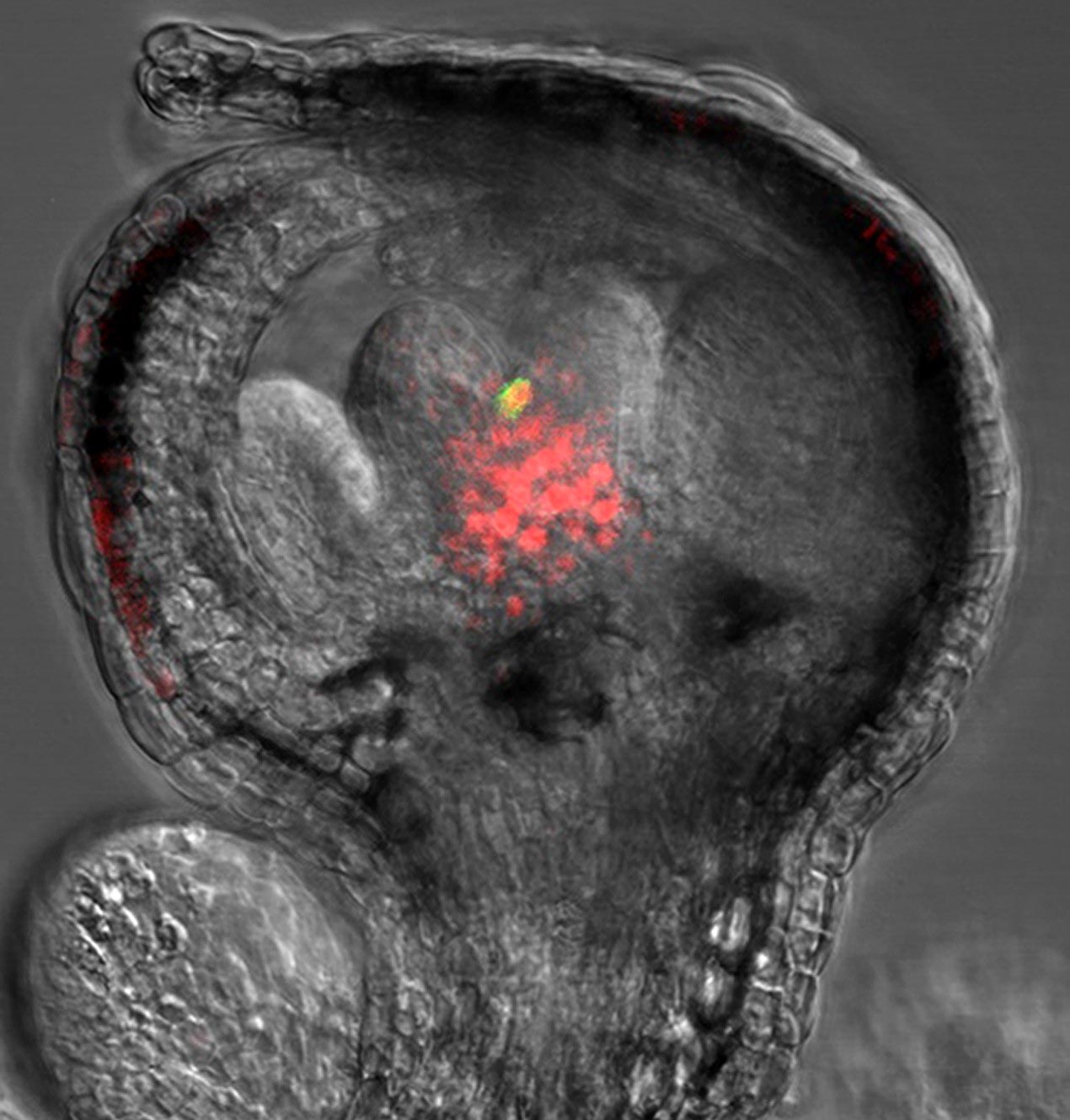
    Early Stage Flower of Arabidopsis thaliana
    The image shows an early stage flower of Arabidopsis thaliana. Using confocal microscopy, Shang Erlei et al. found that KNUCKLES (KNU), encoding a C2H2-type zinc finger repressor, expresses in floral meristem (shown in red) from floral stage 6 and overlaps with the stem cell marker gene CLVTAVA3 (CLV3) expressing cells (shown in green). Further, KNU directly repressed CLV3 and mediates a regulatory framework for the timely controlled floral meristem determinacy. Credit: Bo Sun

    Researchers from Nara Institute of Science and Technology and Nanjing University find that KNUCKLES, a small multi-functional protein, supports the correct timing of floral development for the proper formation of flower reproductive organs.

    How flowers form properly within a limited time frame has been a mystery, at least until now. Researchers from Japan and China have discovered how a multi-tasking protein helps flowers to develop as expected.

    In a study published in Proceedings of the National Academy of Sciences U.S.A., researchers from Nanjing University and Nara Institute of Science and Technology have revealed that a small protein plays multiple roles to ensure that floral reproductive organs are formed properly within a short space of time.

    Flowers develop from floral meristems, which differentiate to produce the sepals, petals, stamens, and carpels. The proper development of these floral organs depends on meristem development being completed within a certain time period. In the early stages of flower development, stem cells provide the cell source for floral organ formation. In floral meristems, stem cell activities are maintained via a feedback loop between WUSCHEL (WUS), a gene that identifies floral stem cells, and CLAVATA3 (CLV3), a stem cell marker gene that is activated and sustained by WUS.

    The Master Regulator of Flower Development

    “A small protein called KNUCKLES (KNU) represses WUS directly, which leads to the completion of floral stem cell activity at the right time,” says lead author Erlei Shang of the study. “What isn’t fully understood is how the robust floral stem cell activity finishes within a limited time period to ensure carpel development.”

    “The team’s research revealed that in Arabidopsis thaliana, KNU can completely deactivate the robust floral meristems at a particular floral stage, thanks to the multiple functions that KNU carries out via its position-specific roles,” says senior author Toshiro Ito.

    KNU both represses and silences WUS, and directly represses CLV3 and CLV1 (a gene that encodes a receptor for the CLV3 peptide). Consequently, KNU eliminates the CLV3-WUS feedback loop via transcriptional and epigenetic mechanisms (i.e., those that do not involve changes in the underlying DNA sequences). Additionally, KNU interacts physically with the WUS protein, which inhibits WUS from sustaining CLV3, disrupting interactions that are required for the maintenance of floral meristems.

    Implications for Flowering and Global Food Crop Yields

    “Our results reveal a regulatory pathway where KNU plays a key role in supporting the completion of floral meristem development within a short time window, and ensures that flower reproductive organs are properly formed,” says corresponding author Bo Sun.

    The results of this research will be useful for genetic studies of food crop species such as rice, tomatoes, and maize. An understanding of the floral meristem termination mechanism discovered in this study will benefit crop yields for food production globally.

    Reference: “Robust control of floral meristem determinacy by position-specific multifunctions of KNUCKLES” by Erlei Shang, Xin Wang, Tinghan Li, Fengfei Guo, Toshiro Ito and Bo Sun, 30 August 2021, Proceedings of the National Academy of Sciences.
    DOI: 10.1073/pnas.2102826118 

    Never miss a breakthrough: Join the SciTechDaily newsletter.
    Follow us on Google and Google News.

    Genetics Nara Institute of Science and Technology Plant Science
    Share. Facebook Twitter Pinterest LinkedIn Email Reddit

    Related Articles

    Hired Blade: Anchoring Complex in Plant Cells Recruits Its Own Katana Sword To Cut New Microtubules

    Tomato’s Hidden DNA Mutations Revealed in Genetic Study of 100 Varieties

    Scientists Find Genes to Save Ash Trees From Deadly Beetle That Is Expected to Kill Billions of Trees Worldwide

    Intriguing Genetics That Flipped the Food Chain to Allow Carnivorous Plants to Hunt Animals

    How to Boost Plant Biomass: Genetic Biologists Uncover Molecular Link to Growth

    Revealed: Plants Molecular ‘Alarm’ System That Protects Them From Predators

    Possible On/Off Switch for Plant Growth Identified

    Plants Harness ‘Bad’ Molecules for Good Ends – Here’s How

    1 Billion Years of Evolution Illuminated by Genetic Sequencing of 1,100 Plants

    Leave A Reply Cancel Reply

    • Facebook
    • Twitter
    • Pinterest
    • YouTube

    Don't Miss a Discovery

    Subscribe for the Latest in Science & Tech!

    Trending News

    Popular Vitamin B3 Supplements May Help Cancer Cells Survive, Scientists Warn

    Scientists Discover Strange Property of Rice and Turn It Into a Smart Material

    NASA Artemis II Skips Burn As Astronaut Captures Stunning View of Earth

    NASA’s Artemis II: Humans Just Left Earth Orbit for the First Time Since 1972

    What Causes Chronic Pain? Scientists Identify Key Culprit in the Brain

    Semaglutide Shows Surprising Mental Health Benefits in Massive 100,000-Person Study

    This Liquid Snapped Instead of Flowing and Scientists Were Shocked

    Breakthrough Alzheimer’s Drug Rewires the Brain Instead of Just Clearing Plaques

    Follow SciTechDaily
    • Facebook
    • Twitter
    • YouTube
    • Pinterest
    • Newsletter
    • RSS
    SciTech News
    • Biology News
    • Chemistry News
    • Earth News
    • Health News
    • Physics News
    • Science News
    • Space News
    • Technology News
    Recent Posts
    • Scientists Uncover the Secret “Glue” That Helps Soil Hold Water
    • Climate Change Is Altering a Key Greenhouse Gas in a Way Scientists Didn’t Expect
    • Why Antarctic Sea Ice Suddenly Collapsed After Decades of Growth
    • Astronomers Discover the Most Pristine Star Ever Found
    • New Study Suggests Gravitational Waves May Have Created Dark Matter
    Copyright © 1998 - 2026 SciTechDaily. All Rights Reserved.
    • Science News
    • About
    • Contact
    • Editorial Board
    • Privacy Policy
    • Terms of Use

    Type above and press Enter to search. Press Esc to cancel.