
Glaciers are losing ice at an accelerating rate, threatening global sea levels and freshwater supplies. A massive international effort has tracked this loss over two decades, revealing that glaciers lost 273 billion tonnes of ice per year on average, with a drastic 36% increase in recent years.
Advanced satellite data and collaboration among 35 research teams have provided crucial insights into this alarming trend. With glacier melt now the second-largest contributor to rising seas, urgent action is needed to understand and mitigate the consequences of this rapid ice depletion.
Glaciers Melting at an Alarming Rate
Glaciers around the world are melting at an accelerating pace, depleting regional freshwater supplies and contributing to rising global sea levels.
A new international study, involving 35 research teams, reveals that glaciers have lost an average of 273 billion tonnes of ice per year since 2000. However, this average masks a concerning trend — ice loss has surged significantly over the last decade.

Staggering Volume of Ice Disappearing
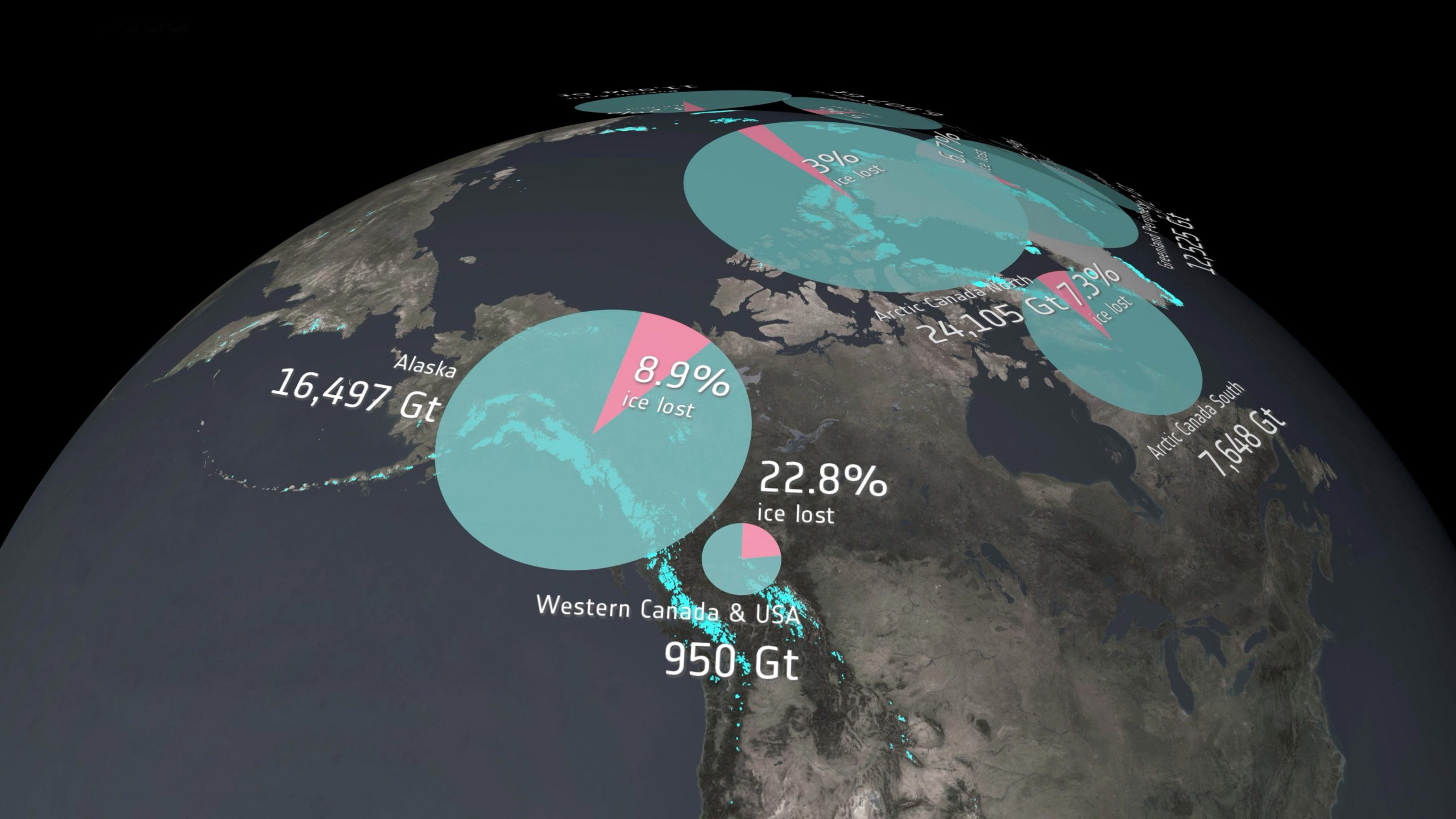
At the start of the study period in 2000, glaciers (excluding the massive ice sheets of Greenland and Antarctica) covered 705,221 square kilometers and contained an estimated 121,728 billion tonnes of ice. Over the past 20 years, they have lost approximately 5% of their total volume, with regional declines varying from 2% in the Antarctic and Subantarctic Islands to a striking 39% in Central Europe.
The rate of ice loss has escalated over time. While the average annual loss stands at 273 billion tonnes, this figure increased by 36% in the second half of the study period (2012–2023) compared to the first half (2000–2011).
Over the full study period, glacier ice loss was 18% greater than that of the Greenland Ice Sheet and more than twice the loss from Antarctica’s Ice Sheet, underscoring the critical role glaciers play in global sea-level rise.
The Glacier Mass Balance Intercomparison Exercise (Glambie)
The research, which was published on February 19 in the journal Nature, was conducted as part of the Glacier Mass Balance Intercomparison Exercise, or Glambie for short.
Glambie is a major research initiative coordinated by the World Glacier Monitoring Service (WGMS) hosted at the University of Zurich, in collaboration with the University of Edinburgh and Earthwave Ltd to generate a community estimate of glacier mass loss globally.
The team coordinated the compilation, standardization and analysis of different data from field measurements and from a wealth of different types of optical, radar, laser and gravimetry satellite missions.
Satellite observations included those from the US Terra/ASTER and ICESat-2, the US–German GRACE, the German TanDEM-X and ESA’s CryoSat missions, among others.

A Comprehensive Global Glacier Dataset
By combining different types of data from these multiple sources, Glambie produced an annual time series of glacier mass change for all glacier regions globally from 2000 to 2023.
“We compiled 233 estimates of regional glacier mass change from about 450 data contributors organized in 35 research teams,” explained Michael Zemp, who co-led the study.
“Benefiting from the different observation methods, Glambie not only provides new insights into regional trends and year-to-year variability, but we could also identify differences among observation methods. This means that we can provide a new observational baseline for future studies on the impact of glacier melt on regional water availability and global sea-level rise.”
Livia Jakob, who hosted a large workshop at Earthwave in Edinburgh to discuss findings with all the participants, noted, “Bringing together so many different research teams from across the globe in a joint effort to increase our understanding and certainty of glacier ice loss has been extremely valuable. This initiative has also fostered a stronger sense of collaboration within the community.”

The Impact on Water and Sea Levels
Between 2000 and 2023, glaciers collectively lost 6542 billion tonnes of ice, contributing 18 mm to global sea-level rise. On average, glaciers lost 273 billion tonnes of ice per year, equivalent to an annual sea-level rise of 0.75 mm.
The rate of glacier ice loss has increased significantly from 231 billion tonnes per year in the first half of the study period to 314 billion tonnes per year in the second half.
Today, glaciers rank as the second-largest contributor to global sea-level rise, following ocean warming related thermal expansion. They surpass the contributions of the Greenland Ice Sheet, the Antarctic Ice Sheet, and changes in land water storage.
Loss of Critical Freshwater Resources
In addition to rising sea levels, glacier melt represents a significant loss of regional freshwater resources.
“To put this in perspective, the 273 billion tonnes of ice lost annually amounts to what the entire global population consumes in 30 years, assuming three liters per person and day,” noted glaciologist Prof. Zemp.
UZH glaciologist Inés Dussaillant, who was involved in the Glambie analyses, added, “Glaciers are vital freshwater resources, especially for local communities in Central Asia and the Central Andes, where glaciers dominate runoff during warm and dry seasons.
“But when it comes to sea-level rise, the Arctic and Antarctic regions, with their much larger glacier areas, are the key players. However, almost one-quarter of the glacier contribution to sea-level rise originates from Alaska.”
Monitoring the Future of Glaciers
Noel Gourmelen who co-led the study, said, “The research is the result of sustained efforts by the community and by space agencies over many years, to exploit a variety of satellites that were not initially specifically designed for the task of monitoring glaciers globally.
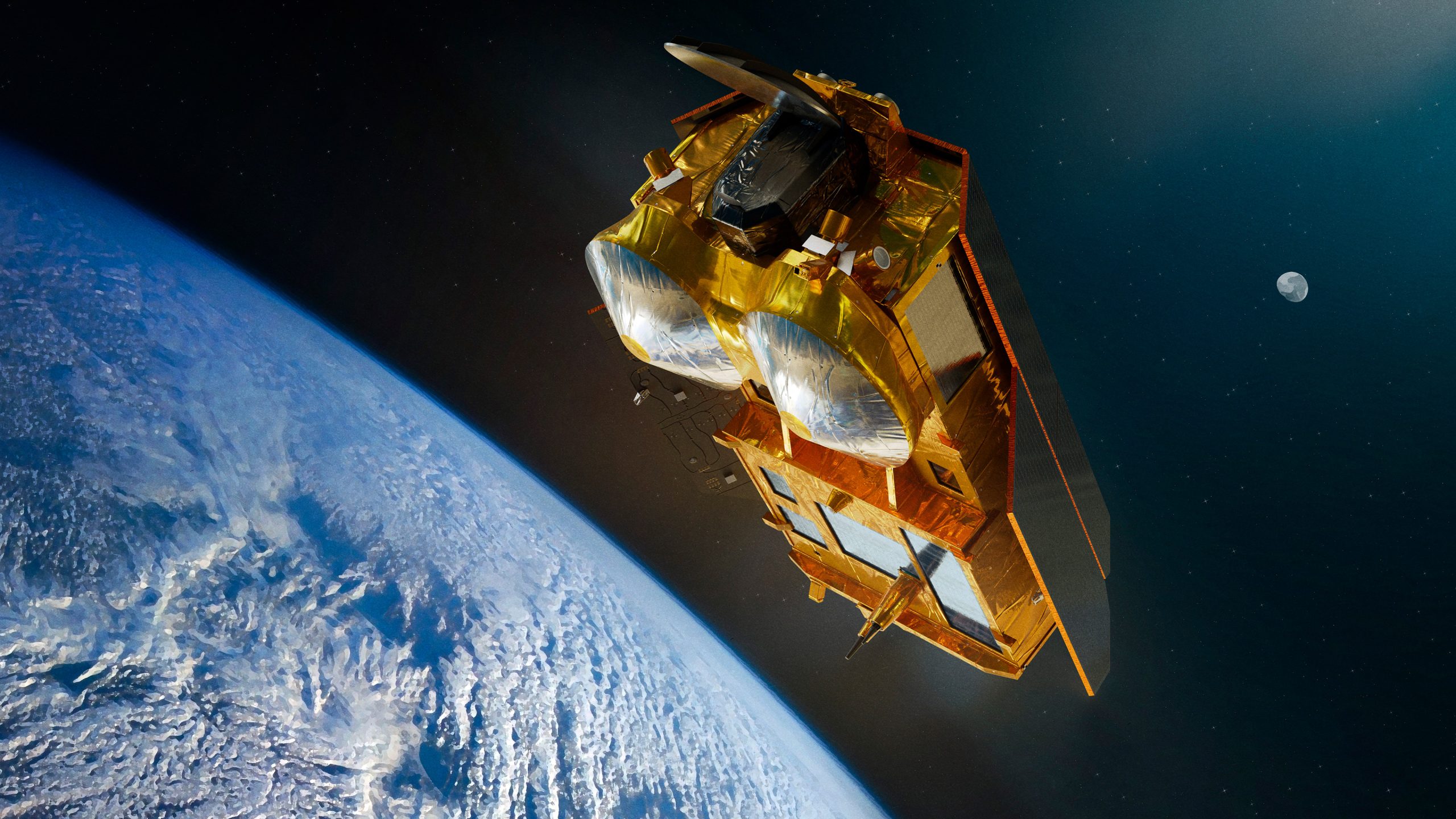
“This legacy is already producing impact with satellite missions being designed to allow operational monitoring of future glacier evolution, such as Europe’s Copernicus CRISTAL mission which builds on the legacy of ESA’s CryoSat.”
Addressing the Challenges Ahead
ESA Earth Observation Applications Scientist, Stephen Plummer, said, “We take great pride in supporting this vital research through our ESA Science for Society program element as it brings together, for the first time, multiple estimates of glacier mass loss from different satellites and in situ observations through a community driven approach.
“These findings are not only crucial for advancing our scientific understanding of global glacier changes, but also provide a valuable baseline to help regions address the challenges of managing scarce freshwater resources and contribute to developing effective mitigation strategies to combat rising sea level.”
Notably, the study marks an important milestone in preparation for this year’s United Nations’ International Year of Glaciers’ Preservation and the Decade of Action for Cryospheric Sciences (2025–2034).
Reference: “Community estimate of global glacier mass changes from 2000 to 2023” by The GlaMBIE Team, 19 February 2025, Nature.
DOI: 10.1038/s41586-024-08545-z
The research was primarily funded by the Science for Society element of ESA’s FutureEO program, with additional support from the International Association for Cryospheric Sciences and various institutional partners.
It was conducted by the Glambie team under the leadership of the WGMS and of the University of Edinburgh, and in collaboration with Earthwave Ltd., and over 30 other research teams from around the world.
Never miss a breakthrough: Join the SciTechDaily newsletter.
Follow us on Google and Google News.
1 Comment
“Glaciers are losing ice at an accelerating rate, threatening global sea levels and freshwater supplies.”
That is probably unsustainable because as the ice surface area declines, even a constant percentage for the melt rate will result in a decline in the absolute volume that melts. That is, the volume of ice melting will decrease approximately inversely with the length of the glacier. A simple linear extrapolation is not justified to try to predict the future.
“…, with the pace of MELTING accelerating sharply in the past decade.”
While the ‘loss’ of ice is blamed on melting resulting from warming, it should probably be considered to be the net change in ice volume. That may be related to a documented change in evaporation from the oceans since 2008, leading to reduced snow fall and concomitant increased sublimation, in addition to melting:
https://agupubs.onlinelibrary.wiley.com/doi/10.1029/2024GL114256
“Over the past 20 years, they have lost approximately 5% of their total volume, …”
While that amounts to about 0.25% (uncertainty not stated) per year, it is almost a certainty that a linear extrapolation will prove to be inaccurate because of natural variations. That is, the implied average lifetime of 400 years before they are completely melted is unlikely to be valid.
With respect to the unstated uncertainty, assuming that the variation is approximately Gaussian, the Empirical Rule in statistics suggests that the uncertainty alone is probably about +/-10%, based on the range.
Fundamentally, what this study has done is confirm that glacial retreat is continuing (except for the hiatus of the Little Ice Age) as it has for at least the last 12 millennia, and provides us with a reasonably precise (+/-10%) estimate of the current rate. However, “mileage may vary” in the future.