
A January 2025 cold wave plunged Chicago into subzero temperatures, initially without snow. By late January, snowfall returned, and Lake Michigan’s ice formed in shifting patterns. While its ice levels stayed near average, Lake Erie’s spiked dramatically, briefly trapping a freighter. Scientists are turning to NASA’s ICESat-2 to refine ice forecasting and better understand freshwater changes.
A Deep Freeze Grips Chicago
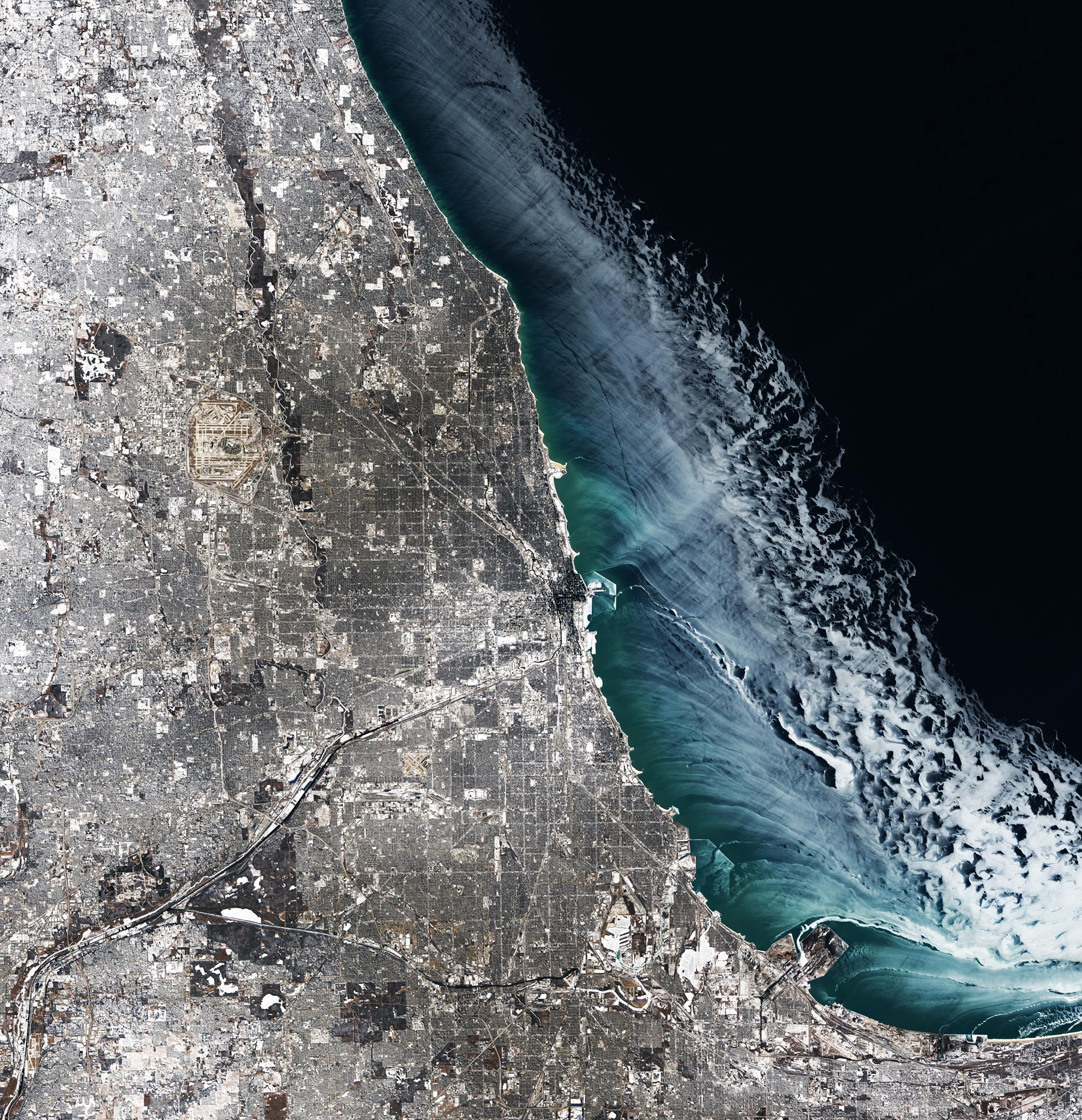
Between January 19 and 24, 2025, Chicago experienced a harsh cold snap. This satellite image captures the icy aftermath.
The coldest temperatures occurred in the first half of the freeze, according to the National Weather Service (NWS). On January 21, Chicago’s air temperature dropped to -15°F (-26°C). Despite the extreme cold, the city remained mostly snow-free, which NWS noted is unusual for subzero conditions.
Snow Returns to the Windy City
Snow finally arrived toward the end of the cold spell. Between the mornings of January 22 and 23, multiple waves of snowfall blanketed the Chicago area. This fresh layer of snow is visible in the image, taken on January 24, 2025, by the Operational Land Imager (OLI) on Landsat 8.
Another expanse of white is visible atop Lake Michigan. This is lake ice, which grows on the Great Lakes each winter, though its extent and timing can be highly variable. Ice coverage on the Great Lakes typically reaches its annual peak in late February or early March.
Winds Shape the Ice Patterns
On January 24, winds were blowing offshore and pushing ice away from the coastline, according to Jia Wang, an ice climatologist at NOAA’s Great Lakes Environmental Research Laboratory (GLERL). Areas of thin (dark) ice closer to shore transition into patchy areas of bright white ice away from shore. Wang thinks these whiter areas might be due to ice that has piled up and formed a very rough surface.
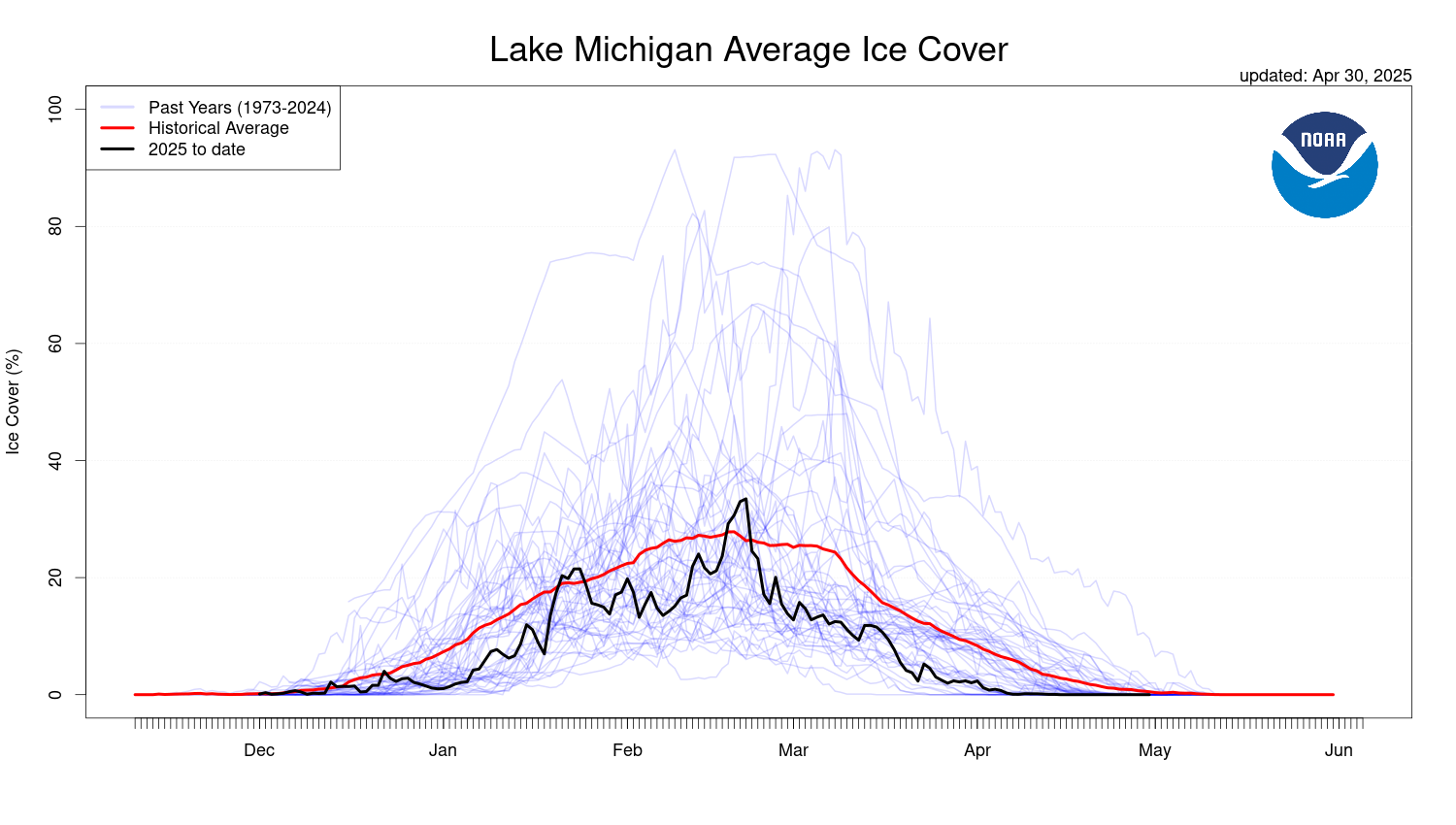
The area of Lake Michigan covered with ice in late January 2025 hovered around the historical average (1973-2024) for the time of year, according to data from GLERL. When the image was acquired, ice covered about 20 percent of the lake.
Ice Strands a Freighter on Lake Erie
Meanwhile, several hundred miles to the east, ice on Lake Erie spiked well above average in late January, according to GLERL, with ice spanning around 80 percent of the lake. The ice was thick enough to temporarily immobilize a Canadian cargo freighter, according to news reports.
NASA’s ICESat-2 and Future Ice Research
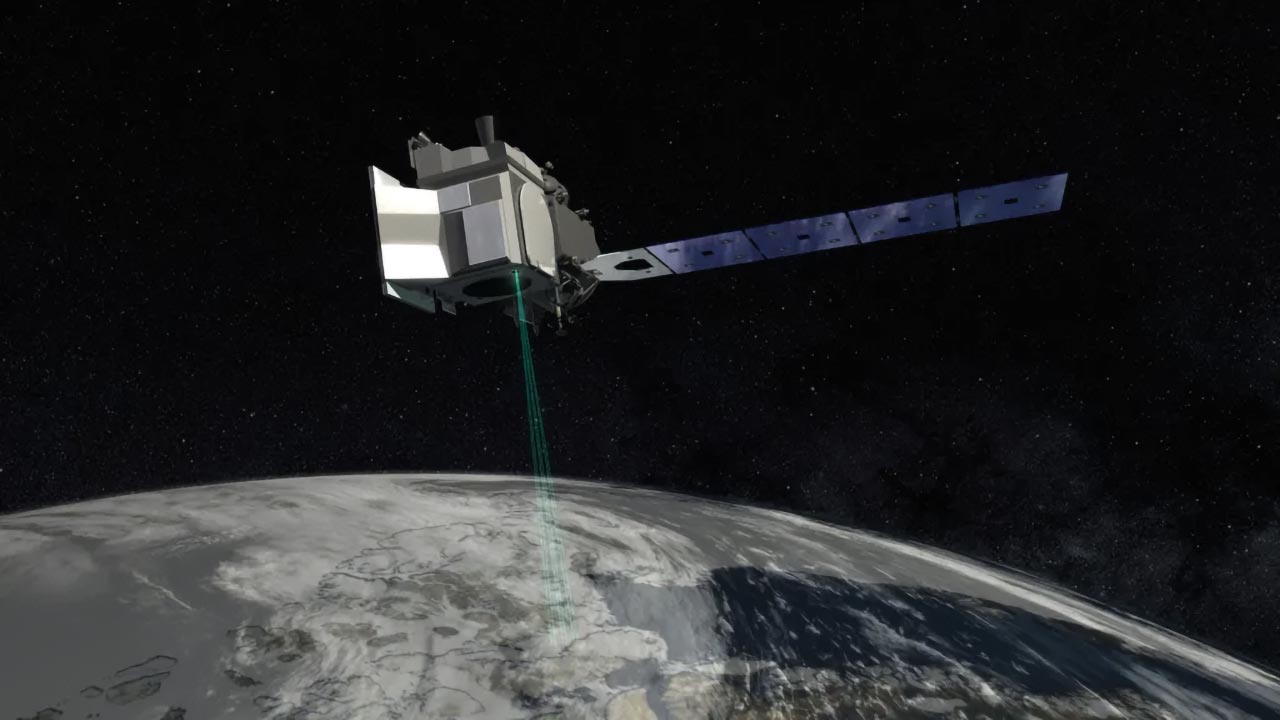
Scientists are currently investigating ways to use altimetry data from NASA’s ICESat-2 (Ice, Cloud and land Elevation Satellite-2) to determine the thickness of ice on the Great Lakes. According to Eric Anderson, a researcher at the Colorado School of Mines, such measurements could improve ice and weather forecasting as well as help us understand changes in Earth’s surface freshwater.
NASA Earth Observatory image by Michala Garrison, using Landsat data from the U.S. Geological Survey.
Never miss a breakthrough: Join the SciTechDaily newsletter.
Follow us on Google and Google News.
6 Comments
The title is misleading. They give no explanation as to “why”. What did they expect to happen versus what actually happened, whether they had an answer or not. One would assume it was because it was colder further east, or because lake erie is smaller than lake michigan therefore easier to freeze faster. Sounds to me like it doesn’t take a rocket scientist to figure that out. Just my opinion.
La Nina is having a big effect this year.
It has been cold an snowing for most of the winter. October to January. We have 3ft of snow in the bush. An January 30. Is -30 north of Elliot Lake.
We need a break 😪!!
Very poorly written. Zero explanation what is different this year. Clearly the Author doesn’t understand what she’s writing about. All I gathered from this is that it got cold and the lake started to freeze.
Her main theam and sat picture was how the wind formed a ragged ice condition off shore. I see some need more comprehension studies.
The claim, that at “extreme” cold temperatures it is unusual that it does not snow, is bogus. I live here in Alberta for the last 50 years, that just the opposite. At -40C I have seen it rarely snow.