
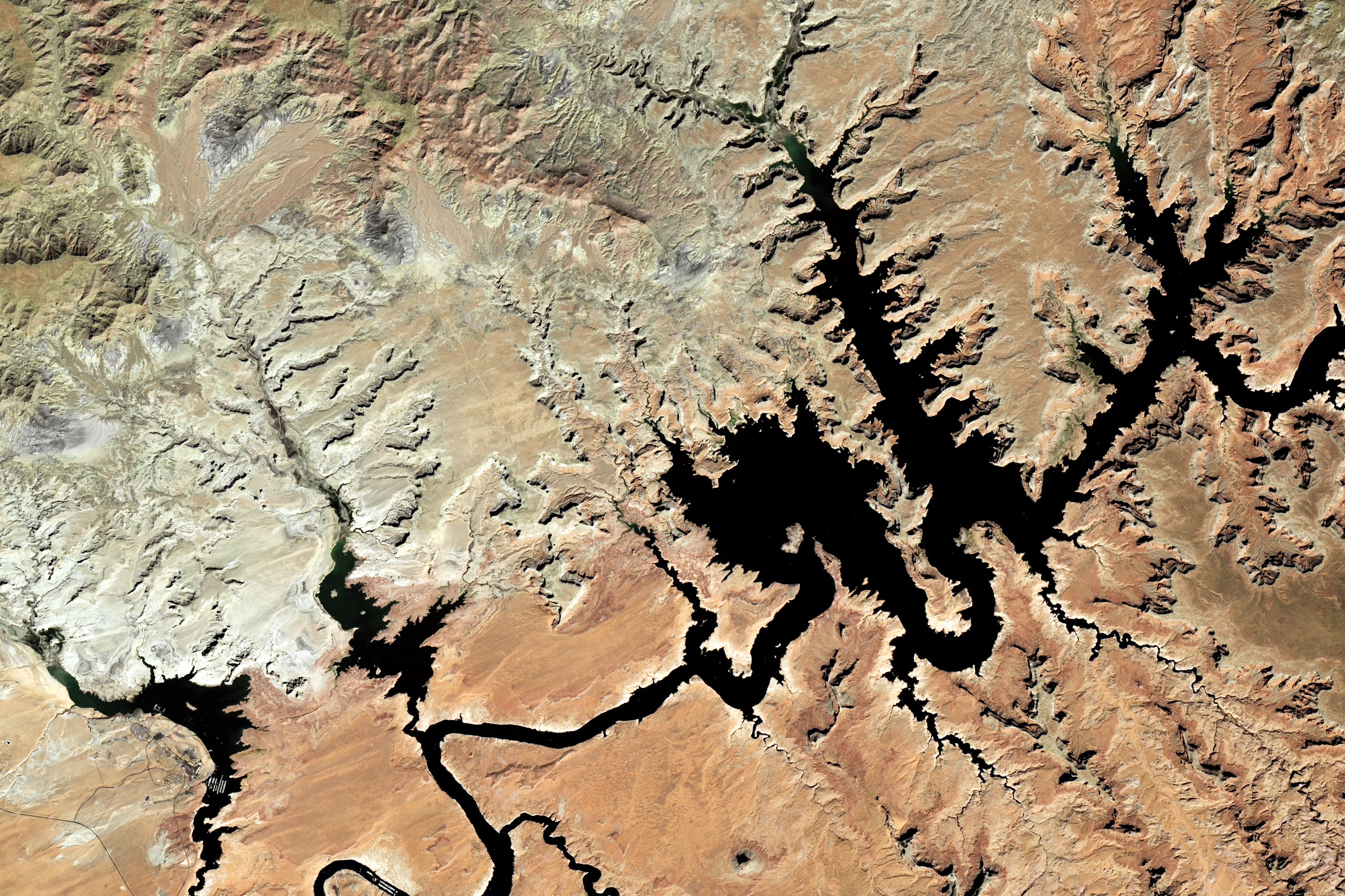
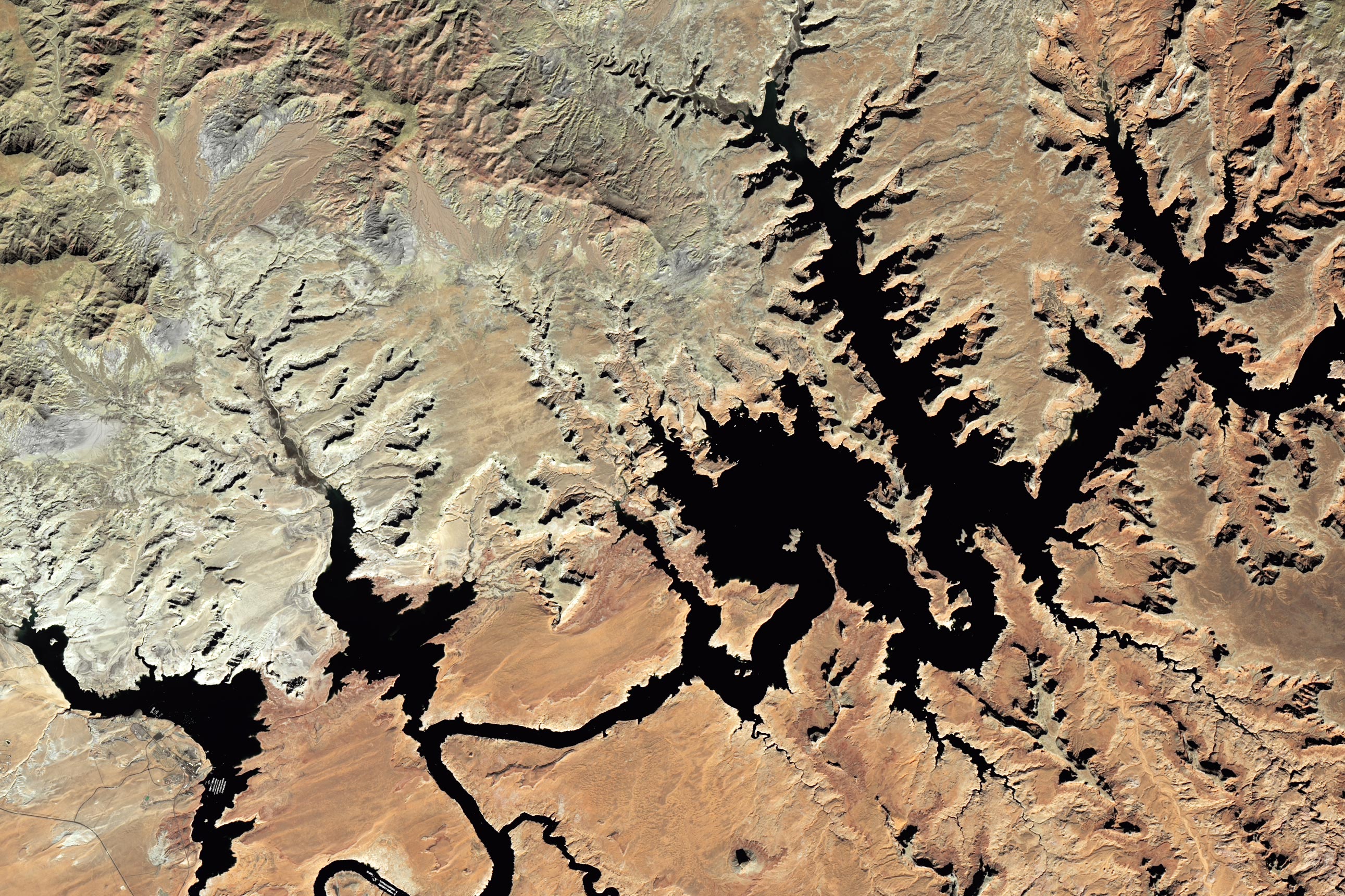
A wet winter in western states provided a short-term reprieve to the decades-long drought in the reservoir.
After falling to record lows in early 2023, water levels in Lake Powell—the second-largest reservoir in the United States—rebounded in the summer of 2023. Above-average snowmelt from the Rocky Mountains provided some short-term relief to the reservoir, but long-term drought remains.
The images above show portions of Lake Powell, which straddles the border of Utah and Arizona, as of October 20, 2023 (right), compared to September 23, 2022 (left). As of November 12, 2023, lake levels stood at 3,572 feet (37 percent full), which is just below the 1991–2020 average for that date. The 2023 image was acquired with the OLI (Operational Land Imager) on Landsat 8 and the 2022 image was acquired by the OLI-2 on Landsat 9.
The Colorado River’s Role
The Colorado River feeds Lake Powell and Lake Mead farther downstream. Most of the river basin is arid or semi-arid and generally receives less than 10 inches (25 centimeters) of precipitation per year. Managed by the U.S. Bureau of Reclamation (USBR) and other agencies, the river provides water and electric power to roughly 40 million people—most notably the cities of Las Vegas, Phoenix, Los Angeles, and San Diego—and water to 4 to 5 million acres of farmland in the Southwest.
Precipitation Patterns and Lake Levels
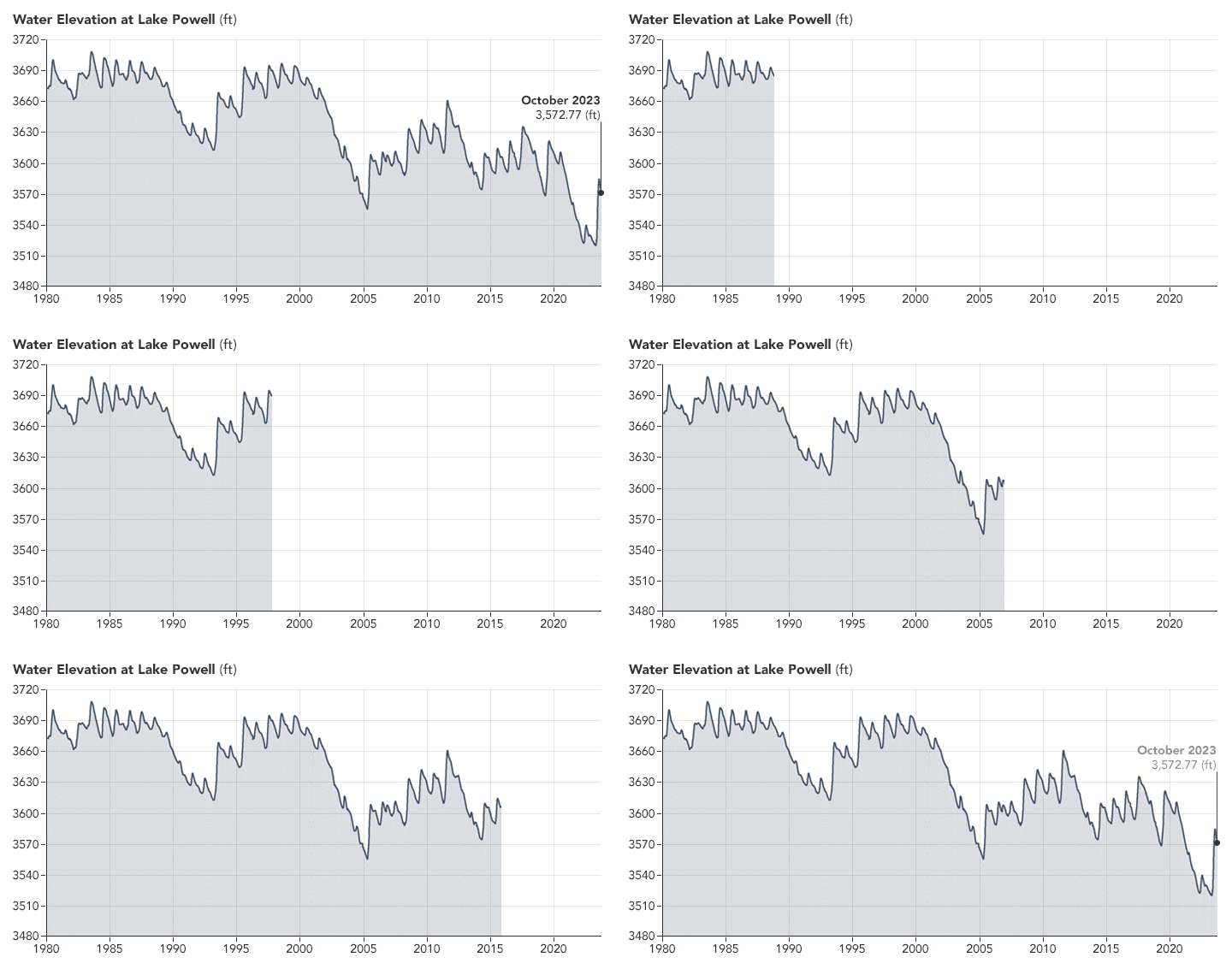
A series of nine atmospheric rivers brought significant amounts of rain and snow to the western U.S. in December 2022 and January 2023. But much of the precipitation in the Colorado River Basin stayed frozen at high elevations of the Rocky Mountains, preventing it from entering Lake Powell. On April 13, water in the lake fell just below 3,520 feet, its lowest level since the reservoir was filled in 1980.
As temperatures increased in spring and summer, above-average runoff from the Rockies provided a much-needed reprieve. The amount of water held in the reservoir rose from 22 percent full in April to about 40 percent full in early July.
Long-Term Drought Challenges
But it will take much more than one wet year to refill the reservoir to “full pool” (elevation 3,700 feet). Two decades of drought in the American Southwest have drawn down water in the reservoir. Water levels in Lake Powell fell to a record low in 2022 and again in 2023.
In April 2023, USBR released a draft Environmental Impact Statement for Colorado River Operations, which assessed the chances of the reservoir falling below the critical elevation of 3,490 feet. This elevation, known as the “minimum power pool,” is the level below which water can no longer flow through the intake valves in the dam to generate hydroelectric power. USBR warned that water levels had a 57 percent chance of dropping to below the minimum power pool before 2026. But because of above-average runoff in the spring and summer, USBR revised these estimates in October 2023. They found that the chance of the reservoir dipping to this elevation through 2026 had fallen to 8 percent.
The impact statement noted that although there is year-to-year variation in flow in the Colorado River and its tributaries, the basin is still in a prolonged period of aridification caused by climate change. Drought and low runoff from 2000 to 2022 have led to “the driest 23-year period in more than a century and one of the driest periods in the last 1,200 years.”
NASA Earth Observatory images by Michala Garrison, using Landsat data from the U.S. Geological Survey and lake elevation data from the Bureau of Reclamation.
Never miss a breakthrough: Join the SciTechDaily newsletter.
Follow us on Google and Google News.
1 Comment
The arrogance of man is often amusing. First we build a dam in the baron desert. Next we assign the proper amount of precipitation that Mother Nature is to provide annually. When she doesn’t comply with our demands, we give her failing a name (drought). Whether it’s true or not, it’s my understanding that they have been releasing more water from reservoir Mead and by extension, reservoir Powell than what comes in since they were build. Furthermore they’ve always known what the end result would be. If you drive your car until it runs out of gas, it’s not a “drought“ in your gas tank, it’s poor planning. Had neither reservoir been constructed then the original river would have simply flowed less during dryer time periods.