
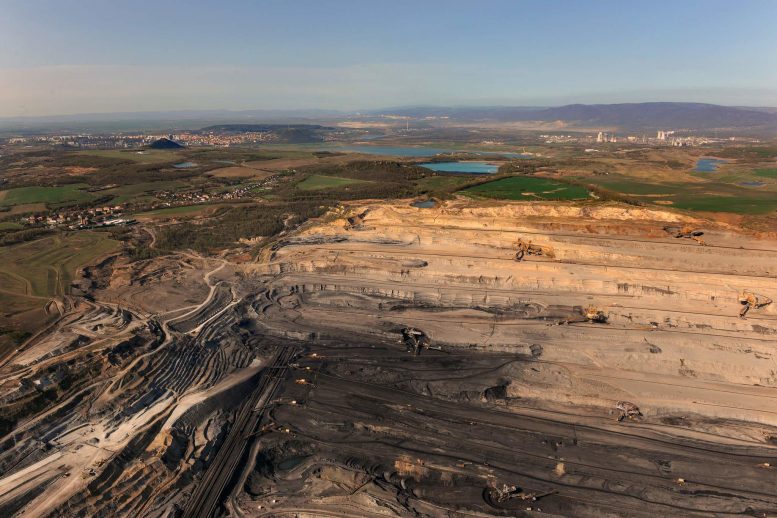
Göttingen University joins forces with other researchers to study the impact of resources, demographics, and disruption in the shift toward clean energy.
Recent research led by the University of Queensland and the University of Göttingen examined the effects of transitioning to clean energy by connecting global resource inventories with demographic systems to uncover potential risks and benefits. The findings suggest that the increased demand for energy transition metals (ETMs) may be more disruptive to some communities than reducing thermal coal production.
Impact of Energy Transition Metals (ETMs) vs. Coal
The researchers determined that while ending coal production could affect at least 33.5 million people living in mine-town systems, an additional 115.7 million may be impacted by disruptions caused by energy transition metals (ETMs). The findings were published in the journal Nature Communications.
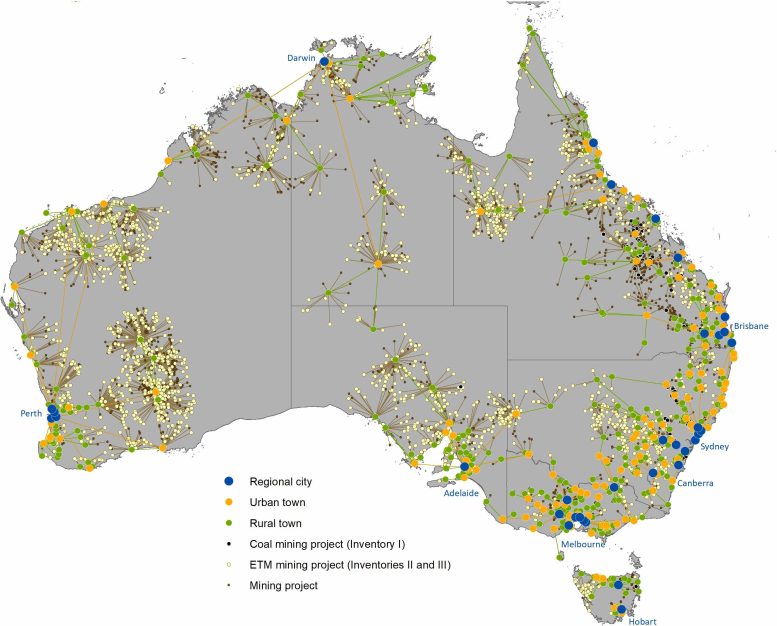
The researchers linked the location and type of resource with human settlements in order to assess interactions, dependencies, and contingencies between resources and populations – a “mine-town systems” approach. The research takes into account both sides of the energy transition by incorporating global resource inventories for coal on the one hand, and the energy transition metals on the other. Energy transition metals refer to the minerals that are required for renewable technologies to accelerate the transition to a clean energy future. These minerals and metals are essential for wind turbines, solar panels, and batteries for electric vehicles.
Dr. Kamila Svobodova, who led the study, is an Honorary Research Fellow at the University of Queensland and holds a research fellowship at the University of Göttingen. Svobodova explained: “These findings will help inform future planning and regulation of the energy transition. Our new mine-town systems approach establishes an empirical basis for examining the scale and location of demographic effects of changing energy systems.”
Asymmetry in Global Risks
“The data shows an asymmetry in the distribution of risks: mine-town systems within the United States are most sensitive to coal phase-out, while systems in Australia and Canada are most sensitive to ETM phase-in. This study highlights an urgent need for more granular socio-economic data on populations living and working in affected areas, and for targeted macro-level planning in order to support a transition from coal to ETMs that is fair for local people.”
Svobodova adds: “Questions of social disruption are rarely considered at a global scale. However, in this study, we are able to deliver a global-scale model which can also be scaled down to national jurisdictions and regions which are under pressure from energy transition.”
Reference: “Decarbonization, population disruption and resource inventories in the global energy transition” by Kamila Svobodova, John R. Owen, Deanna Kemp, Vítězslav Moudrý, Éléonore Lèbre, Martin Stringer and Benjamin K. Sovacool, 15 December 2022, Nature Communications.
DOI: 10.1038/s41467-022-35391-2
Never miss a breakthrough: Join the SciTechDaily newsletter.
Follow us on Google and Google News.
1 Comment
It is interesting. I don’t think this “ETM- Energy Transition Minerals” phrasing is as helpful as it is marketing. These minerals (and metals) need to continue to be mined as the wind turbines and solar panels degrade then fail in a decade or two, and the batteries within a decade (how’s your cellphone battery life?). Batteries don’t transition to clean energy, they just store a little energy, and the renewables need fossil fuel energy to produce/maintain/renew capture devices. If the point is a transition to clean technology like fusion energy, neither “accelerate the transition to a clean energy future” at all.
On the transition having impacts, the coal is still powering the electricity and oil is powering the mining. Winding-down the coal industry is having a big upsetting impact, but I hate coal in the fracking era. There’s a lot of opportunity for jobs and success in new mines, so I don’t mean to destroy their clean green slogan masquerading as a technical acronym. I’m glad someone realized that changing energy systems might impact people and decided to study it.