

Research suggests the Earth captured the Moon from space, rather than forming the rocky satellite from collision particles during planetary formation.
This theory, supported by celestial mechanics and evidence from other moons like Neptune’s Triton, points to a dynamic and evolving lunar orbit influenced by tidal forces.
Early Discoveries and Theories on Moon’s Origin
Between 1969 and 1972, during six Apollo missions, astronauts retrieved over 800 pounds of lunar rock and soil. Analyses revealed these samples were strikingly similar to Earth’s rock and soil, characterized by their calcium-rich, basaltic composition, and dating back approximately 60 million years after the solar system’s formation.
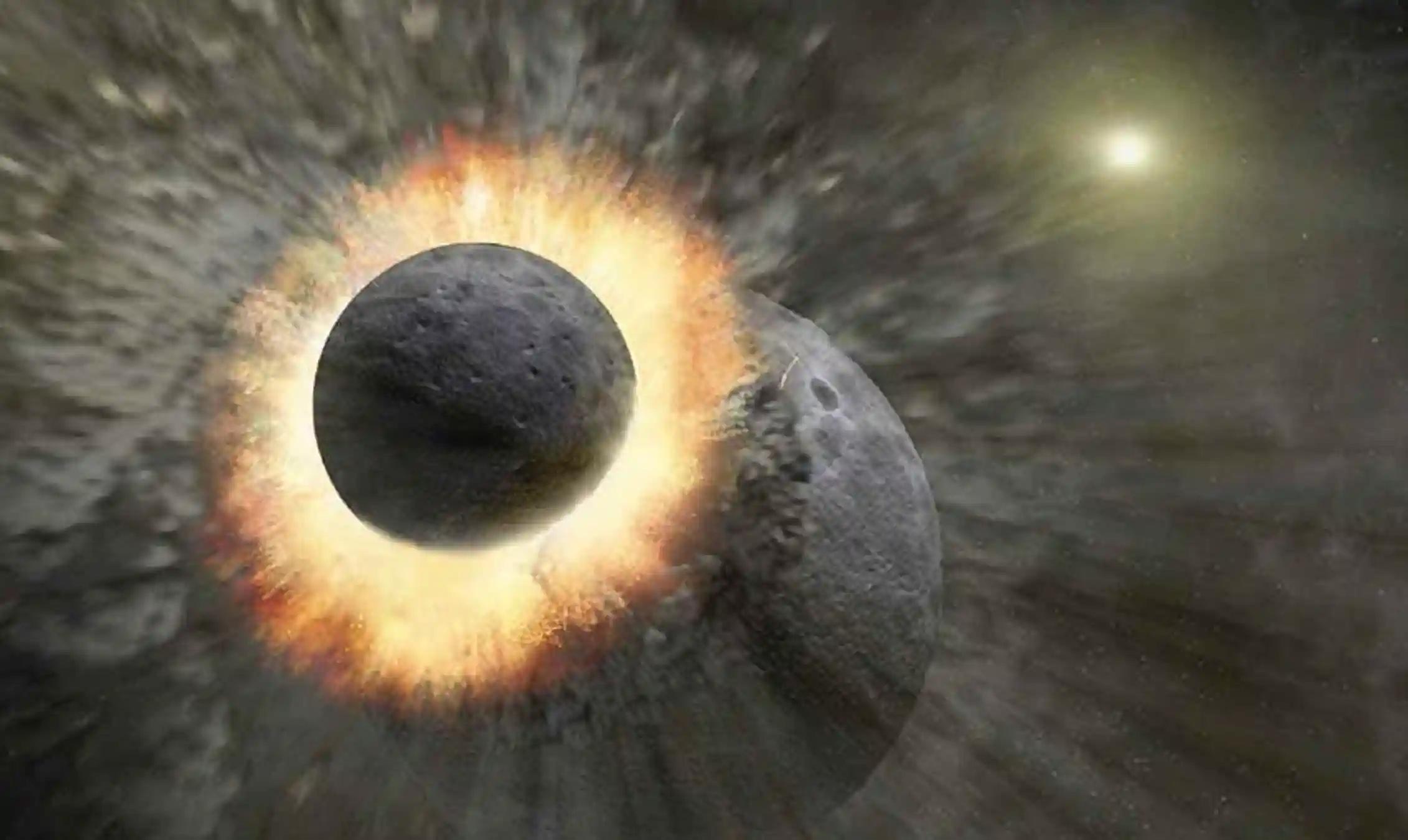
This led planetary scientists at the 1984 Kona Conference in Hawaii to conclude that the moon originated from debris resulting from a collision with the nascent Earth.
Challenging the Status Quo
But that might not be the moon’s true origin story, according to two Penn State researchers. New research published on September 24 in The Planetary Science Journal by Darren Williams, professor of astronomy and astrophysics at Penn State Behrend, and Michael Zugger, a senior research engineer at the Applied Research Lab at Penn State, offers another possibility: That the moon was captured during a close encounter between a young Earth and a terrestrial binary — the moon and another rocky object.
New Insights Into Moon’s Orbital Dynamics
“The Kona Conference set the narrative for 40 years,” Williams said. But questions still lingered. For example, a moon that forms from a planetary collision, taking shape as debris clumps together in a ring, should orbit above the planet’s equator. Earth’s moon orbits in a different plane.
“The moon is more in line with the sun than it is with the Earth’s equator,” Williams said.

Alternative Theories and Celestial Mechanics
In the alternative binary-exchange capture theory, the researchers said, Earth’s gravity separated the binary, snagging one of the objects — the moon — and making it a satellite that orbits in its current plane.
There is evidence of this happening elsewhere in the solar system, Williams said, pointing to Triton, the largest of Neptune’s moons. The reigning hypothesis in the field is that Triton was pulled into orbit from the Kuiper Belt, where one of every 10 objects is thought to be a binary. Triton orbits Neptune in a retrograde orbit, moving in the opposite direction of the planet’s rotation. Its orbit is also significantly tilted, angled 67 degrees from Neptune’s equator.
Implications of a Captured Celestial Body
Williams and Zugger determined that Earth could have captured a satellite even larger than the moon — an object the size of Mercury or even Mars — but the resulting orbit might not have been stable.
The problem is that the “capture” orbit — the one the moon follows — began as an elongated ellipse, rather than a circle. Over time, influenced by extreme tides, the shape of the orbit changed.
Long-Term Changes in Moon’s Orbit
“Today, the Earth tide is ahead of the moon,” Williams said. “High tide accelerates the orbit. It gives it a pulse, a little bit of boost. Over time, the moon drifts a bit farther away.”
The effect is reversed if the moon is closer to Earth, as it would have been immediately after capture. By calculating tidal changes and the orbit’s size and shape, the researchers determined that the moon’s initial elliptical orbit contracted over a timescale of thousands of years. The orbit also became more circular, rounding its path until the lunar spin locked into its orbit around the Earth, as it is today.
At that point, Williams said, the tidal evolution likely reversed, and the moon began to gradually drift away.
Rethinking the Moon’s Formation and Future Research
Every year, he said, the moon moves 3 centimeters farther from Earth. At its current distance from Earth — 239,000 miles — the moon now feels a significant tug from the sun’s gravity.
“The moon is now so far away that both the sun and Earth are competing for its attention,” Williams said. “Both are pulling on it.”
His calculations show that, mathematically, a binary-exchange captured satellite could behave as Earth’s moon does. But he’s not certain that’s how the moon came to be.
“No one knows how the moon was formed,” he said. “For the last four decades, we have had one possibility for how it got there. Now, we have two. This opens a treasure trove of new questions and opportunities for further study.”
Reference: “Forming Massive Terrestrial Satellites through Binary-exchange Capture” by Darren M. Williams and Michael E. Zugger, 24 September 2024, The Planetary Science Journal.
DOI: 10.3847/PSJ/ad5a9a
The Penn State Consortium for Planetary and Exoplanetary Science and Technology supported this research.
Never miss a breakthrough: Join the SciTechDaily newsletter.
Follow us on Google and Google News.
11 Comments
This is the most detailed research that I have read on this page that the moon was taken from space and did not come from the impact of the stars in the solar system last year. Milky joined the solar system, they are not actually moons, the planets were small stars of the arm of the Milky Way galaxy, which became the moons of our solar bodies, even rocky planets were from the stars of the arm of the galaxy
Planets are not stars and Milky Way is the galaxy.
Yup! Theory for sure. Guestimology
Yields to artificial thesis constructs
Which leads to non factual thinking taught as fact. What if the moon was created where it is?
If so, how do you explain this bogus capture thinking?
The paper do have good capture models. But it would be an odd capture, as it looks like an impact result (and so does the Moon composition).
IIRC the original capture theory was considered improbable.
Knowing the scientific and geological explanation for the existence of the lunar seas is a window to knowing the origin of the moon, the earth, and the solar system in general. Meteorites and asteroids are not the reason for the existence of the lunar seas. This is what the theory I arrived at shows. How were the lunar seas formed? I hope to communicate with a planetary scientist about the matter.
The Moon isotopic composition is very near Earth composition, with giant impact models perfectly explaining that. It is moons that seems to have form with the planet’s formation that are expected to have an equatorial orbital plane, e.g. the Galilean moons that lies within 1 degree of Jupiter’s equatorial plane. Moon’s orbit plane is instead very nearly Earth’s orbital plane at 5 degrees, as would be expected by an impact origin. That would not be expected by a capture such as e.g. Triton’s, which is in a retrograde and oblique orbit plane at 30 degrees.
Like Mars at 25 degrees, Earth’s axis is tilted with respect to the orbital plane at 23 degrees.
The tilting of the axis of the planets is not the reason for their formation around the sun. When the planets that entered the solar system from the Milky Way, the arm of the galaxy, along with their stars, after hitting the solar bodies and the sun, all their metal elements, dust and dust on the surface of the planet Earth. Moon, Venus and Mercury were poured, as a result, on the surface of all these objects, the same substances that exist on the moon and other planets are one and the same. They were born next to the sun, no, these objects of the solar system and all the moons of the planets turned into solar objects from the big arms of the Milky Way, but most of the scientists are unaware of this, because they decomposed the materials and soil on the surface of the planets and the moon, and they are all of the same type. They think that they were born in the solar system, but this is not the case. The planets that hit the sun came from the arm of the galaxy towards the sun. After hitting the sun, all the elements of these planets fell on the surface of the moon and the earth, and elements up to a height of several kilometers The surface of the moon and the earth are made of the same material. This flow has misled most scientists. Scientists should know that the 250 planets that turned from the arm of the galaxy into the moons of the solar system, where did they join the solar system? They were extrasolar, none of them had moons, why do gas planets have more than 240 moons, none of the moons of the solar system were born next to the sun, all solar bodies except Jupiter and Saturn joined the solar bodies from the two arms of the galaxy
Nope.
Nice. What would be a confirmation of this? The visiting satellite body that just came and went? The satellites of Mars?
And here is me having been taught at Primary School at the tender age of about 7 years old (7 decades) ago that the Moon came out of the Pacific, leaving a big hole to be filled by the sea. Perhaps a precursor to the impact theory………….?