

High fledgling survival in American Kestrels suggests adult mortality and migration risks may better explain their population decline.
North America’s smallest falcon, the American Kestrel (Falco sparverius), has been declining across the continent since the 1970s, but the reasons behind this trend remain unclear. A recent study offers new insight by revealing that fledglings in the Northeastern United States, where kestrel declines are most severe, actually have relatively high survival rates.
The study, published in the Journal of Raptor Research, is the first to examine winter survival at northern latitudes, track fledgling survival for both sexes after they leave the nest, and follow individual kestrels across multiple seasons in both migratory and resident populations. These findings may help guide future research toward new and previously overlooked areas.
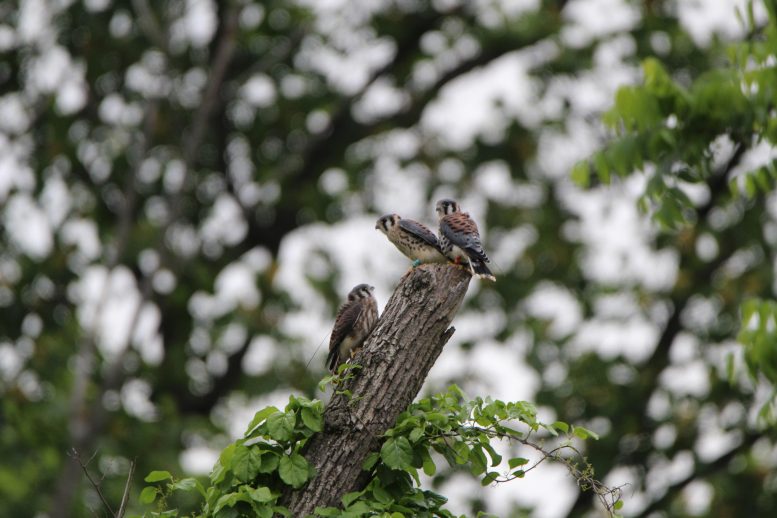
American Kestrels are small, colorful falcons found throughout the western hemisphere, from Southeast Alaska to Argentina. Until now, most studies have concentrated on the nesting season. Breeding adults face significant challenges, especially due to the high energy demands of raising chicks. But not every bird in the population is a breeder. Young, non-breeding kestrels often experience high mortality shortly after leaving the nest, and birds of all ages encounter a wide range of threats during migration and on their wintering grounds. These less-studied life stages are critical for fully understanding the species’ overall decline.
Tracking kestrels year-round with new tech
To explore these overlooked stages, lead author Dr. Mercy Melo and a team of scientists from Hawk Mountain Sanctuary, The Smithsonian, and the University of Massachusetts-Amherst fitted 202 American Kestrels with lightweight radio transmitters that tracked their movements for six months. Between 2021 and 2023, they tagged 146 fledglings from the Northeastern U.S. and 56 adults from Pennsylvania and Florida.
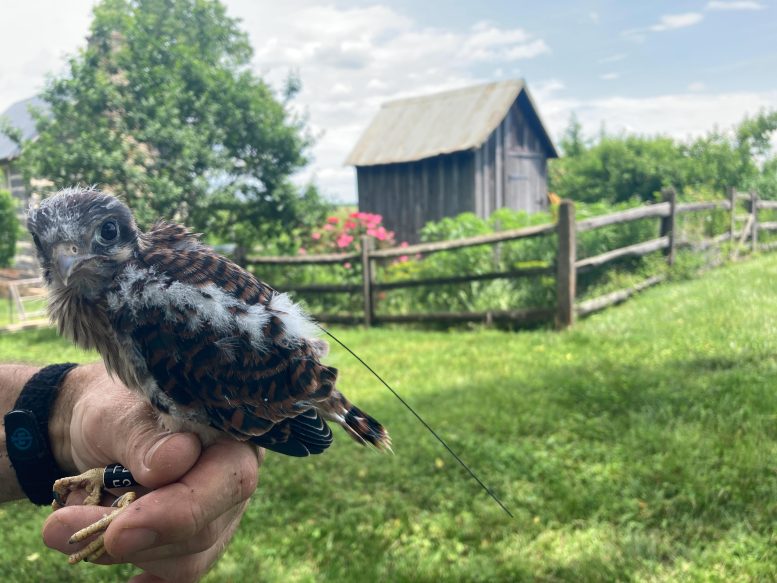
Of their tagged birds, overwintering adults demonstrated a lower survival rate in Pennsylvania than in Florida, and most confirmed adult deaths across sites were human-caused. Mechanisms of these mortalities included vehicle collisions and entrapment in buildings.
Fledgling survival exceeds expectations
The most surprising finding was that during the first weeks outside of the nest, juvenile survival was much higher than expected across sites. With any bird species, juveniles are anticipated to have lower survival rates due to lack of experience in foraging and evading risks.
“Our study documented very high survival rates for juveniles across the eastern states, with some sites even boasting one hundred percent survival,” says Melo. Although these young birds could not be tracked once they left the nesting area, and therefore their fates following migration and overwintering are unknown, the confirmation of their success during that first stage of initial independence fills an important knowledge gap.
When wildlife species falter, the reasons can be overwhelmingly complex. Studies like this focus research efforts towards probable realms of discovery and fuel a necessary process of elimination — if fledgling survival is high at these study sites, then the next step is to ask new questions about adults.
“Understanding the factors influencing the American Kestrel population decline will help kestrels but will also improve our understanding of other declining species,” says Melo. She points to grassland songbirds as one such group. “We hope this article entices researchers to adopt collaborative approaches across geographical regions.” Though they are pint-sized, kestrels are top predators and therefore pack an ecological punch. Their absence would be felt across the Americas, especially within open habitats where fewer and fewer species are maintaining a foothold.
Reference: “Juvenile and Adult Survival Estimates of American Kestrels Throughout the Full Annual Cycle in Eastern North America” by Mercy Melo, Joseph M. Kolowski, Rebecca A. McCabe, John A. Smallwood, Allison Cornell, David King and Jean-François Therrien, 14 March 2025, Journal of Raptor Research.
DOI: 10.3356/jrr2414
Never miss a breakthrough: Join the SciTechDaily newsletter.
Follow us on Google and Google News.