

Physicists are closer than ever to answering fundamental questions about the origins of the universe by learning more about its tiniest particles.
Scientists are intensifying research into neutrinos, mysterious particles that pass through matter almost unhindered. Key goals include studying how neutrinos change types and searching for previously unknown varieties, which could transform current understanding of physics.
The Mystery of the Sterile Neutrino
University of Cincinnati Professor Alexandre Sousa has detailed the next decade of global research into neutrinos, incredibly tiny particles that travel at nearly the speed of light and pass through virtually everything by the trillions each second.
Neutrinos are the most abundant particles with mass in the universe, making them a key focus for scientists seeking to understand fundamental aspects of physics.
These particles are produced in various processes, including nuclear fusion in the sun, radioactive decay in nuclear reactors and Earth’s crust, and experiments in particle accelerators. As they move, neutrinos can switch between three types, or “flavors,” in a process that continues to intrigue researchers.
But unexpected experimental results made physicists suspect there might be another neutrino flavor, called a sterile neutrino because it appears immune to three of the four known “forces.”
“Theoretically, it interacts with gravity, but it has no interaction with the others, weak nuclear force, strong nuclear force, or electromagnetic force,” Sousa said.

Neutrino Research Collaborations and Goals
In a new white paper published in the Journal of Physics G, Sousa and his co-authors discuss experimental anomalies in neutrino exploration that have baffled researchers.
The paper was a product of the Particle Physics Community Planning Exercise, referred to as “Snowmass 2021/2022.“
Representatives in high energy physics gather every 10 years to collaborate on the future of particle physics in the United States and its international partners.
Their collective vision is articulated and confronted with science funding scenarios by the Particle Physics Project Prioritization Panel, or P5, whose final report issued in 2023 made direct recommendations to Congress about funding the projects.
Sousa was a corresponding author of the paper that discusses some of the most promising projects coming in the next decade.
UC Professor Jure Zupan, UC Associate Professor Adam Aurisano, UC visiting scholar Tarak Thakore, UC postdoctoral fellow Michael Wallbank and UC physics students Herilala Razafinime and Miriama Rajaoalisoa also contributed to the paper.
“Neutrinos seem to hold the key to answering these very deep questions.”
Physicist Alexandre Sousa, UC College of Arts and Sciences

Future Prospects in Neutrino Physics
“Progress in neutrino physics is expected on several fronts,” Zupan said.
Besides the search for sterile neutrinos, Zupan said physicists are looking at several experimental anomalies — disagreements between data and theory — that they will be able to test in the near future with the upcoming experiments.
Learning more about neutrinos could upend centuries of our understanding about physics. Several neutrino projects have been recognized with the world’s top scientific award, the Nobel Prize, most recently with the discovery of neutrino oscillations receiving the 2015 Nobel Prize in Physics. Countries such as the United States are investing billions of dollars into these projects because of the immense scientific interest in pursuing these questions.
One question is why the universe has more matter than antimatter if the Big Bang created both in equal measure. Neutrino research could provide the answer, Sousa said.
“It might not make a difference in your daily life, but we’re trying to understand why we’re here,” Sousa said. “Neutrinos seem to hold the key to answering these very deep questions.”
DUNE: The Cutting-Edge of Neutrino Experiments
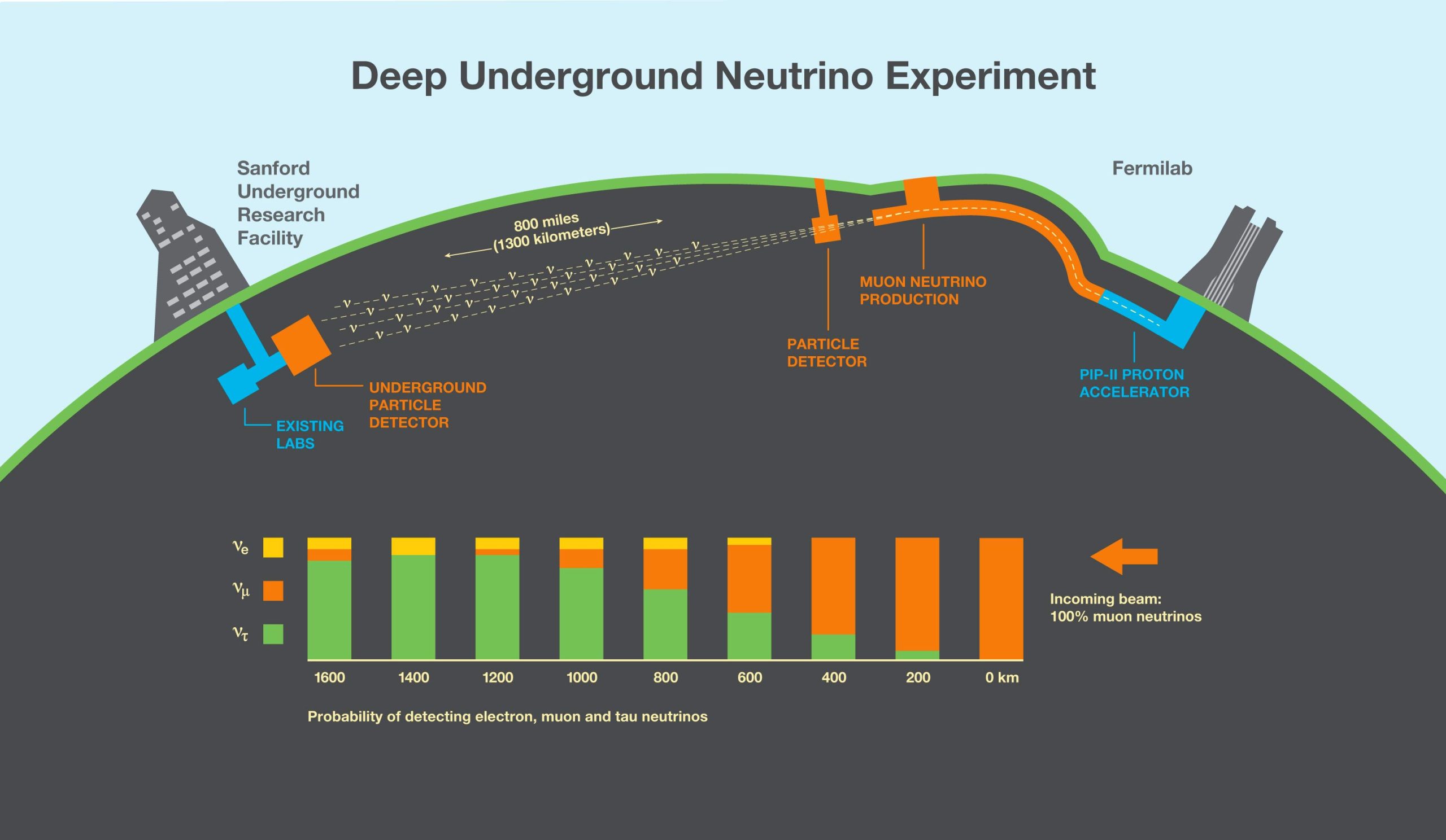
Sousa is part of one of the most ambitious neutrino projects called DUNE or the Deep Underground Neutrino Experiment conducted by the Fermi National Accelerator Laboratory. Crews have excavated the former Homestake gold mine 5,000 feet underground to install neutrino detectors. It takes about 10 minutes just for the elevator to reach the detector caverns, Sousa said.
Researchers put detectors deep underground to shield them from cosmic rays and background radiation. This makes it easier to isolate the particles generated in experiments.
The experiment is set to begin in 2029 with two of its detector modules measuring neutrinos from the atmosphere. But starting in 2031, researchers at Fermilab will shoot a high-energy beam of neutrinos 800 miles through the Earth to the waiting detector in South Dakota and a much closer one in Illinois. The project is a collaboration of more than 1,400 international engineers, physicists, and other scientists.
“With these two detector modules and the most powerful neutrino beam ever we can do a lot of science,” Sousa said. “DUNE coming online will be extremely exciting. It will be the best neutrino experiment ever.”

Conclusion and Future Directions
The paper was an ambitious undertaking, featuring more than 170 contributors from 118 universities or institutes and 14 editors, including Sousa.
“It was a very good example of collaboration with a diverse group of scientists. It’s not always easy, but it’s a pleasure when it comes together,” he said.
Meanwhile, Sousa and UC’s Aurisano are also involved in another Fermilab neutrino experiment called NOvA that examines how and why neutrinos change flavor and back. In June, his research group reported on their latest findings, providing the most precise measurements of neutrino mass to date.
Another major project called Hyper-Kamiokande, or Hyper-K, is a neutrino observatory and experiment under construction in Japan. Operations there could begin as early as 2027 as it, too, looks for evidence of sterile neutrinos, among other research questions.
“That should hold very interesting results, especially when you put them together with DUNE. So the two experiments combined will advance our knowledge immensely,” Sousa said. “We should have some answers during the 2030s.”
UC’s Zupan said these multibillion-dollar projects hold promise for answering core questions about matter and antimatter and the origins of the universe.
“So far we know of only one such parameter in particle physics that has a nonzero value, and has to do with the properties of quarks,” Zupan said. Whether or not something similar also is present for the neutrinos is an interesting open question.”
Sousa said scientists around the world are working on many other neutrino experiments that could provide answers or generate new questions.
And then?
“Then I’ll be thinking about retirement,” Sousa joked.
Reference: “White paper on light sterile neutrino searches and related phenomenology” by M A Acero, C A Argüelles, M Hostert, D Kalra, G Karagiorgi, K J Kelly, B R Littlejohn, P Machado, W Pettus, M Toups, M Ross-Lonergan, A Sousa, P T Surukuchi, Y Y Y Wong, W Abdallah, A M Abdullahi, R Akutsu, L Alvarez-Ruso, D S M Alves, A Aurisano, A B Balantekin, J M Berryman, T Bertólez-Martínez, J Brunner, M Blennow, S Bolognesi, M Borusinski, T Y Chen, D Cianci, G Collin, J M Conrad, B Crow, P B Denton, M Duvall, E Fernández-Martinez, C S Fong, N Foppiani, D V Forero, M Friend, A García-Soto, C Giganti, C Giunti, R Gandhi, M Ghosh, J Hardin, K M Heeger, M Ishitsuka, A Izmaylov, B J P Jones, J R Jordan, N W Kamp, T Katori, S B Kim, L W Koerner, M Lamoureux, T Lasserre, K G Leach, J Learned, Y F Li, J M Link, W C Louis, K Mahn, P D Meyers, J Maricic, D Markoff, T Maruyama, S Mertens, H Minakata, I Mocioiu, M Mooney, M H Moulai, H Nunokawa, J P Ochoa-Ricoux, Y M Oh, T Ohlsson, H Päs, D Pershey, R G H Robertson, S Rosauro-Alcaraz, C Rott, S Roy, J Salvado, M Scott, S H Seo, M H Shaevitz, M Smiley, J Spitz, J Stachurska, M Tammaro, T Thakore, C A Ternes, A Thompson, S Tseng, B Vogelaar, T Weiss, R A Wendell, R J Wilson, T Wright, Z Xin, B S Yang, J Yoo, J Zennamo, J Zettlemoyer, J D Zornoza, J Zupan, S Ahmad, E Arrieta-Diaz, V S Basto-Gonzalez, N S Bowden, B C Cañas, D Caratelli, C V Chang, C Chen, T Classen, M Convery, G S Davies, S R Dennis, Z Djurcic, R Dorrill, Y Du, J J Evans, U Fahrendholz, J A Formaggio, B T Foust, H Frandini Gatti, D Garcia-Gamez, S Gariazzo, J Gehrlein, C Grant, R A Gomes, A B Hansell, F Halzen, S Ho, J Hoefken Zink, R S Jones, P Kunkle, J-Y Li, S C Li, X Luo, Yu Malyshkin, C J Martoff, D Massaro, A Mastbaum, R Mohanta, H P Mumm, M Nebot-Guinot, R Neilson, K Ni, J Nieves, G D Orebi Gann, V Pandey, S Pascoli, G Paz, A A Petrov, X Qian, M Rajaoalisoa, S H Razafinime, C Roca, G Ron, B Roskovec, E Saul-Sala, L Saldaña, D W Schmitz, K Scholberg, B Shakya, P L Slocum, E L Snider, H Th J Steiger, A F Steklain, M R Stock, F Sutanto, V Takhistov, R Tayloe, Y-D Tsai, Y-T Tsai, D Venegas-Vargas, M Wallbank, E Wang, P Weatherly, S Westerdale, E Worcester, W Wu, G Yang and B Zamorano, 29 October 2024, Journal of Physics G: Nuclear and Particle Physics.
DOI: 10.1088/1361-6471/ad307f
Never miss a breakthrough: Join the SciTechDaily newsletter.
Follow us on Google and Google News.
9 Comments
Neutrinos are the most abundant particles with mass in the universe, making them a key focus for scientists seeking to understand fundamental aspects of physics.
GOOD.
Ask the physicist:
If neutrinos is the most abundant particle (or matter) with mass, why do you need to look around for it?
Please continue to engage your imagination. Neutrinos, God particles, or Devil particles are prize worthy, they represent the spirit and hope of today’s physics.
However, while imagination is a beautiful and essential aspect of human creativity, it often does not align with scientific principles. Has today’s physics long been accustomed to treating deer as horses?
Nonetheless, we encourage you to proceed, as the Physical Review publications have always valued imagination thinking. Your contributions may lead to significant recognition. Congratulations will be in order if that happens.
For example:
A paper called “Question of Parity Conservation in Weak Interactions”. Which published by Physical Review (PR) in October 1956. In which the question of parity conservation in β decays and in hyperon and meson decays is examined. Possible experiments are suggested which might test parity conservation in these interactions.
However, there are not clear evidence to support the inference and the possible experiments.
Here’s why,
1. If we don’t understand how θ & τ was formed, there will be no clear evidence to infer parity violation of them in weak interaction.
2. There is no clear evidence to suggest that two sets of cobalt-60 can be transformed into symmetry by rotating in opposite directions. Similarly, the motion of two hydrogen atoms – electrons around the nucleus – may not necessarily be symmetrical at the same time, even via reverse rotation.
— –Extracted from https://scitechdaily.com/microscope-spacecrafts-most-precise-test-of-key-component-of-the-theory-of-general-relativity/#comment-811427.
All things follow certain laws, which can be revealed through observation and research ( such as topological structures ). Today, so-called academic publications (such as PRL, Nature, Science, etc.) obstinately believe that two sets of cobalt 60 rotating in opposite directions can become two mirror images of each other. This is a public humiliation to the normal intelligence of the public. They conducted extensive pseudo scientific research based on CP violations, published countless pseudo scientific papers, and received various awards. The so-called scientific evaluation system constructed based on these so-called academic publications opened the dirtiest, ugliest, and most evil era in the history of modern science.
You asked, “If neutrinos is [sic] the most abundant particle (or matter) with mass, why do you need to look around for it?”
The article states:
“Researchers put detectors deep underground to shield them from cosmic rays and background radiation. This makes it easier to isolate the particles generated in experiments.
The experiment is set to begin in 2029 with two of its detector modules measuring neutrinos from the atmosphere. But starting in 2031, researchers at Fermilab will shoot a high-energy beam of neutrinos 800 miles through the Earth to the waiting detector in South Dakota and a much closer one in Illinois.”
Please continue to engage your imagination, as the Physical Review publications have always valued imagination thinking.
CP violation, God particles, Devil particles and Neutrinos are prize worthy, they represent the spirit and hope of today’s physics.
Interestingly, in a linked article in this very magazine it is stated that sterile neutrinos don’t exist at all. Yet here they’re being touted as the “key to all the secrets”.
So, which is it, SciTechDaily?
Such a lovely piece. Thank you all!!
For the physicist…. I’m just a Maintenance man with questions so please have mercy on me. I recently read about lung tissue taken from a dead human that grew cilia moved and repurposed itself to continue survival. Are neutrinos doing the same? If all matter as we know it is just neatly arranged protons, neutrons, and electrons, could neutrinos be acting intelligently and changing their “flavor” to fill in the gaps and help build essential elements? If our universe is still expanding and we can’t account for the antimatter, could it be the external force holding, and shaping our universe? Any answers from a real scientist will be greatly appreciated!! Thank you!
Head, what does your easy money scheme have to do with the fundamental particles that make up the known universe? Inquiring minds want to know.
Just SPAM, it’s appearing on quite a few pages.
Lol at the title of this article. Newsflash, scientists will never figure it out. They have no idea even where to look.
Why antimatter is missing: no one really knows. Scientists have many plausible ideas, but those are hard to test with real evidence.
Antimatter holding universe in: unlikely. When matter and antimatter meet, they both vanish and produce light energy as a result. This has been observed in labs. So, matter – antimatter boundary (if the two ever touch) would have been ablaze with spectacular explosions of light energy, and eventually ordinary matter would have vanished.
Changes in the neutrino, if such a thing is happening: different from changes in living things. Changes in living things is due to natural selection. Example: gray moths do better than lighter moths in grayish surroundings of industrial cities, because they (gray moths) can hide better from predators. Their progenies are gray, and so the trend continues. Notice how the change is over several generations, not to the same organism. There’s also no intelligence involved. The movement to predominance of gray moths is not intentional.
Cilia in lungs: property of lung tissue itself. It is quite useful to us. But again, no intentionality or intelligence involved – just the mechanical process of natural selection at work.