
Scientists at CERN have made a groundbreaking discovery that deepens our understanding of why the Universe is made of matter and not antimatter.
By analyzing an enormous trove of data from the LHC, researchers observed a subtle but significant asymmetry in the behavior of a particle called the beauty-lambda baryon and its antimatter twin. This marks the first confirmed case of CP violation in baryons – particles that include protons and neutrons – offering new insights into one of the biggest unsolved mysteries in physics. The discovery hints that there may be forces or particles beyond what the Standard Model can currently explain.
New Milestone in Matter-Antimatter Research
Earlier this month, at the Rencontres de Moriond conference in La Thuile, Italy, scientists from the LHCb collaboration at CERN announced a major advance in our understanding of the subtle, but crucial, differences between matter and antimatter.
By analyzing large datasets from the Large Hadron Collider (LHC), the international team found strong evidence that baryons, particles like protons and neutrons, which make up atomic nuclei, experience a kind of mirror-breaking behavior in the laws of nature. This asymmetry, known as CP violation, means matter and antimatter don’t behave exactly the same. The discovery sheds new light on why the particles that make up matter follow the patterns described by the Standard Model of particle physics, and why matter appears to have won out over antimatter in the early universe.
According to physics, the Big Bang should have produced matter and antimatter in equal amounts. Yet, antimatter almost entirely vanished while matter formed everything we see today. This imbalance suggests a subtle difference in how matter and antimatter behave—an asymmetry known as CP violation. Understanding how and why this asymmetry arose could explain one of the most fundamental questions in science: why the Universe contains anything at all, instead of being an empty void.
From Mesons to Baryons: The Evolution of CP Violation Studies
CP violation was first observed in the 1960s in mesons, particles made of a quark and an antiquark, and has been closely studied in both collider and fixed-target experiments ever since. Physicists have long suspected that baryons, made of three quarks, would also show signs of CP violation. Until now, however, only small hints had been seen in this class of particles.
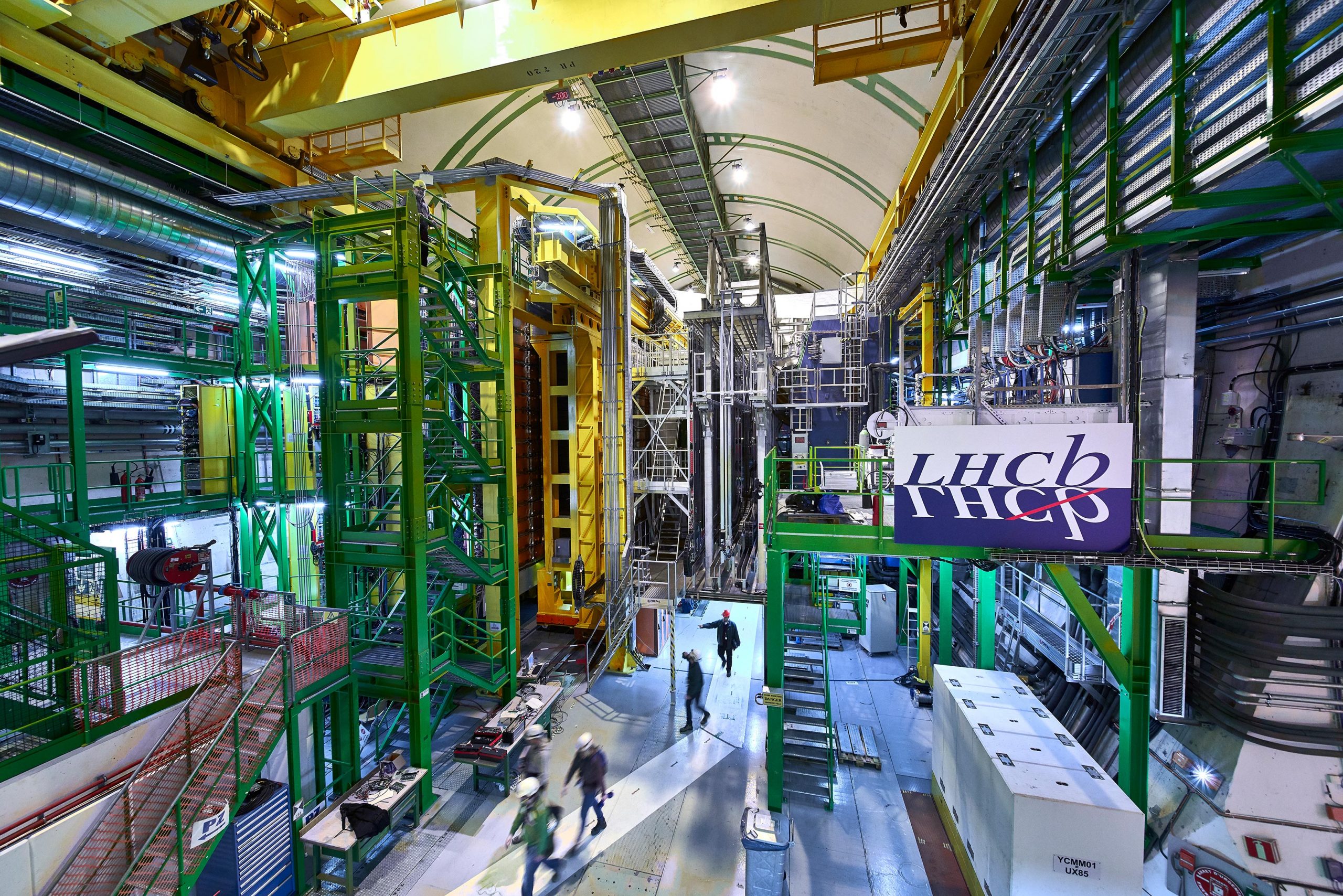
“The reason why it took longer to observe CP violation in baryons than in mesons is down to the size of the effect and the available data,” explains LHCb spokesperson Vincenzo Vagnoni. “We needed a machine like the LHC capable of producing a large enough number of beauty baryons and their antimatter counterparts, and we needed an experiment at that machine capable of pinpointing their decay products. It took over 80 000 baryon decays for us to see matter-antimatter asymmetry with this class of particles for the first time.”
How CP Violation Breaks Symmetry
Particles are known to have identical mass and opposite charges with respect to their antimatter partners. However, when particles transform or decay into other particles, for example as occurs when an atomic nucleus undergoes radioactive decay, CP violation causes a crack in this mirror-like symmetry. The effect can manifest itself in a difference between the rates at which particles and their antimatter counterparts decay into lighter particles, which physicists can log using highly sophisticated detectors and data analysis techniques.
The LHCb collaboration observed CP violation in a heavier, short-lived cousin of protons and neutrons called the beauty-lambda baryon Λb, which is composed of an up quark, a down quark, and a beauty quark. First, they sifted through data collected by the LHCb detector during the first and second runs of the LHC (which lasted from 2009 to 2013 and from 2015 to 2018, respectively) in search of the decay of the Λb particle into a proton, a kaon and a pair of oppositely charged pions, as well as the corresponding decay of its antimatter counterpart, the anti-Λb. They then counted the numbers of the observed decays of each and took the difference between the two.
Quantifying the Asymmetry: Significant Deviation from Zero
The analysis showed that the difference between the numbers of Λb and anti-Λb decays, divided by the sum of the two, differs by 2.45% from zero with an uncertainty of about 0.47%. Statistically speaking, the result differs from zero by 5.2 standard deviations, which is above the threshold required to claim an observation of the existence of CP violation in this baryon decay.
While it has long been expected that CP violation exists among baryons, the complex predictions of the Standard Model of particle physics are not yet precise enough to enable a thorough comparison between theory and the LHCb measurement.
Perplexingly, the amount of CP violation predicted by the Standard Model is many orders of magnitude too small to account for the matter-antimatter asymmetry observed in the Universe. This suggests the existence of new sources of CP violation beyond those predicted by the Standard Model, the search for which is an important part of the LHC physics program and will continue at future colliders that may succeed it.
Toward New Physics Beyond the Standard Model
“The more systems in which we observe CP violations and the more precise the measurements are, the more opportunities we have to test the Standard Model and to look for physics beyond it,” says Vagnoni. “The first-ever observation of CP violation in a baryon decay paves the way for further theoretical and experimental investigations of the nature of CP violation, potentially offering new constraints for physics beyond the Standard Model.”
A Major Step Forward for the LHC
“I congratulate the LHCb collaboration on this exciting result. It again underlines the scientific potential of the LHC and its experiments, offering a new tool with which to explore the matter–antimatter asymmetry in the Universe,” says CERN Director for Research and Computing, Joachim Mnich.
Never miss a breakthrough: Join the SciTechDaily newsletter.
Follow us on Google and Google News.
7 Comments
All this stuff is mind-blowing.
I wish I could understand all of it.
All things in their fundamental nature are not namable or explicable. They cannot be adquately expressed in any form or language. ” Absolute ” knowledge involving an understanding of the totaly of life. Being well aware of the essential interrelationship of the universe, realize that to explain something means, ultimately, to show how it is connected to everything else.
By analyzing an enormous trove of data from the LHC, researchers observed a subtle but significant asymmetry in the behavior of a particle called the beauty-lambda baryon and its antimatter twin. This marks the first confirmed case of CP violation in baryons – particles that include protons and neutrons – offering new insights into one of the biggest unsolved mysteries in physics.
GOOD….
According to mathematical theory, matter and antimatter exhibit precise symmetry through the simultaneous transformation of parity conservation, charge conjugation, and time reversal. Any so-called scientific research that ignores time and studies the symmetry between matter and antimatter is absurd.
In quantum theory, researchers observe asymmetry in their studies because of their observational behavior which is also one of the reasons lead to matter and antimatter change from symmetry to asymmetry. It is absolutely unacceptable to infer this phenomenon as the CP violation between matter and antimatter.
Ask the researchers:
1. How do you achieve simultaneous observation of matter and antimatter in your research?
2. How do you determine whether the two objects you observe are still matter and antimatter when you observe them?
3. How do you understand the principle of uncertainty?
The rampant spread of pseudoscience is truly shocking and infuriating!
CP violation has misled physics for almost a century and continues to do so. This is one of the dirtiest and ugliest behavior of some so-called peer-reviewed publications.
Some so-called peer-reviewed publications deviate from the fundamental principles of mathematics, geometry, and topology, exhibit moral decay, act recklessly, mislead scientific research, and hinder technological progress and development.
If the universe was made of antimatter, then we would call antimatter “matter” – and we would call matter “antimatter”. And we would be asking the exact same stupid question.
What I’d like to know is why isn’t the universe made of ice cream. Can CERN answer that one?
It was, but it went past it’s sell-by date.