

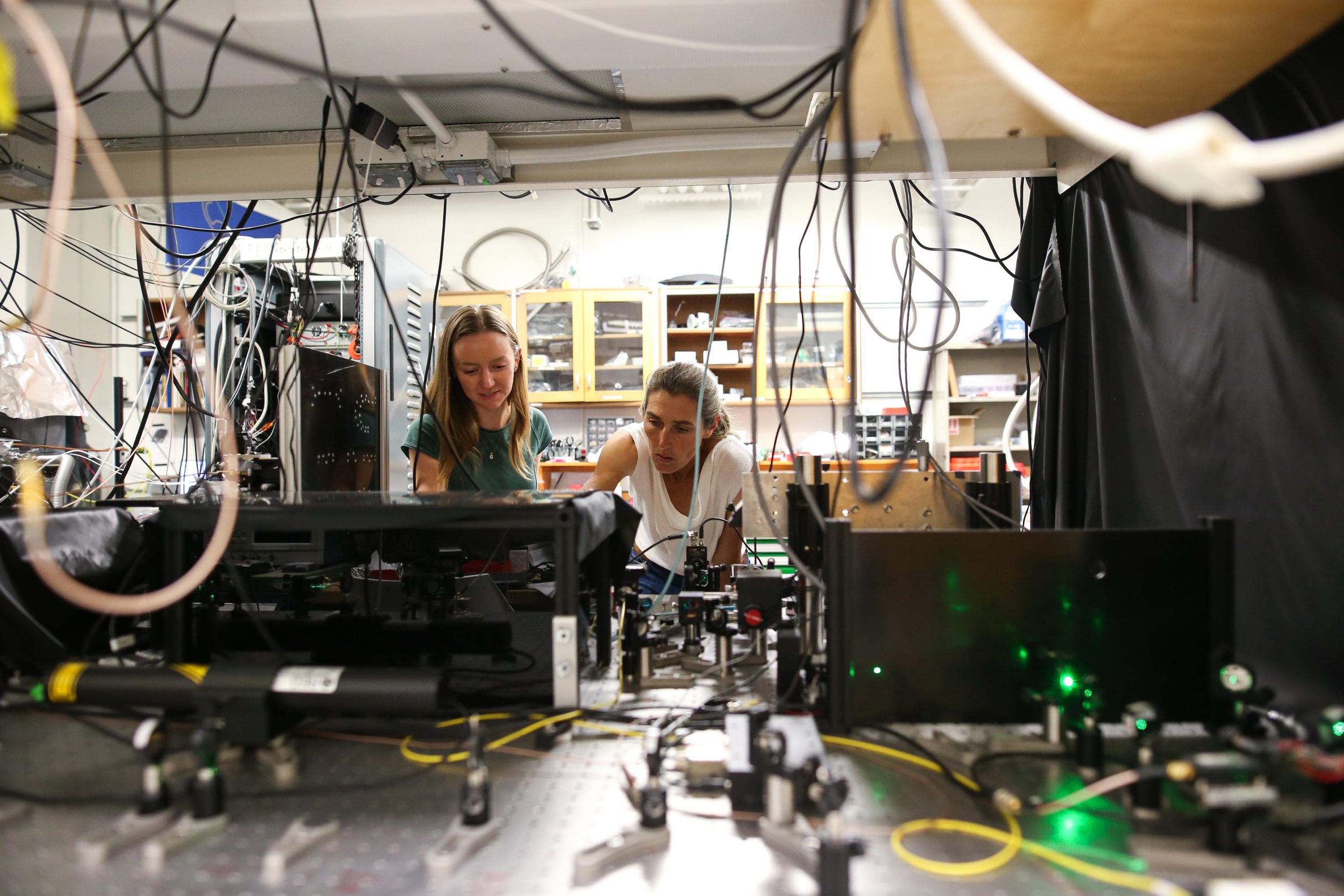
In Ania Jayich’s laboratory, recent PhD graduate Lillian Hughes is pushing the boundaries of quantum science by creating two-dimensional arrays of entangled spin qubits in diamond.
The journey toward practical quantum technology begins with grasping the basic principles that define quantum behavior and discovering how to apply them in real materials. At UC Santa Barbara, physicist Ania Jayich, Bruker Endowed Chair in Science and Engineering, Elings Chair in Quantum Science, and co-director of the National Science Foundation Quantum Foundry, leads a lab that uses lab-grown diamond as its platform of choice.
Bringing together materials science and quantum physics, Jayich’s team investigates how tiny, intentionally created flaws in diamond (known as spin qubits) can function as precise tools for quantum sensing. Among the lab’s leading contributors, recent Ph.D. graduate Lillian Hughes, who is set to begin postdoctoral research at the California Institute of Technology, has made a major stride in this work.
In three recent studies co-authored with Jayich—one published in PRX in March and the second and third in Nature in October—Hughes demonstrated for the first time how large, two-dimensional networks of these defects can be organized and entangled within diamond. This achievement establishes a path toward achieving a metrological quantum advantage in solid materials, representing a crucial milestone in the development of future quantum technologies.

Well-designed defects
“We can create a configuration of nitrogen-vacancy (NV) center spins in the diamonds with control over their density and dimensionality, such that they are densely packed and depth-confined into a 2D layer,” Hughes said. “And because we can design how the defects are oriented, we can engineer them to exhibit non-zero dipolar interactions.” This accomplishment was the subject of the PRX paper, titled “A strongly interacting, two-dimensional, dipolar spin ensemble in (111)-oriented diamond.”
The NV center in diamond consists of a nitrogen atom, which substitutes for a carbon atom, and an adjacent, missing carbon atom (the vacancy).“The NV center defect has a few properties, one of which is a degree of freedom called a spin — a fundamentally quantum mechanical concept. In the case of the NV center, the spin is very long lived,” Jayich said. “These long-lived spin states make NV centers useful for quantum sensing. The spin couples to the magnetic field that we’re trying to sense.”
The ability to use the spin degree of freedom as a sensor has been around since the 1970s’ invention of magnetic resonance imaging (MRI), explained Jayich, noting that the MRI works by manipulating the alignment and energy states of protons and then detecting the signals they emit as they return to equilibrium, creating an image of some part of the internal body.
“Previous quantum-sensing experiments conducted in a solid-state system have all made use of single spins or non-interacting spin ensembles,” Jayich said. “What’s new here is that, because Lillian was able to grow and engineer these very strongly interacting dense spin ensembles, we can actually leverage the collective behavior, which provides an extra quantum advantage, allowing us to use the phenomena of quantum entanglement to get improved signal-to-noise ratios, providing greater sensitivity and making a better measurement possible.”
The type of entanglement-assisted sensing that Hughes’s work enables has been demonstrated previously in gas-phase atomic systems. “Ideally, for many target applications, your sensor should be easy to integrate and to bring close to the system under study,” Jayich said. “It is much easier to do that with a solid-state material, like diamond, than gas-phase atomic sensors on which, for instance, GPS is based. Furthermore, atomic sensors require significant auxiliary hardware to confine and control, such as vacuum chambers and numerous lasers, making it hard to bring an atomic sensor within nanometer-scale proximity to a protein, for instance, prohibiting high-spatial-resolution imaging.”
In the Jayich lab, the focus is on using diamond sensors to look at material-based electronic effects and phenomena. But, analogous to placing a solid-state sensor into a cell, Jayich said, “You can place material targets into nanometer-scale proximity of a diamond surface, thus bringing them really close to sub-surface NV centers. So it’s very easy to integrate this type of diamond quantum sensor with a variety of interesting target systems. That’s a big reason why this platform is so exciting.”
“A solid-state magnetic sensor of this kind could be very useful for probing, for instance, biological systems,” Jayich said. “Nuclear magnetic resonance [NMR] is based on detecting very small magnetic fields coming from the constituent atoms in, for example, biological systems. Such an approach is also useful if you want to understand new materials, whether electronic materials, superconducting materials, or magnetic materials that could be useful for a variety of applications.”
Squeezing
Any measurement contains associated noise that limits the measurement to some degree of precision. One fundamental source of noise, called quantum projection noise, limits measurement precision to a value called the standard quantum limit, a value that is classically reduced by the square root of N, the number of quantum sensors used in the measurement. If, however, one can engineer a particular form of interactions between the sensors, it becomes possible to break the standard quantum limit for N unentangled sensors. One clever way to do that is to “squeeze” the amplitude of the noise by inducing correlations among the particles and producing a spin-squeezed state.
“It’s as if you were trying to measure something with a meter stick having gradations a centimeter apart; those centimeter-spaced gradations are effectively the amplitude of the noise in your measurement. You would not use such a meter stick to measure the size of an amoeba, which is much smaller than a centimeter,” Jayich said. “By squeezing — silencing the noise — you effectively use quantum mechanical interactions to ‘squish’ that meter stick, effectively creating finer gradations and allowing you to measure smaller things more precisely.”
The second paper describes another type of metrological gain that can be achieved by using the same system, in this case, amplifying the signal strength without increasing the noise level to make a better measurement. In terms of the amoeba example given above, amplifying the signal has the effect of making the amoeba bigger so that the measuring stick with its one-centimeter gradation can now be used to measure it.
In terms of eventual real-world applications, Jayich said, “I don’t think the foreseen technical challenges will prevent demonstrating a quantum advantage in a useful sensing experiment in the near future. It’s mostly about making the signal amplification stronger or increasing the amount of squeezing. One way to do that is to control the position of the spins in the 2Dxy plane, forming a regular array.
“There’s a materials challenge here, in that, because we can’t dictate exactly where the spins will incorporate, they incorporate in somewhat random fashion within a plane,” Jayich added. “That’s something we’re working on now, so that eventually we can have a grid of these spins, each placed a specific distance from each other. That would address an outstanding challenge to realizing practical quantum advantage in sensing.”
References:
“Spin squeezing in an ensemble of nitrogen-vacancy centers in diamond” by Weijie Wu, Emily J. Davis, Lillian B. Hughes, Bingtian Ye, Zilin Wang, Dominik Kufel, Tasuku Ono, Simon A. Meynell, Maxwell Block, Che Liu, Haopu Yang, Ania C. Bleszynski Jayich and Norman Y. Yao, 18 March 2025, arXiv.
DOI: 10.48550/arXiv.2503.14585
“Signal amplification in a solid-state sensor through asymmetric many-body echo” by Haoyang Gao, Leigh S. Martin, Lillian B. Hughes, Nathaniel T. Leitao, Piotr Put, Hengyun Zhou, Nazli U. Koyluoglu, Simon A. Meynell, Ania C. Bleszynski Jayich, Hongkun Park and Mikhail D. Lukin, 1 October 2025, Nature.
DOI: 10.1038/s41586-025-09452-7
“Spin squeezing in an ensemble of nitrogen–vacancy centres in diamond” by Weijie Wu, Emily J. Davis, Lillian B. Hughes, Bingtian Ye, Zilin Wang, Dominik Kufel, Tasuku Ono, Simon A. Meynell, Maxwell Block, Che Liu, Haopu Yang, Ania C. Bleszynski Jayich and Norman Y. Yao, 1 October 2025, Nature.
DOI: 10.1038/s41586-025-09524-8
Never miss a breakthrough: Join the SciTechDaily newsletter.
Follow us on Google and Google News.
2 Comments
There’s a materials challenge here, in that, because we can’t dictate exactly where the spins will incorporate, they incorporate in somewhat random fashion within a plane. That is an outstanding challenge to realizing practical quantum advantage in sensing.
VERY GOOD!
Please ask researchers to think deeply:
1. Which is easier to understand, topological spin or quantum spin?
2. Which is more specific and accurate, topological materials or quantum materials?
3. How do you understand the quantum phase?
When we pursue the ultimate truth of all things, the space in which our bodies and all things exist may itself be the final and deepest puzzle we need to explore. This is not only the pursuit of physics, but also the most magnificent exploration of the origin of the universe by human reason.
Based on the Topological Vortex Theory (TVT), space is an uniformly incompressible physical entity. Space-time vortices are the products of topological phase transitions of the tipping points in space, are the point defects in spacetime. Point defects do not only impact the thermodynamic properties, but are also central to kinetic processes. They create all things and shape the world through spin and self-organization.
In today’s physics, some so-called peer-reviewed journals—including Physical Review Letters, Nature, Science, and others—stubbornly insist on and promote the following:
1. Even though θ and τ particles exhibit differences in experiments, physics can claim they are the same particle. This is science.
2. Even though topological vortices and antivortices have identical structures and opposite rotational directions, physics can define their structures and directions as entirely different. This is science.
3. Even though two sets of cobalt-60 rotate in opposite directions and experiments reveal asymmetry, physics can still define them as mirror images of each other. This is science.
4. Even though vortex structures are ubiquitous—from cosmic accretion disks to particle spins—physics must insist that vortex structures do not exist and require verification. Only the particles that like God, Demonic, or Angelic are the most fundamental structures of the universe. This is science.
5. Even though everything occupies space and maintains its existence in time, physics must still debate and insist on whether space exists and whether time is a figment of the human mind. This is science.
6. Even though space, with its non-stick, incompressible, and isotropic characteristics, provides a solid foundation for the development of physics, physics must still insist that the ideal fluid properties of space do not exist. This is science.
and go on.
Is this the counterintuitive science they widely promote?
Under the topological vortex architecture, it is highly challenging for even two hydrogen atoms or two quarks to be perfectly symmetrical, let alone counter-rotating two sets of cobalt-60. Contemporary physics and so-called peer-reviewed publications (including Physical Review Letters, Science, Nature, etc.) stubbornly believe that two sets of counter rotating cobalt-60 are two mirror images of each other, constructing a more shocking pseudoscientific theoretical framework in the history of science than the “geocentric model”. This pseudo scientific framework and system have seriously hindered scientific progress and social development.
For nearly a century, physics has been manipulated by this pseudo scientific theoretical system and the interest groups behind it, wasting a lot of manpower, funds, and time. A large amount of pseudo scientific research has been conducted, and countless pseudo scientific papers have been published, causing serious negative impacts on scientific and social progress, as well as humanistic development.
Complexity does not necessarily mean that there is no logical and architectural framework to follow. Mathematics is the language and tool that reveals the motion of spacetime, rather than the motion itself. Although the physical form of spacetime vortices is extremely simple, their interaction patterns are highly complex, and we must develop more and richer mathematical languages to describe and understand them.
The development of the Topological Vortex Theory (TVT) reflects a progression from concrete physical phenomena to abstract mathematical modeling and, ultimately, to interdisciplinary unification.
——Excerpted from https://t.pineal.cn/blogs/4569/An-Overview-of-the-Development-of-Topological-Vortex-Theory-TVT.