
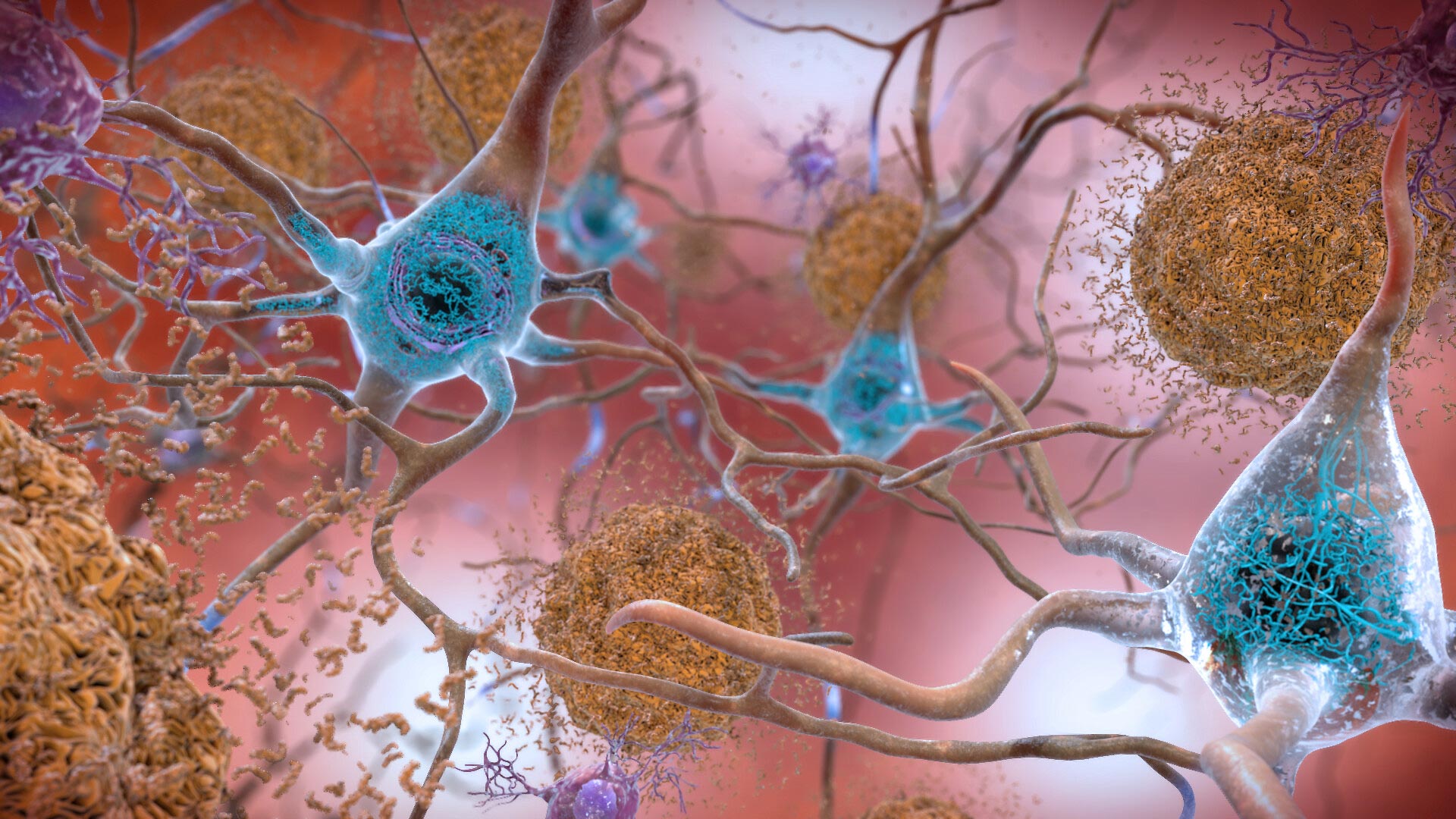
New research from Emory University suggests that proteins accumulating around amyloid-beta deposits, rather than the deposits themselves, may play a crucial role in the progression of Alzheimer’s disease, offering new directions for treatment.
Recent research from Emory University is prompting a reevaluation of current theories on the origins of Alzheimer’s disease, a major cause of dementia globally. Led by scientists at the Goizueta Brain Health Institute, the team has uncovered compelling evidence that suggests a different mechanism may be responsible for Alzheimer’s.
In a paper published in the journal Cell Reports Medicine, Todd E. Golde and Yona Levites explain how the amyloid beta deposits long known to build up in the brains of Alzheimer’s patients serve as a kind of scaffold for the accumulation of other proteins. Because many of these proteins have known signaling functions, their presence around the amyloid accumulations, known as plaques, could be the culprit causing brain cell damage rather than the amyloid itself.
In the brains of those who suffer from Alzheimer’s, amyloids accumulate and build up into sticky plaque that disrupts brain functions and causes cognitive decline. The big unknown has been exactly how that occurs. According to the most widely adopted hypothesis, the amyloid beta buildup disrupts cell-to-cell communication and activates immune cells in a process that eventually destroys brain cells.
Insights from Advanced Research Techniques
In the study, Golde, director of the Emory Center for Neurodegenerative Disease in the Goizueta Institute, Levites, associate professor in Emory University’s School of Medicine, and their colleagues presented a new hypothesis, emphasizing a different role for amyloid beta, a simple protein that forms in all brains but normally dissolves out by natural processes.
In experiments, they used cutting-edge analytical technologies to identify and measure the level of more than 8,000 proteins in human brains with Alzheimer’s, as well as similar proteins in mice. Focusing on proteins whose levels increased most dramatically, they identified more than 20 proteins that co-accumulate with amyloid beta in both the human brains with Alzheimer’s and the mice. As the research continues, they suspect they’ll find more.
Potential for New Therapeutic Approaches
“Once we identified these new proteins, we wanted to know whether they were merely markers of Alzheimer’s or if they could actually alter the disease’s deadly pathology,” says Golde. “To answer that, we focused on two proteins, midkine and pleiotrophin. Our research showed they accelerated amyloid aggregation both in the test tube and in mice. In other words, these additional proteins may play an important role in the process that leads to brain damage rather than the amyloid itself. This suggests they might be a basis for new therapies for this terrible brain affliction that’s been frustratingly resistant to treatment over the years.”
While the basics of Alzheimer’s have been understood for more than a century, the search for a cure has been slow, often marked by repeated cycles of initially promising treatments that didn’t work in trials, as well as continuing controversy over competing theories to best explain how the disease damages the brain. As the researchers put it, “The initial notion of a purely linear amyloid cascade is now recognized as simplistic. Studies have unveiled the vast complexity of changes occurring over decades in the brains of individuals as Alzheimer’s pathologies emerge.”
Significantly, multiple kinds of amyloid buildup, besides amyloid beta, have been implicated in more than 30 human disorders affecting tissues and organs throughout the body. Because this new research proposes a novel process by which Alzheimer’s develops, it may allow for fresh approaches to discovering treatment targets for other diseases as well.
Reference: “Integrative proteomics identifies a conserved Aβ amyloid responsome, novel plaque proteins, and pathology modifiers in Alzheimer’s disease” by Yona Levites, Eric B. Dammer, Yong Ran, Wangchen Tsering, Duc Duong, Measho Abreha, Joshna Gadhavi, Kiara Lolo, Jorge Trejo-Lopez, Jennifer Phillips, Andrea Iturbe, Aya Erquizi, Brenda D. Moore, Danny Ryu, Aditya Natu, Kristy Dillon, Jose Torrellas, Corey Moran, Thomas Ladd, Farhana Afroz, Tariful Islam, Jaishree Jagirdar, Cory C. Funk, Max Robinson, Srikant Rangaraju, David R. Borchelt, Nilüfer Ertekin-Taner, Jeffrey W. Kelly, Frank L. Heppner, Erik C.B. Johnson, Karen McFarland, Allan I. Levey, Stefan Prokop, Nicholas T. Seyfried and Todd E. Golde, 9 August 2024, Cell Reports Medicine.
DOI: 10.1016/j.xcrm.2024.101669
This research was supported in part by the National Institutes of Health.
Never miss a breakthrough: Join the SciTechDaily newsletter.
Follow us on Google and Google News.
40 Comments
Exciting research by noted academics.
NIH has already identified Dr Bredesn’s Re-Code program as the only known successful reversal of Alzheimer’s Disease. KetoFLEX-12-3. I have the APOE4 gene & practice ketoFLEX-16-3 and no longer concerned about my original prognosis from Roskamp Institute and am now working on MCI and am confident I will overcome this too. Diet and lifestyle. I am 82 years old and looking forward to many more productive years. Big Pharma is not in favor of cures without drugs.
Dr Bredesen
Could not edit for my earlier comment.
The interesting thing is that it took us several decades, ballpark around 50 years, to accept that The beta-amyloid plaque buildup theory might not be the answer. Less than a decade from the origination of the theory, several scientists questioned the theory and proposed alternatives. What if plaque buildup isn’t the cause but an additional consequence of the cause? Those scientists were shouted down by proud and arrogant scientists who refused to accept even the possibility of being wrong.
While science invariably “just works”, humans, even scientists, aren’t perfect and can’t remain objective. Now we’re only now accepting beta-amyloid plaque might not be THE answer. Thanks to arrogance and pride, we wasted decades of potential research into alternative theories because everyone was focused on a single possibility and told anyone who tried to think outside the box they were wrong and dumb for trying.
Moral: don’t be to proud to admit you might be wrong. Science welcomes all theories until they are thoroughly disproven.
Billions invested so difficult to admit failure. AVXL Waiting for approval in Europe. Small molecule pill form.
It was neither arrogance nor pride, just a promising lead. And no one has been able to rule it out either as we can see with the science presented here, based on the lead.
👏🙌👆 couldn’t be said better!
A young PhD told me tau not amyloid ~10 years ago and for certain, that mice prone to Beta Amyloid accumulation gave the spurious indication. News ?
What can we do you change our diets that might help. Please leave out scientific fluff?
Simply put by a 79 year old who’s father and brother suffer from this frustrating disease.
I left a reply under Heike for Susan Wilson concerning the article about eating Basil for brain health.
As the spouse of a man with Alzheimer’s coming from a family where it is 100%, is it possible bacteria in water could be the culprit? Family members tended to live in an area with a common water source until maybe the past 50 years when families started scattering more
I’ve been caring for my husband for for 7 years now. We have good days and some really squirrelly ones. He’s now in his 80s.
His mother was a lifelong vegetarian. His father ate a normal American diet. Both had Alzheimer’s as did their parents and siblings. My husband is the youngest of four and they ALL developed the disease.
I rule out diet due to the variations and the dedicated vegetarian. But what about well water? No one seems to be paying attention to that possible factor that is in anything I’ve read.
What do you think you have done differently from your Father and Brother that you are free from this disease? Just curious.
Every country outside the US recognizes that what Americans call Alzheimer’s is actually diabetes 3.
No. Alzheimer’s is a global diagnosis.
“However, the concept of type 3 diabetes is controversial, and as of 2021 it was not an officially recognized diagnosis.[5]” [Wikipedia]
No, it has not.
What NIH clearly says is that there is no reversal (cure) but medicines that slow progress and medicines that help with associated problems. “While there is currently no cure for Alzheimer’s, medications are emerging to treat the progression of the disease by targeting its underlying causes. There are also medications that may temporarily improve or stabilize memory and thinking skills in some people and may help manage certain symptoms and behavioral problems.”
A Dr. Dale Bredesen is mentioned once in a 2008 conference minutes where he describes his group as working with a new disease model.
NIH is not a conspiracy theory of “Big Pharma”.
I can find publication descriptions of Bredesen’s “ReCODE” program hosted by NIH, but that doesn’t mean they “identify” the program as a candidate for use. A 2021 paper describes a small, unblinded trial which cannot separate between placebo and effective effects.
I can also find an “Apollo Health” commercial “medical information company” that sells Bredesen’s snake oil.
In any case, I wish you luck with handling your prognosis. Of course my professional ethics (I’m a bioinformatician) prompt me to inform you that you should seek professional medical second opinions on the diagnosis and if confirmed professional medical help.
Dr Bredesen
Could not edit for my earlier comment.
I found another article on scitechdaily.com about the herb Basil
containing a short chain fatty acid (SCFA)
which may help. (The end of the article is easier to understand.) SFCA are also produced by gut bacteria and it was recently found that prebiotics which feed gut bacteria (probiotics) enhance our memory. They are often sold together over the counter.
So, take care of your intestinal bacteria and eat Basil.
Better yet, seek professional advice instead of heeding unhelpful (and potentially dangerous if inefficient, harmful, et cetera), web comments.
Alzheimer’s, as a brain disease, is affected by sleep position, which affects brain circulation. Sleeping with the head of the bed elevated slightly improves circulation in the brain, and can help prevent many brain diseases, including dementia, glaucoma, sleep apnea, migraines, stroke, and more. See my article, Heads Up! The Way you Sleep can be Killing You. https://www.academia.edu/1483361/Heads_Up_The_Way_You_Are_Sleeping_May_Be_Killing_You_
Go check out the work of Cassava Sciences on the role of Filamin A in Alzheimers. They are almost done with their phase 3 drug trials of the best drug candidate for AD that the world has seen. If you want to help them, go invest at the ticker $SAVA. Not financial advice, just spreading the good news.
AVXL is ahead of Cassava. So the best seen is overstatement big time just like the former CEO of Cassava who got canned in June for making inaccurate statements. Not good in biotech
This is spamming a non-peer reviewed vanity press article.
There is no evidence suggesting sleep position affects Alzheimers.
Simufilam drug uses a novel pathway, NOT a plaque remover, to halt progression of AD over 2+ years in 85 mild AD patients.
“Cassava is developing simufilam (previously known as PTI-125 and sumifilam), an oral-tablet drug candidate for the treatment of Alzheimer’s disease; simufilam is in phase III clinical trials as of 2022. In June 2024, the United States Department of Justice charged an advisor to Cassava Sciences, Hoau-Yan Wang, with fraud over research results related to the experimental drug. Less than a month later, the president, chief executive officer and chairman of the board, Remi Barbier, resigned along with Lindsay Burns, his wife,[1] who was a Cassava senior vice president and Wang’s co-author.” [Wikipedia]
We ALL shall soon see what Cassava Sciences can do for Mild to Moderate Alzheimer’s patients. A miracle drug? It’s beginning to appear that it is very possible they have it. The world will know before the end of this year (2024).
You are absolutely correct about Cassava!
I guess the former CEO of Cassava got canned for saying inaccurate statements. Why replace leadership if Cassava is getting approved in 2024? AVXL drug will get approved for Alzheimer before Cassava.
.Why replace leadership if Cassava is getting approved in 2024? AVXL drug will get approved for Alzheimer before Cassava.
My sister had big memory loss in 2010 a lot of stress in her family. By 2015 she no longer knew me went blind in 2021 and passed away at 88, Jan. 2024. Her body went for research and I hope she was some help for our future. I changed my life style after learning that I had a blood disorder, which now is called “Low Platelets” and my normal is 117- 127. I now am 86, take no medication and my last brain scan was ok. With longevity in my family it will be interesting to see if I make it to 100 like most women in our family.
When I first began trying find the answers & help myself, I literally couldn’t get from the beginning of a word to the end of the word without forgetting the 1st part of the word or even what I was attempting to read or why.
I simply new it was vital.
Piece by piece, I worked my way out.
Utilizing all known science regarding our biology.
I’ve now been through well over 10,000 studies and I can tell you with absolute certainty the answers are all available.
Humanity has placed their lives in the hands of folks who support a pharmaceutical industry instead.
We are facing a worldwide deficiency that presents differently based on a myriad of personal factors, and it’s in our food supply as well.
We are not legally allowed to refer to that information as a cure.
“Cures” are synthetic molecules and processes regulated by the FDA.
The future of healthcare isnt just personalized, it requires folks to “Know Thyself.”
That includes your biology.
We were given brains and they are going to have to be utilized if you dont want to suffer.
Pharmaceutics works, the alternatives doesn’t.
*Proposed* alternatives – they aren’t really.
“Inhalational Alzheimers ReCODE protocol and Mold Illness”
https://youtu.be/QGEdHqTqQ5c
https://www.biotoxinjourney.com
See my response to Paul Parr, “ReCODE” looks like snake oil.
“…been through well over 10,000 studies”. That comes out to every single day for a 27+ years.
You claim that you have healed yourself “utilizing all known science regarding our biology.” So what IS this cure? And please don’t tell us we all have to work it out ourselves.
Sounds like gobbledegook You have nothing to say so dazzzle them with BS.
What about Leqembi that has been approved by FDA?
I believe Heavy metals are the root cause of these brain diseases. Specially Mercury
I have tested SO many patients with memory disorders for heavy metals and it is rare indeed to see anyone with any elevated heavy metal.