
Close Menu
    Facebook X (Twitter) Instagram
    SciTechDaily
    • Biology
    • Chemistry
    • Earth
    • Health
    • Physics
    • Science
    • Space
    • Technology
    Facebook X (Twitter) Pinterest YouTube RSS
    SciTechDaily
    Home»Space»The Roller Coaster Tech Keeping NASA’s Astronauts Safe
    Space

    The Roller Coaster Tech Keeping NASA’s Astronauts Safe

    By NASAAugust 24, 2024No Comments7 Mins Read
    Facebook Twitter Pinterest Telegram LinkedIn WhatsApp Email Reddit
    Share
    Facebook Twitter LinkedIn Pinterest Telegram Email Reddit
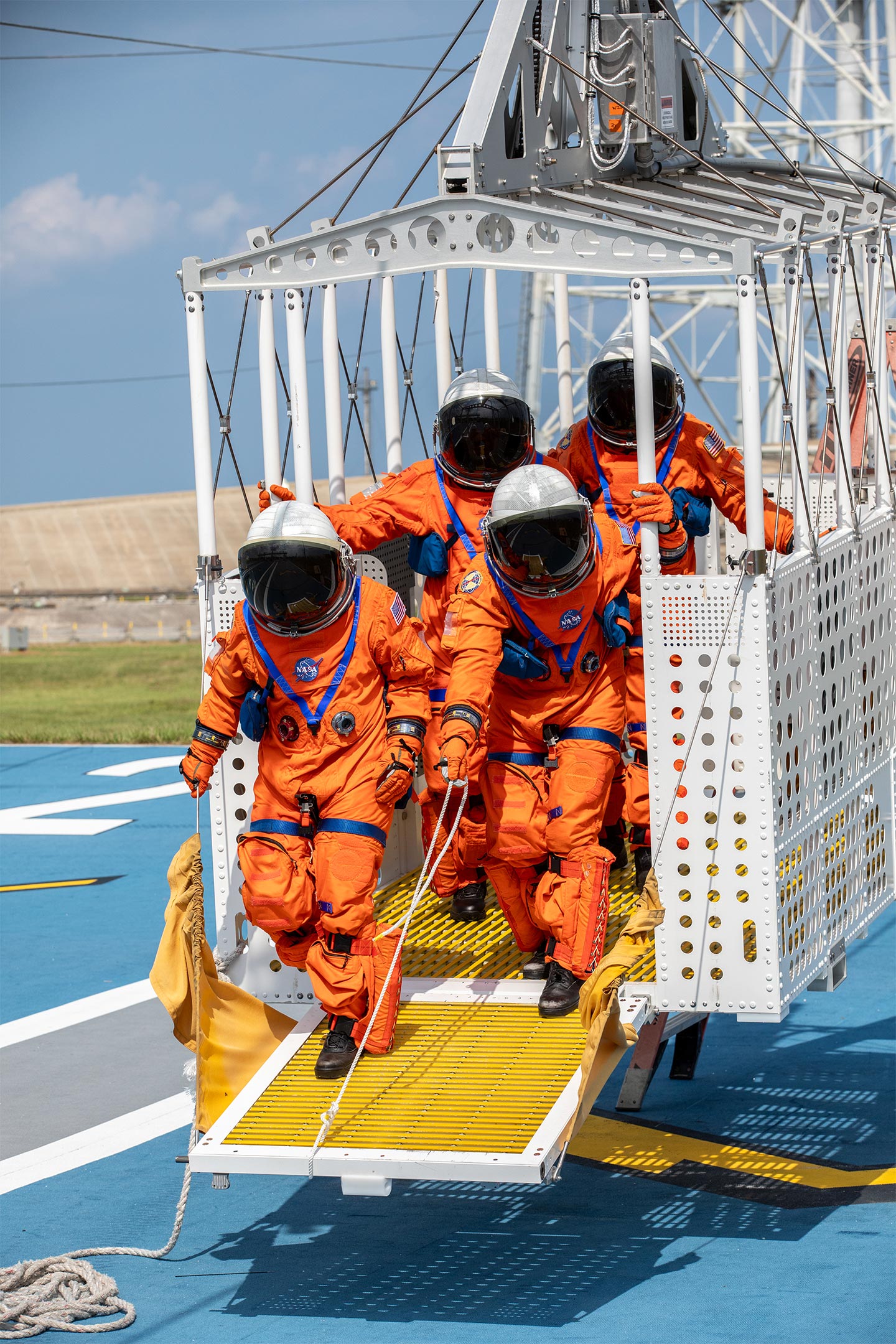
    NASA Artemis II Emergency Escape Practice
    In preparation for NASA’s Artemis II crewed mission, teams at the agency’s Kennedy Space Center in Florida practice getting out of the emergency escape, or egress, basket on August 9, 2024. The baskets, similar to gondolas on ski lifts, are used in the case of a pad abort emergency to enable astronauts and other pad personnel a way to quickly escape from the mobile launcher to the base of the pad where waiting emergency transport vehicles will then drive them away. Credit: NASA/Kim Shiflett

    NASA has teamed up with amusement park engineers to refine a magnetic braking system for Artemis missions, ensuring safe emergency egress. Inspired by roller coaster technology, the system is designed for rare but critical use, with maintenance practices borrowed from amusement parks.

    Recently, teams with NASA’s Exploration Ground Systems (EGS) Program at the agency’s Kennedy Space Center met with engineering teams at a central Florida amusement park to share knowledge on a new braking system NASA is using for its launch pad emergency egress system for Artemis missions.
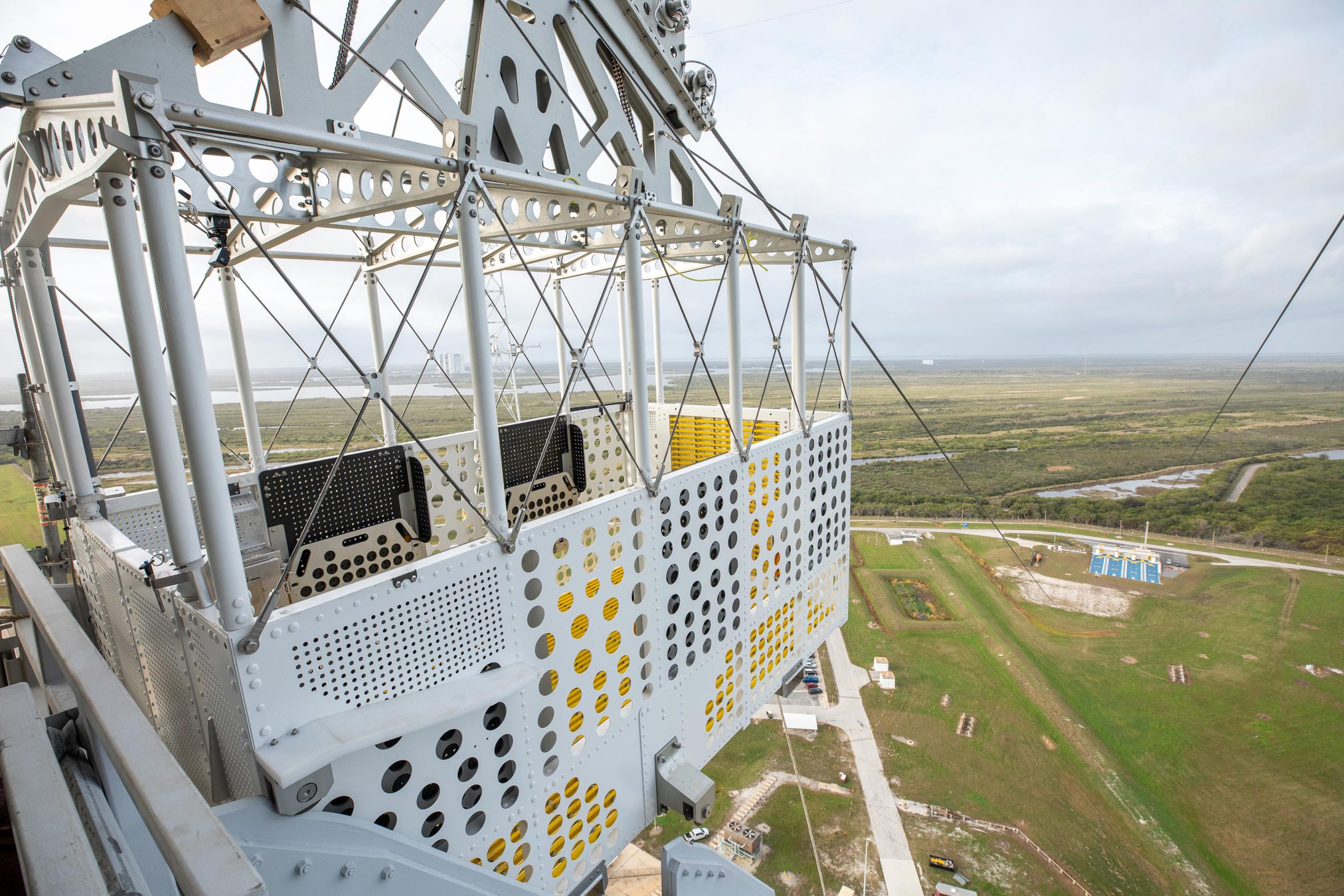
    Emergency Egress Basket Installation
    Teams with NASA’s Exploration Ground Systems Program, in preparation for the agency’s Artemis II crewed mission to the Moon, begin installing the first of four emergency egress baskets on the mobile launcher at Launch Complex 39B at the agency’s Kennedy Space Center in Florida on Wednesday, January 24, 2024. The baskets, similar to gondolas on ski lifts, are used in the case of a pad abort emergency to enable astronauts and other pad personnel a way to quickly escape away from the mobile launcher to the base of the pad and where waiting emergency transport vehicles will then drive them away. Credit: NASA/Isaac Watson

    The Magnetic Braking System for Artemis

    “We have a new magnetic braking system for the Artemis emergency egress system and NASA hasn’t used this technology on the ground infrastructure side before to support launches,” said Jesse Berdis, mobile launcher 1 deputy project manager for EGS. “I realized we have neighbors 50 miles from us in Orlando that are essentially the world experts on magnetic braking systems.”

    For Artemis, teams will use a track cable that connects the mobile launcher to the terminus site near the perimeter of NASA Kennedy’s Launch Pad 39B, where four baskets, similar to gondola lifts, can ride down. This is where the magnetic braking system operates to help control the acceleration of the baskets in multiple weight and environmental conditions. At the pad terminus site, armored emergency response vehicles are stationed to take personnel safely away from the launch pad to a designated safe site at Kennedy.
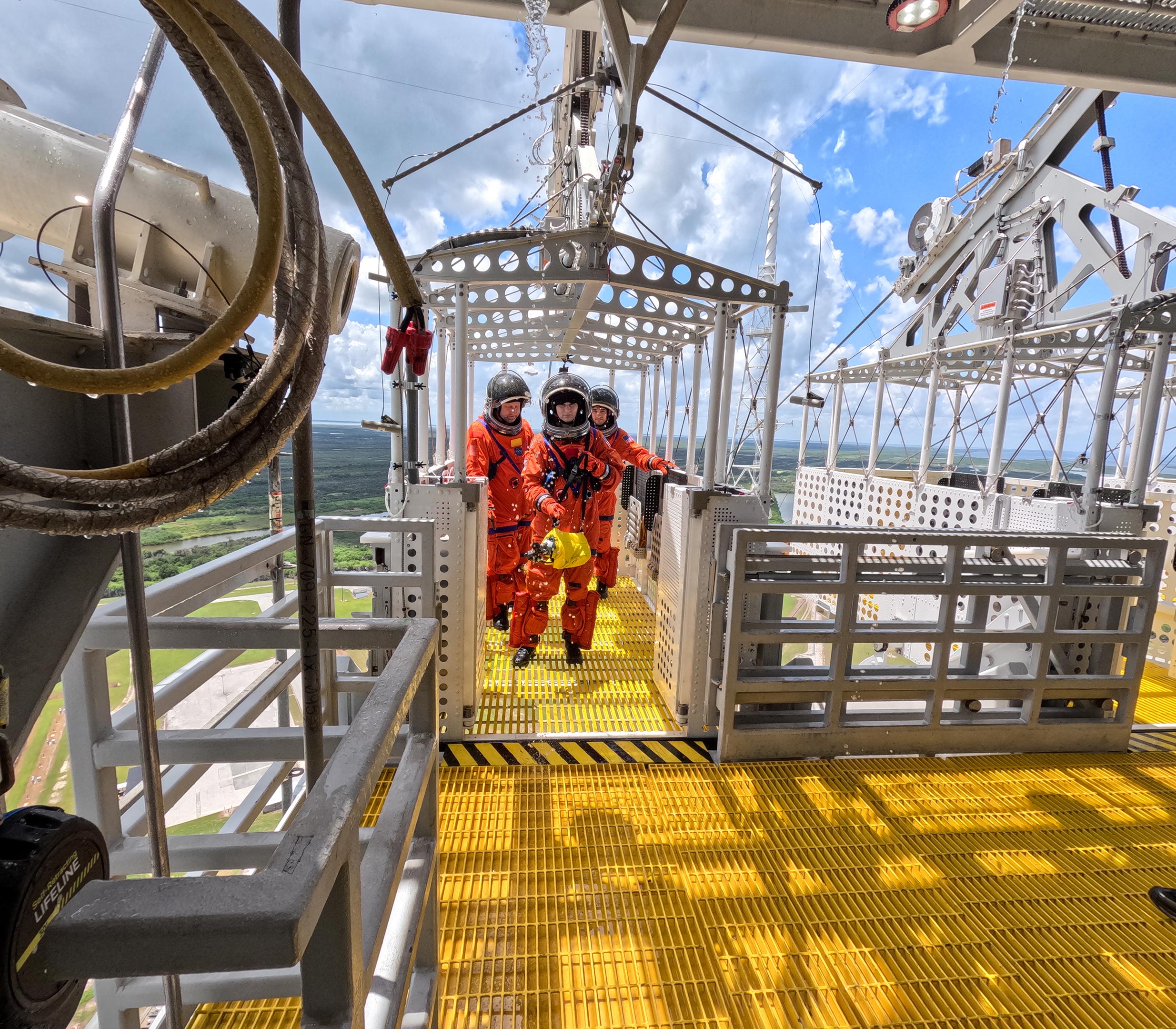
    ISVV-1 Artemis Emergency Egress Demonstration
    Teams at NASA’s Kennedy Space Center in Florida practice the Artemis mission emergency escape or egress procedures during a series of integrated system verification and validation tests at Launch Pad 39B on Sunday, Aug. 11, 2024. Members of the closeout crew, simulated flight crew, pad rescue team, and the Exploration Ground Systems Program practiced the process of getting inside and out of the emergency egress baskets. While the crew and other personnel will ride the emergency egress baskets to the terminus area in a real emergency, no one rode the baskets for this test. Instead, teams tested the baskets during separate occasions by using water tanks filled to different levels to replicate simulate the weight of passengers. Credit: NASA/Kim Shiflett

    Maintenance Insights From Roller Coaster Systems

    Many roller coaster manufacturers employ the use of an “eddy current braking system,” which involves using magnetics to help slow down a vehicle. Though the applications used on the roller coasters differ slightly from what the EGS teams are using for Artemis, the concept is the same, explained Amanda Arrieta, mobile launcher 1 senior element engineer.
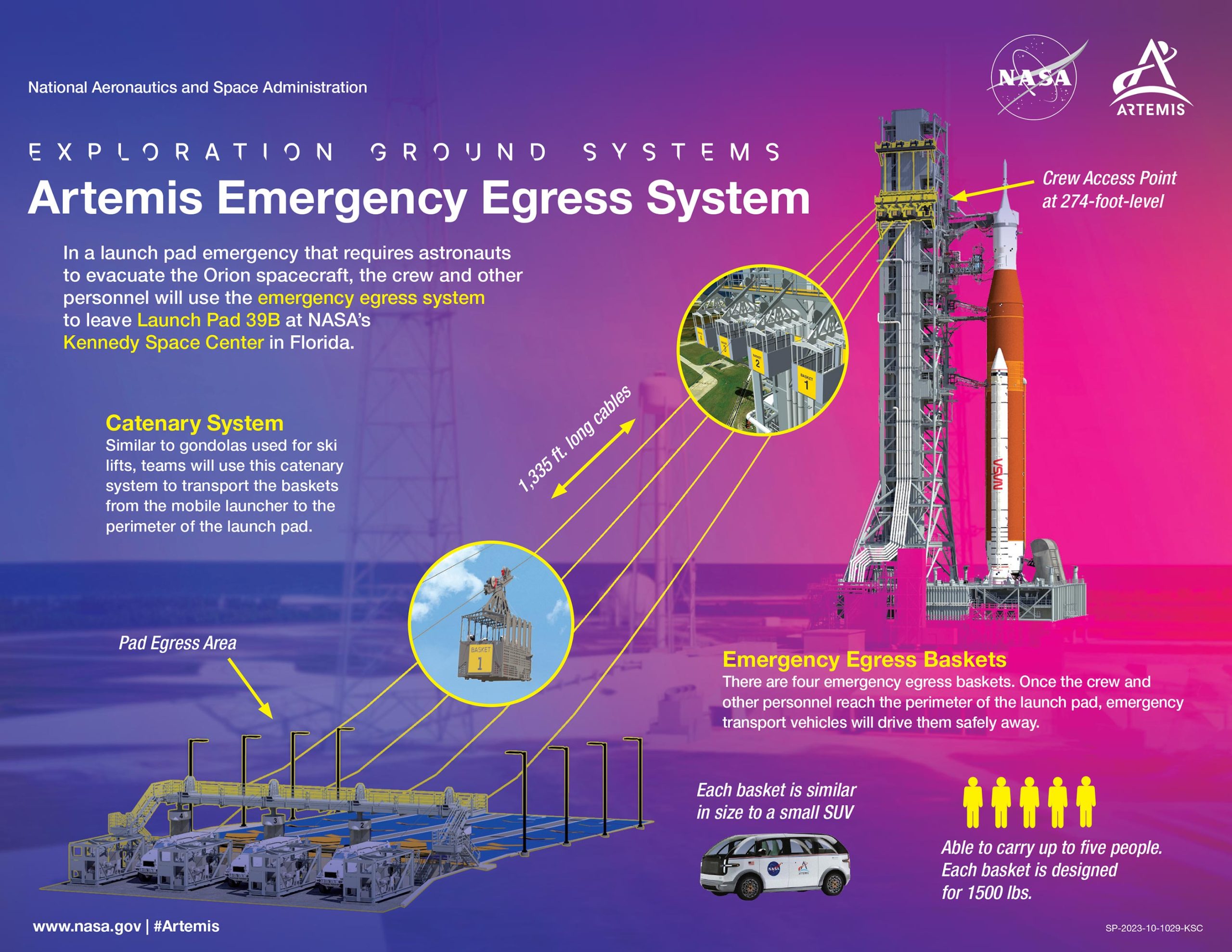
    Artemis Emergency Egress System Infographic
    Infographic shows the route astronauts and personnel would take during an emergency abort situation. Credit: NASA

    However, unlike roller coasters which are typically in use daily for multiple hours on end, the Artemis emergency egress system is there for emergency situations only.

    “We don’t plan to ever run our system unless we’re testing it or performing maintenance,” Berdis said.

    Key Knowledge for Future Artemis Missions

    Regardless of this, teams at Kennedy have ensured the system is able to function for years to come to support future Artemis missions.

    “The maintenance crews [at the amusement park] were awesome because they showed us their nightly, monthly, and yearly inspections on what they were doing,” Berdis said. “That gave our operations teams a really good foundation and baseline knowledge of what to expect when they maintain and operate this system for the Artemis missions.”

    Focus on Safety in Emergency Egress Systems

    Some of the conversations and suggestions teams shared include adding an acceleration sensor in the emergency egress baskets during testing. The sensor will help detect how fast the baskets are going when they ride down.

    The emergency egress system is one of several new additions the EGS team is implementing to prepare for future crewed missions starting with Artemis II, and this system especially emphasizes the importance of safety.

    “We have a mission, and a part of that mission is in case of an emergency, which we don’t expect, is to protect our astronauts and supporting teams at the launch pad,” Berdis said. “We want our teams to be safe and, for any scenario we put them in, especially on the ground infrastructure side, it’s important for us to do our due diligence. That includes talking to other groups that are the experts in their field to ensure we have looked at all possibilities across the board to ensure our mission is a safe one for our teams.”

    Historical Perspective on Emergency Egress

    During the Space Shuttle Program, teams used a similar system for the escape route astronauts and other personnel take in the event of an emergency during a launch countdown. However, instead of using a magnetic braking system for the baskets, teams used a mechanical braking system, which involved using a catch net and drag chain to slow and then halt the baskets sliding down the wire.
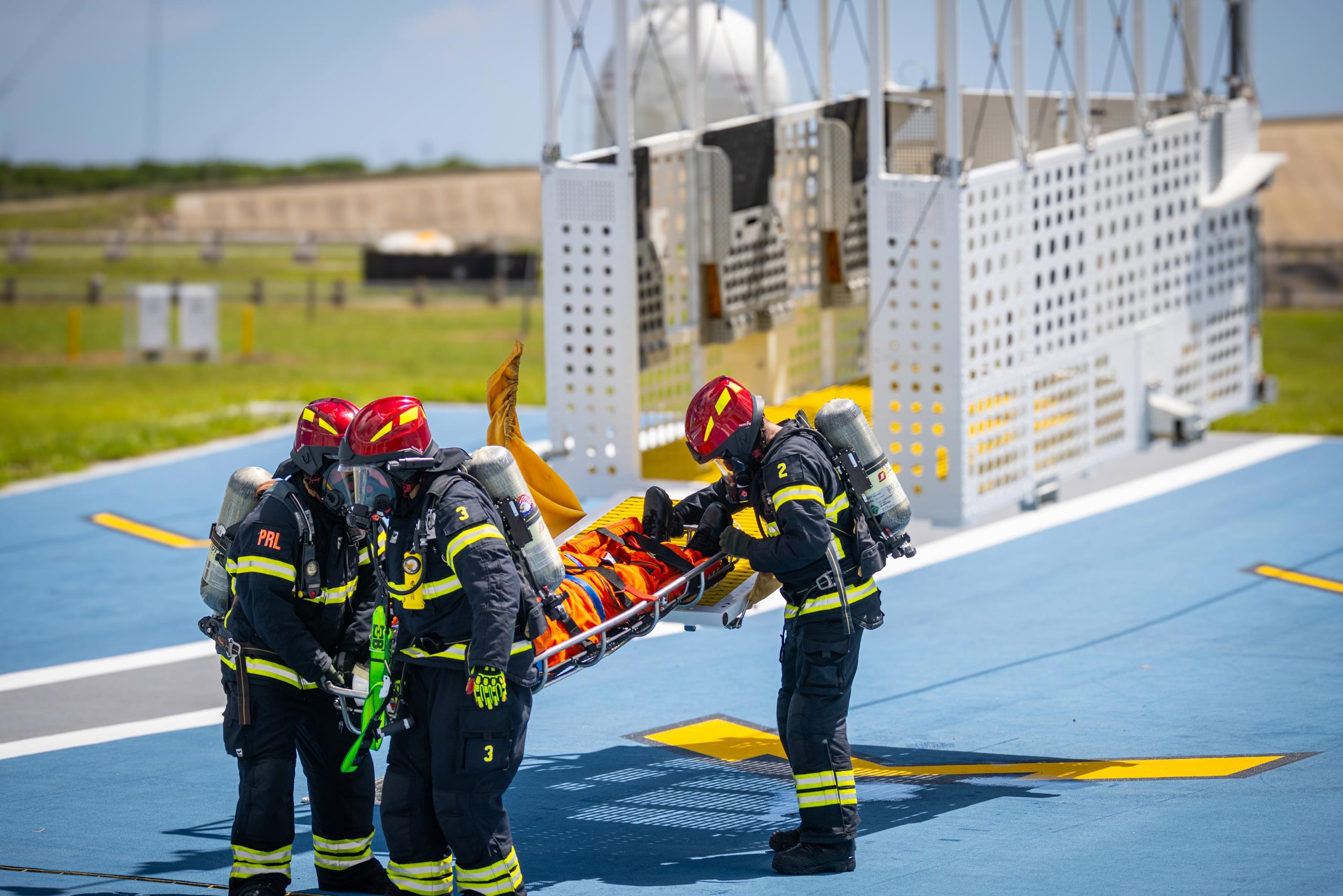
    Artemis Emergency Egress Demonstration
    Teams at NASA’s Kennedy Space Center in Florida practice the Artemis mission emergency escape or egress procedures during a series of integrated system verification and validation tests at Launch Pad 39B on Monday, August 12, 2024. Members of the closeout crew, pad rescue team, and the Exploration Ground Systems Program practiced the process of getting inside and out of the emergency egress baskets. While the crew and other personnel will ride the emergency egress baskets to the terminus area in a real emergency, no one rode the baskets for this test. Instead, teams tested the baskets during separate occasions by using water tanks filled to different levels to replicate simulate the weight of passengers. Credit: NASA/Frank Michaux

    For the agency’s Commercial Crew Program, SpaceX also uses a catch net and drag chain for its slidewire cable at NASA Kennedy’s Launch Complex 39A pad and a deployable chute at Space Launch Complex 40 at Cape Canaveral Space Force Station. Boeing and United Launch Alliance also use a slidewire, but instead of baskets, the team deploys seats, like riding down a zip line, that ride down the slide wires at Space Launch Complex 41 at Cape Canaveral Space Force Station.

    Artemis Campaign: Paving the Way for Future Exploration

    Under NASA’s Artemis campaign, the agency will establish the foundation for long-term scientific exploration at the Moon, land the first woman, first person of color, and its first international partner astronaut on the lunar surface, and prepare for human expeditions to Mars for the benefit of all.

    Never miss a breakthrough: Join the SciTechDaily newsletter.
    Follow us on Google and Google News.

    ARTEMIS Mission Astronaut Kennedy Space Center NASA
    Share. Facebook Twitter Pinterest LinkedIn Email Reddit

    Related Articles

    How NASA Plans to Rescue Artemis Astronauts in Emergencies

    Journey Around the Moon: Artemis II Crew Inspects Orion Spacecraft Ahead of Historic Mission

    Charging Towards the Moon: NASA Receives Zero-Emission Vehicles for Artemis Missions

    NASA’s Lunar Loo Challenge: $35,000 in Prizes for Toilet Design That Works on the Moon

    SpaceX Reaches for Milestone in Spaceflight – A Private Company Launches Astronauts Into Orbit at Low Cost

    Searching With Sasquatch: Recovering NASA’s Orion Spacecraft

    More Than 12,000 Potential Astronauts Apply to Join NASA’s Artemis Generation

    Orion Spacecraft Returns to Kennedy Space Center for Final Preparations Before Artemis I Launch

    Exploration Extravehicular Mobility Unit – Next Generation Spacesuit for Artemis Astronauts

    Leave A Reply Cancel Reply

    • Facebook
    • Twitter
    • Pinterest
    • YouTube

    Don't Miss a Discovery

    Subscribe for the Latest in Science & Tech!

    Trending News

    Millions Take These IBS Drugs, But a New Study Finds Serious Risks

    Scientists Unlock Hidden Secrets of 2,300-Year-Old Mummies Using Cutting-Edge CT Scanner

    Bread Might Be Making You Gain Weight Even Without Eating More Calories

    Scientists Discover Massive Magma Reservoir Beneath Tuscany

    Europe’s Most Active Volcano Just Got Stranger – Here’s Why Scientists Are Rethinking It

    Alzheimer’s Symptoms May Start Outside the Brain, Study Finds

    Millions Take This Popular Supplement – Scientists Discover a Concerning Link to Heart Failure

    The Universe Is Expanding Too Fast and Scientists Can’t Explain Why

    Follow SciTechDaily
    • Facebook
    • Twitter
    • YouTube
    • Pinterest
    • Newsletter
    • RSS
    SciTech News
    • Biology News
    • Chemistry News
    • Earth News
    • Health News
    • Physics News
    • Science News
    • Space News
    • Technology News
    Recent Posts
    • Simple Blood Test May Predict Alzheimer’s Years Before Brain Scans Show Signs
    • Scientists Say Adding This Unusual Seafood to Your Diet Could Reverse Signs of Aging
    • U.S. Waste Holds $5.7 Billion Worth of Crop Nutrients
    • Scientists Say a Hidden Structure May Exist Inside Earth’s Core
    • Doctors Surprised by the Power of a Simple Drug Against Colon Cancer
    Copyright © 1998 - 2026 SciTechDaily. All Rights Reserved.
    • Science News
    • About
    • Contact
    • Editorial Board
    • Privacy Policy
    • Terms of Use

    Type above and press Enter to search. Press Esc to cancel.