
Close Menu
    Facebook X (Twitter) Instagram
    SciTechDaily
    • Biology
    • Chemistry
    • Earth
    • Health
    • Physics
    • Science
    • Space
    • Technology
    Facebook X (Twitter) Pinterest YouTube RSS
    SciTechDaily
    Home»Space»The Search for Life on Other Worlds Continues
    Space

    The Search for Life on Other Worlds Continues

    By Harvard-Smithsonian Center for Astrophysics / Jareen Imam, CNNJune 22, 2016No Comments3 Mins Read
    Facebook Twitter Pinterest Telegram LinkedIn WhatsApp Email Reddit
    Share
    Facebook Twitter LinkedIn Pinterest Telegram Email Reddit
    Astronmers Seek Life on Other Worlds
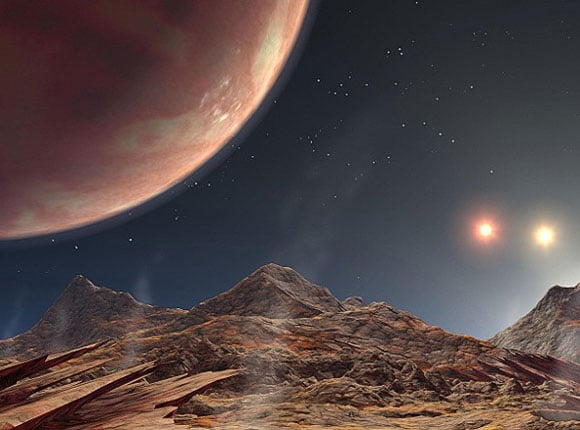
    This Jupiter-like planet in the HD-188753 system, 149 light-years from Earth, has three suns. The main star is similar in mass to our own Sun. The system has been compared to Luke Skywalker’s home planet Tatooine in “Star Wars.”

    The search for Earth-like planets has intensified as astronomers continue to look for potential life on other worlds.

    Now one of the leading exoplanet hunters is being recognized for his contributions to science.

    On Tuesday, Harvard University astronomy professor David Charbonneau was honored as one of three winners of the 2016 Blavatnik National Awards for Young Scientists for his methods of discovering exoplanets.

    The honor comes after NASA’s Kepler spacecraft, a mission Charbonneau has participated in, discovered more than 1,284 planets in May, doubling the number of planets previously confirmed by the probe.

    The importance of exoplanets

    The recent exoplanet findings reveal that worlds smaller than Earth are pretty common in our galaxy, contrary to what scientists originally believed.

    Since the discovery of thousands of exoplanets — worlds that orbit a star outside of our solar system — Charbonneau explained that we need to start looking for chemical signatures that may indicate life in these “Goldilocks” exoplanets located in habitable zones.

    “By studying alien worlds, we may find the first direct evidence of life beyond Earth, a sign that our living planet is, yet again, one among many,” Charbonneau told CNN.

    The main characteristics Charbonneau and other astronomers are looking for in these exoplanets are liquid water and atmospheric oxygen, ingredients that are essential for supporting life.

    Since traveling to these exoplanets is impossible — it’s beyond our current technology — how do we figure out which worlds have oxygen or liquid water?

    The answer is telescopes, Charbonneau said.

    Two large telescopes could help us narrow our search for life soon, Charbonneau said. The Giant Magellan Telescope in Chile will be one of the biggest telescopes to focus its sight on analyzing exoplanets, and NASA is launching the James Webb space telescope in 2018, which is essentially like a giant version of the Hubble telescope. It will be able to look at exoplanets clearly without the interference of our atmosphere.

    Is something really out there?

    Scientists at the SETI Institute have been listening for signals from space for decades.

    And obviously, we haven’t made contact with aliens yet. Some astronomers argue that if there is intelligent life somewhere in the universe, it will take at least 1,500 years to make contact because of the vastness of space.

    But that isn’t discouraging Charbonneau.

    The life he’s searching for isn’t the science fiction kind we’ve seen in movies and literature.

    “We are talking about life that changes the planet,” he said. “If you were look at the solar system, you would see something is really different about the third planet. You would see a lot of oxygen. And you know oxygen is very reactive, and that would be surprising. We’re looking for those chemical signatures.”

    Charbonneau said he’s open-minded about the possibility that life exists somewhere in space.

    “I am ready for the possibility. But I’m also open to the possibility that life is a rare occurrence,” he said. “That doesn’t mean there isn’t life in the universe, but maybe not in a nearby star.”

    Never miss a breakthrough: Join the SciTechDaily newsletter.
    Follow us on Google and Google News.

    Astrobiology Harvard-Smithsonian Center for Astrophysics Planets
    Share. Facebook Twitter Pinterest LinkedIn Email Reddit

    Related Articles

    Bold Plan to Determine If Planet Nine Is a Primordial Black Hole

    Stanford: Promising Signs for Past Martian Life at Jezero Crater, Mars

    Astronomers Detect Pre-Biotic Molecule Glycolonitrile in Space

    Astronomers Discover Complex Organic Molecules in Infant Star System

    Tidal Heating Suggests Less Habitable Planets

    Earth in Motion and the Galaxies Around it

    Rogue Planets Captured by Stars

    Runaway Planets at 30 Million MPH

    Scientists Rank Most Livable Alien Worlds

    Leave A Reply Cancel Reply

    • Facebook
    • Twitter
    • Pinterest
    • YouTube

    Don't Miss a Discovery

    Subscribe for the Latest in Science & Tech!

    Trending News

    Researchers Have Found a Dietary Compound That Increases Longevity

    Scientists Baffled by Bizarre “Living Fossil” From 275 Million Years Ago

    Your IQ at 23 Could Predict Your Wealth at 27, Study Finds

    320 Light-Years Away, a Planet Confirms a Fundamental Cosmic Assumption

    The Crown Jewel of Dentistry? Breakthrough Tech Could Transform Tooth Repair

    Python Blood Could Hold the Secret to Weight Loss Without Side Effects

    Naturally Occurring Bacteria Completely Eradicate Tumors in Mice With a Single Dose

    New “Nanozyme Hypothesis” Could Rewrite the Story of Life’s Origins

    Follow SciTechDaily
    • Facebook
    • Twitter
    • YouTube
    • Pinterest
    • Newsletter
    • RSS
    SciTech News
    • Biology News
    • Chemistry News
    • Earth News
    • Health News
    • Physics News
    • Science News
    • Space News
    • Technology News
    Recent Posts
    • These New Molecules Could Change How We Treat Lupus and Arthritis
    • Saunas May Do More Than Raise Body Temperature – They Activate Your Immune System
    • Exercise in a Pill? Metformin Shows Surprising Effects in Cancer Patients
    • Saturn’s Magnetic Shield Isn’t What Scientists Expected
    • Hidden Oceans of Magma Could Be Protecting Alien Life
    Copyright © 1998 - 2026 SciTechDaily. All Rights Reserved.
    • Science News
    • About
    • Contact
    • Editorial Board
    • Privacy Policy
    • Terms of Use

    Type above and press Enter to search. Press Esc to cancel.