
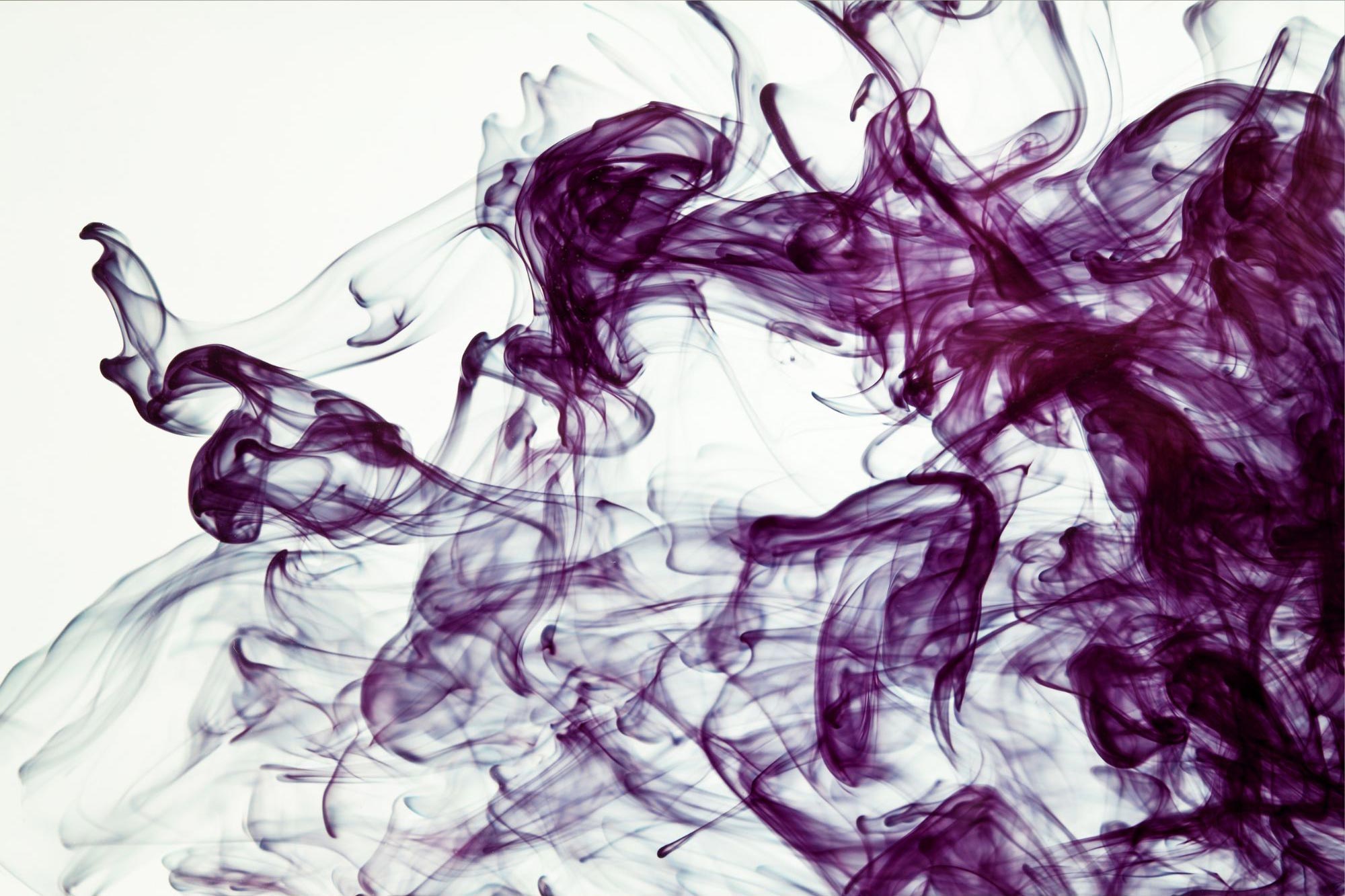
Researchers discovered that ink in a soap-and-milk experiment follows the path of least resistance due to surface tension interactions.
What began as a demonstration of the complexity of fluid systems evolved into an art piece in the American Physical Society’s Gallery of Fluid Motion and ultimately became a puzzle that researchers have now solved.
Their new study is published in the journal Physical Review Letters.
“We came up with this experiment because we were having a hard time convincing people of certain effects happening for the problem of drag reduction,” said assistant professor Paolo Luzzatto-Fegiz, an assistant professor of mechanical engineering, whose research specialties include modeling flow and investigating drag — as in, the resistive forces that act on solid objects traveling through fluids.
“We had a hypothesis for how this worked,” Luzzatto-Fegiz said. “And this paper actually works out a mathematical model of that phenomenon.”
Ink That “Chooses” Its Path
Of particular interest to the research group, which included UCSB engineering professor Frederic Gibou and collaborators at Princeton University, University of Manchester in the UK, and the Université de Rennes in France, was the ink’s rather uncanny ability to “choose” and move in the correct direction, when intuition would perhaps suggest that the ink would diffuse in a more general manner.
Surface tension — the cohesion that causes molecules on the surface of a fluid to pull together and act like a membrane, resisting exterior forces — plays a large role in this ink-on-milk experiment. The soap — a surfactant, or a substance that reduces surface tension — reduces local tension around the ink, creating motion. However, according to the researchers’ calculations, it’s the presence of surfactants already in the milk that help the ink/soap mixture solve the maze.
How Surfactants Solve the Maze
“The added surfactant and the preexisting one end up working together,” Luzzatto-Fegiz said. The endogenous surfactant already in the milk creates a landscape of varying resistances that push back on the ink and soap as the mixture moves through the maze, he explained. Dead ends and small spaces push back more strongly, according to the researchers, while the route with the greatest surface area, which also happens to be the one with the exit, offers the path of least resistance.
“That means the added surfactant instantly knows the layout of the maze,” Luzzatto- Fegiz said.
This work complements earlier studies of the forces that drive the movement of the ink/soap. Called the Marangoni effect, it’s what happens when there is a gradient of surface tension, such as that introduced by the added surfactant, which results in the liquid being pulled from regions of lower surface tension to areas of higher surface tension.
This effect is a “new consequence” that hasn’t been studied yet, and can be relevant in applications and processes that involve “surfactant-driven transport in complex networks, such as lung airways,” according to the study, and “can inspire improved strategies for drug delivery or fluid transport in complex systems.”
Reference: “Exogenous–Endogenous Surfactant Interaction Yields Heterogeneous Spreading in Complex Branching Networks” by Richard Mcnair, Fernando Temprano-Coleto, François J. Peaudecerf, Frédéric Gibou, Paolo Luzzatto-Fegiz, Oliver E. Jensen and Julien R. Landel, 23 January 2025, Physical Review Letters.
DOI: 10.1103/PhysRevLett.134.034001
Never miss a breakthrough: Join the SciTechDaily newsletter.
Follow us on Google and Google News.
3 Comments
Researchers discovered that ink in a soap-and-milk experiment follows the path of least resistance due to surface tension interactions.
Ask the researchers:
1. Is the path of least resistance abnormal?
2. Physical Review Letters (PRL) promotes and is stubbornly believe that two sets of cobalt-60 can form the mirror image of each other by rotating in opposite directions. It a publication that respects science?
Scientific research guided by correct theories can enable researchers to think more.
According to the Topological Vortex Theory (TVT), spins create everything, spins shape the world. There are substantial distinctions between Topological Vortex Theory (TVT) and traditional physical theories. Grounded in the inviscid and absolutely incompressible spaces, TVT introduces the concept of topological phase transitions and employs topological principles to elucidate the formation and evolution of matter in the universe, as well as the impact of interactions between topological vortices and anti-vortices on spacetime dynamics and thermodynamics.
Within TVT, low-dimensional spacetime matter serves as the foundation for high-dimensional spacetime matter, and the hierarchical structure of matter and its interaction mechanisms challenge conventional macroscopic and microscopic interpretations. The conflict between Quantum Physics and Classical Physics can be attributed to their differing focuses: Quantum Physics emphasizes low-dimensional spacetime matter, whereas Classical Physics centers on high-dimensional spacetime matter.
Subatomic particles in the quantum world often defy the familiar rules of the physical world. The fact repeatedly suggests that the familiar rules of the physical world are pseudoscience. In the familiar rules of the physical world, two sets of cobalt-60 can form the mirror image of each other by rotating in opposite directions, and should receive the Nobel Prize for physics.
Please witness the grand performance of some so-called peer review publications (including PRL, PNAS, Nature, Science, etc.). https://scitechdaily.com/microscope-spacecrafts-most-precise-test-of-key-component-of-the-theory-of-general-relativity/#comment-854286. Some so-called academic publications (including PRL, PNAS, Nature, Science, etc.) are addicted to their own small circles and have deviated from science for a long time.
If the researchers are truly interested in science, please read: The Application of Inviscid and Absolutely Incompressible Spaces in Engineering Simulation (https://scitechdaily.com/microscope-spacecrafts-most-precise-test-of-key-component-of-the-theory-of-general-relativity/#comment-870077).
As the background of various material interactions and movements, space exhibits isotropic physical characteristics. It may form various forms of spacetime vortices through topological phase transitions. Hence, vortex phenomena are ubiquitous in cosmic space, from vortices of quantum particles and living cells to tornados and black holes. Stars and radioactive elements are one of the most active topological nodes in spacetime. Utilizing them is more valuable and meaningful than simulating them. Small or micro power topology intelligent batteries may be the direction of future energy research and development for human society.
Under the topological vortex architecture, science and pseudoscience are clear at a glance. Topological Vortex Theory (TVT) can play a crucial role in elucidating the foundations of physics, establishing its principles, and combating pseudoscience. Therefore, TVT has been strongly opposed and boycotted by traditional so-called peer review publications (such as PRL, PNAS, Nature, Science, etc.).
These so-called peer review publications (including PRL, PNAS, Nature, Science, etc.) mislead the direction of science and are known for their various absurdities and wonders. They collude together, reference each other, and use so-called Impact Factor (IF) or the Nobel Prize to deceive people around. Is science distinguished from pseudoscience by the FI value or the Nobel Prize? They hardly know what is dirty and ugly.
Publications that mislead the public under the guise of scholarship are more reprehensible than ordinary publications. The field of physics faces an ongoing challenge in maintaining scientific rigor and integrity in the face of pervasive pseudoscientific claims. Fighting against rampant pseudoscience, physics still has a long way to go.
While my comments may be lengthy, they are necessary to combat the proliferation of rampant pseudoscience and to promote the advancement of science and technology, and also is all I can do.
Appreciate the SciTechDaily for its inclusivity, openness, transparency, and fairness.
Ask the so-called peer review publications (including PRL, PNAS, Nature, Science, etc.) again:
1. What are your criteria for distinguishing science from pseudoscience?
2. Is your Impact Factor (IF) the standard for distinguishing science from pseudoscience?
3. Is the Nobel Prize the standard for distinguishing science from pseudoscience?
4. What is the most important aspect of academic publications?
5. Is the most important aspect of academic publications being flashy and impractical articles?
Pseudo academic publications (including PRL, PNAS, Nature, Science, etc.) are neither inclusivity nor openness, nor transparency and fairness, and have already had a serious negative impact on the progress of science and technology. Some so-called peer review publications (including PRL, PNAS, Nature, Science, etc.) are addicted to their own small circle and no longer know what science is.
I notice sommething… Would Like to share.