
Fangzhou Zhao
A new study reveals how the Auger-Meitner effect causes energy loss in LEDs, leading to improved semiconductor efficiency.
Defects frequently hinder the efficiency of gadgets like light-emitting diodes (LEDs). While we have a clear understanding of how defects lead to charge carrier loss in materials that emit red or green light, the reasons for such losses in blue or ultraviolet wavelength emitters have remained unclear.
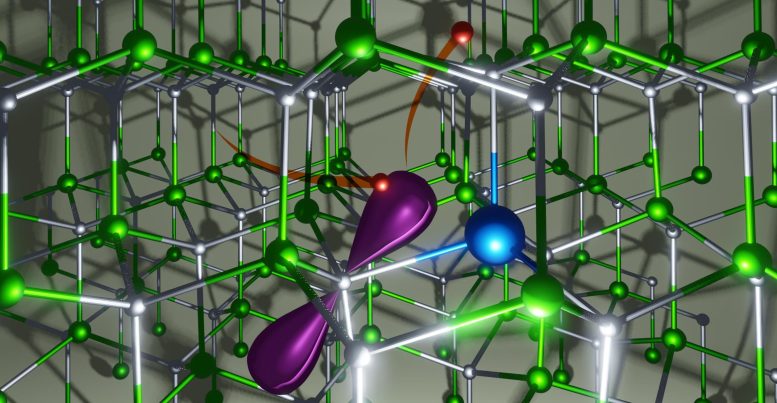
Researchers in the Department of Materials at UC Santa Barbara, however, recently uncovered the crucial role of the Auger-Meitner effect, a mechanism that allows an electron to lose energy by kicking another electron up to a higher-energy state.
“It is well known that defects or impurities — collectively referred to as ‘traps’ — reduce the efficiency of LEDs and other electronic devices,” said Materials Professor Chris Van de Walle, whose group performed the research.
A Major Breakthrough in Understanding Energy Loss
The new methodology revealed that the trap-assisted Auger-Meitner effect can produce loss rates that are orders of magnitude greater than those caused by other previously considered mechanisms, thus resolving the puzzle of how defects affect the efficiency of blue or UV light emitters. The findings are published in the journal Physical Review Letters.
Observations of this phenomenon date back to the 1950s, when researchers at Bell Labs and General Electric observed its detrimental impact on transistors. Van de Walle explained that electrons can get trapped at defects and become unable to perform their intended role in the device, be it amplifying a charge in a transistor or emitting light by recombining it with a hole (an unoccupied lower-energy state) in an LED. The energy lost in this recombination process was assumed to be released in the form of phonons, i.e., lattice vibrations that heat up the device.
Van de Walle’s group had previously modeled this phonon-mediated process and found that it duly fitted the observed efficiency loss in LEDs that emit light in the red or green regions of the spectrum. However, for blue or ultraviolet LEDs the model failed; the larger amount of energy carried by the electrons at these shorter wavelengths simply cannot be dissipated in the form of phonons.
“This is where the Auger-Meitner process comes in,” explained Fangzhou Zhao, a postdoctoral researcher in Van de Walle’s group and the project’s lead researcher. The researchers found that, instead of releasing energy in the form of phonons, the electron transfers its energy to another electron that gets kicked up to a higher energy state. This process is often referred to as the Auger effect, after Pierre Auger, who reported it in 1923. However Lise Meitner — whose many accomplishments were never properly recognized during her lifetime — had already described the same phenomenon in 1922.
Experimental work in the group of UC Santa Barbara materials professor James Speck had suggested previously that trap-assisted Auger-Meitner processes could occur; however, based on measurements alone, it is difficult to rigorously distinguish between different recombination channels. Zhao and his co-researchers developed a first-principles methodology that, combined with cutting-edge computations, conclusively established the crucial role of the Auger-Meitner process. In the case of gallium nitride, the key material used in commercial LEDs, the results showed trap-assisted recombination rates that were more than a billion times greater than if only the phonon-mediated process had been considered. Clearly, not every trap will show such huge enhancements; but with the new methodology in hand, researchers can now accurately assess which defects or impurities are actually detrimental to the efficiency.
Revolutionizing Defect Analysis in Semiconductor Materials
“The computational formalism is completely general and can be applied to any defect or impurity in semiconducting or insulating materials,” said Mark Turiansky, another postdoctoral researcher in Van de Walle’s group who was involved in the project. The researchers hope that these results will increase understanding of recombination mechanisms not only in semiconductor light emitters but also in any wide-band-gap material in which defects limit efficiency.
Reference: “Trap-Assisted Auger-Meitner Recombination from First Principles” by Fangzhou Zhao, Mark E. Turiansky, Audrius Alkauskas and Chris G. Van de Walle, 2 August 2023, Physical Review Letters.
DOI: 10.1103/PhysRevLett.131.056402
The research was supported by the Department of Energy Office of Basic Energy Sciences and a Department of Defense Vannevar Bush Faculty Fellowship, which was awarded to Van de Walle in 2022. Zhao was the recipient of an Elings Prize Postdoctoral Fellowship. The computations were performed at the National Energy Research Scientific Computing Center (NERSC).
Never miss a breakthrough: Join the SciTechDaily newsletter.
Follow us on Google and Google News.
1 Comment
According to topological vortex gravitational field theory, understanding where the energy of electron spin comes from is more helpful for understanding of recombination mechanisms not only in semiconductor light emitters but also in any wide-band-gap material in which defects limit efficiency.