

After 40 years of research, scientists at Michigan State University have uncovered how plants use isoprene to defend themselves against insect attacks.
A powerful, plant-made compound may offer a safer way to fight pests, and it has been hiding in plain sight. However, might also impact the environment.
For decades, scientists have known that many plants produce a natural chemical called isoprene, but its role remained a mystery. Now, after 40 years of dedicated research, a team from Michigan State University has discovered that isoprene can help plants repel insects and how some plants that don’t usually make isoprene might be able to switch it on when under stress.
Leading the research is Tom Sharkey, a University Distinguished Professor at MSU. He is part of the Department of Energy Plant Research Laboratory, the MSU Plant Resilience Institute, and the Department of Biochemistry and Molecular Biology. Sharkey has spent most of his career investigating this elusive compound. His latest findings open up exciting possibilities for engineering crops that are more resistant to both environmental stress and insect attacks.
The team’s paper in Science Advances uncovers a hormonal response triggered by isoprene that makes insects steer clear of those plants. Insects that munched on isoprene-treated leaves got a stomachache, thanks to indigestible proteins that kick in when the compound is present. Those proteins also stunt the growth of worms that dare to keep eating them.
Another paper, published in the Proceedings of the National Academy of Sciences, reveals that soybeans produce isoprene when their leaves are wounded. This discovery was particularly surprising since researchers previously believed modern crops didn’t produce isoprene. This ability could make crops more resilient to heat and pests.
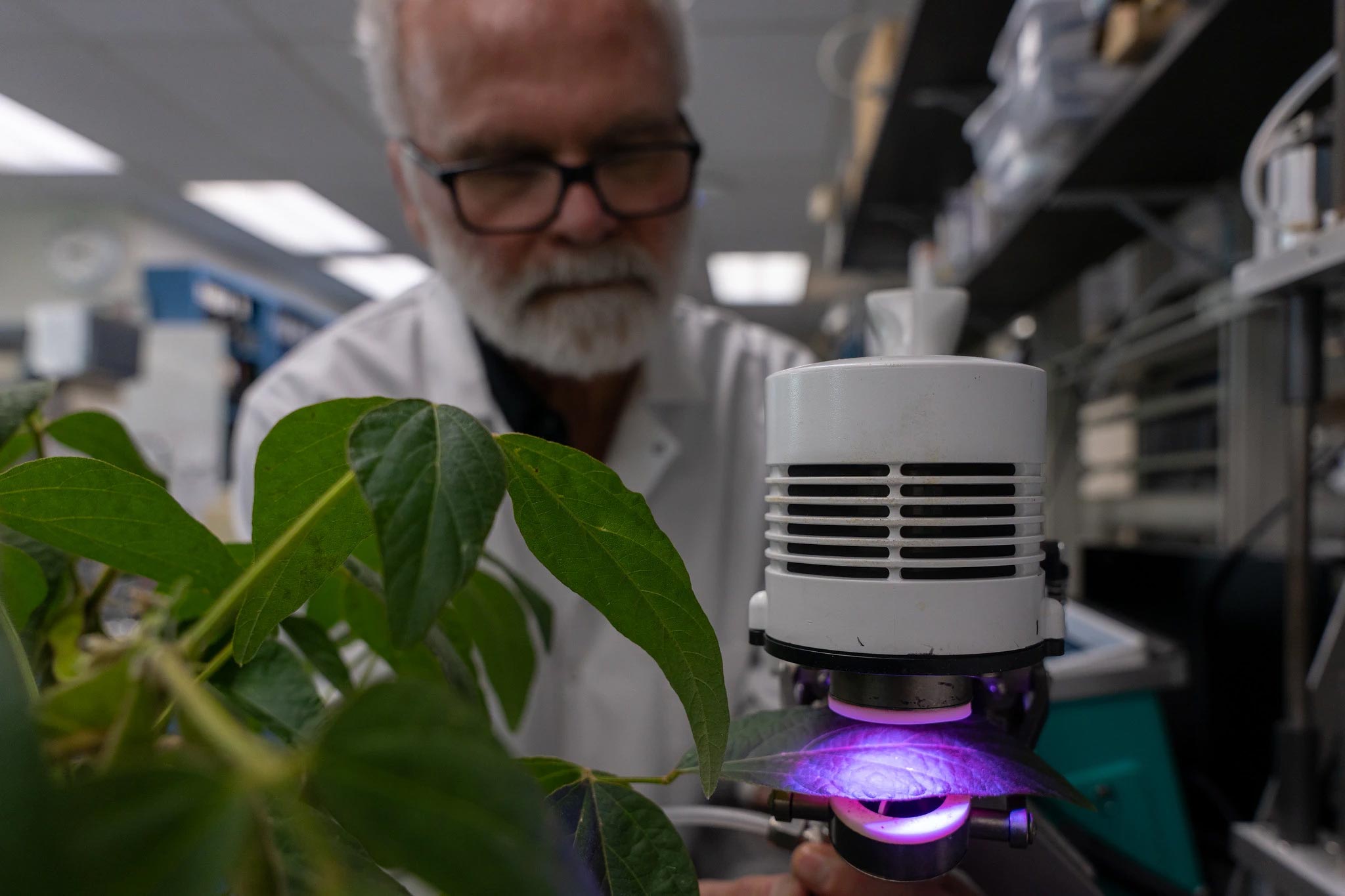
But that benefit could come at a cost. Isoprene is a hydrocarbon that worsens air pollution, especially in areas that already have poor air quality. If more crop plants were engineered to release isoprene, that could further damage the Earth’s atmosphere. The research also has implications for how soybeans may impact air pollution.
“That’s one of the questions that’s most important to come out of this research,” Sharkey said. “Should we add isoprene to crop plants so that they’re protected against insects and put up with their effect on the ozone? Or should we genetically engineer plants to turn off the isoprene synthase as much as we can to improve the atmosphere?”
A misunderstood compound
Isoprene is one of the highest emitted hydrocarbons on Earth, second only to methane emissions from human activity. These organic compounds interact with sunlight and nitrogen oxide from coal-burning facilities and vehicle emissions, creating a toxic brew of ozone, aerosols, and other harmful byproducts.
Not all plants produce isoprene, however, and the ones that do tend to make more in hot weather. It’s mostly found in oak and poplar trees, but unlike similar molecules in pine and eucalyptus trees, isoprene doesn’t have a scent.
“Everyone understands what it smells like when you walk through a pine forest,” Sharkey said. “In an oak grove, which has more hydrocarbons because it makes so much isoprene, you just don’t notice it.”
Isoprene-producing plants pump out more of the compound on hot summer days. Scientists believe this helps stabilize plants and neutralize stress reactions. Isoprene-emitting plants are also thought to be pest-resistant, though until now, there had been little study of why. But as plants make more isoprene, they sacrifice some of their growth potential. When plants make isoprene, they divert carbon away from growth and storage and invest instead in their defense. Some believe this is why many plants folded under evolutionary pressure to get rid of the isoprene synthase.
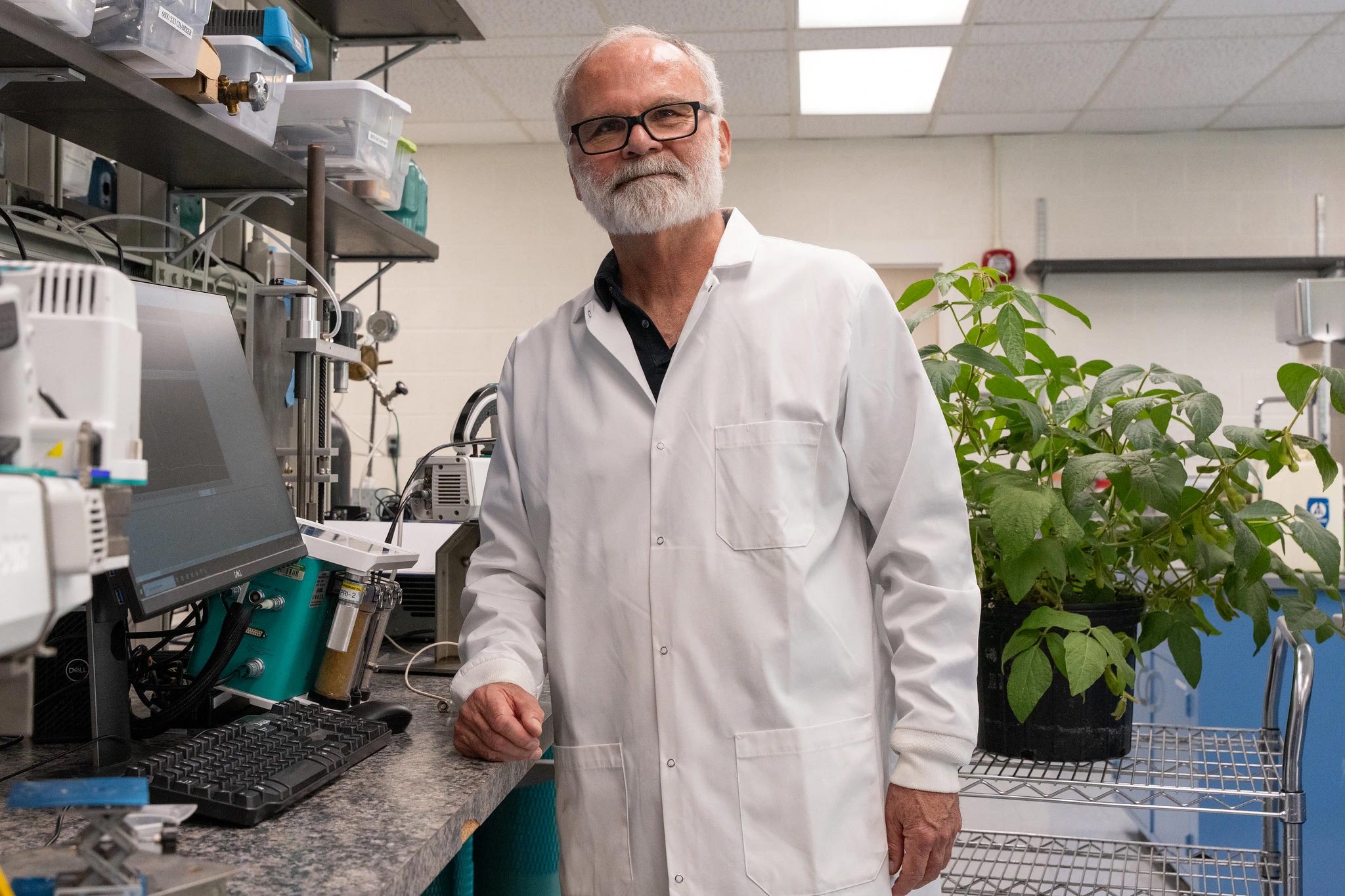
Sharkey first became interested in isoprene as an MSU graduate student. Based on a simple cost-benefit analysis, he knew there had to be a benefit to keeping the isoprene-producing gene around. He’s devoted much of his career, first at the University of Wisconsin and now at MSU, to finding out what that is.
He’s studying isoprene with support from the National Science Foundation, the MSU Plant Resilience Institute, and MSU AgBioResearch.
An accidental experiment
A whitefly infestation in an MSU greenhouse was the first test of how isoprene protects plants from insects. Sharkey’s lab grew two types of tobacco plants in the greenhouse: one genetically engineered to emit isoprene and the other a non-emitting plant. It was obvious even to a casual observer that whiteflies preferred the non-emitting plant.
Researchers tested their theory further by watching tobacco hornworms. The worms voraciously attacked the non-emitting leaves while leaving the others alone. After 10 days, the hornworms that only ate isoprene-emitting leaves were significantly smaller than those that snacked on the untreated leaves.
The isoprene itself isn’t what repels the insects. Instead, isoprene triggers an increase in jasmonic acid, a molecule that reduces an insect’s ability to digest proteins and slows their growth.
“The defense was not the isoprene itself, but the consequence of what isoprene did to the plant,” Sharkey said.
Discovering isoprene genes in soybeans
Until recently, scientists thought crop plants like soybeans and corn didn’t produce isoprene because their ability to do so was lost through evolution. Then, in 2022, researchers discovered two intact isoprene synthase, or ISPS, genes in soybeans. Sharkey decided to experiment whether environmental stresses could activate the dormant ISPS gene.
To test this question, they placed clamps on soybean leaves and damaged them. The leaves responded with a small burst of isoprene. Sharkey said this means soybeans have their cake and eat it too — they’re able to make isoprene when needed, but they can shut off the process under normal conditions.
More research is needed to determine how this ability protects soybeans from stressors, as well as whether isoprene production is triggered by extreme heat. Sharkey is concerned by the potential impact soybeans might have on the atmosphere if they’re churning out isoprene during increasingly frequent hot spells.
“What drives me most is that I think we should understand these big things,” Sharkey said. “Isoprene is the single biggest source of hydrocarbon in the atmosphere. We should understand it.”
References: “Isoprene deters insect herbivory by priming plant hormone responses” by Abira Sahu, Mohammad Golam Mostofa, Yuan Xu, Bianca M. Serda, James O’Keefe and Thomas D. Sharkey, 18 April 2025, Science Advances.
DOI: 10.1126/sciadv.adu4637
“Cryptic isoprene emission of soybeans” by Mohammad Golam Mostofa, Abira Sahu, Yuan Xu, Insiya Basrai, Lior Doron, Violet Lefrancois and Thomas D. Sharkey, 12 June 2025, Proceedings of the National Academy of Sciences.
DOI: 10.1073/pnas.2502360122
Never miss a breakthrough: Join the SciTechDaily newsletter.
Follow us on Google and Google News.
1 Comment
So, if humans are the second cause of hydrocarbons where do the Canadian wild fires come into the picture?
We have weeks most years where our visibility drop to half a mile or less. I live in Northcentral SD but the smoke from the fires cover the entire Midwest. I might also add the hydrocarbons that volcanoes emit.