
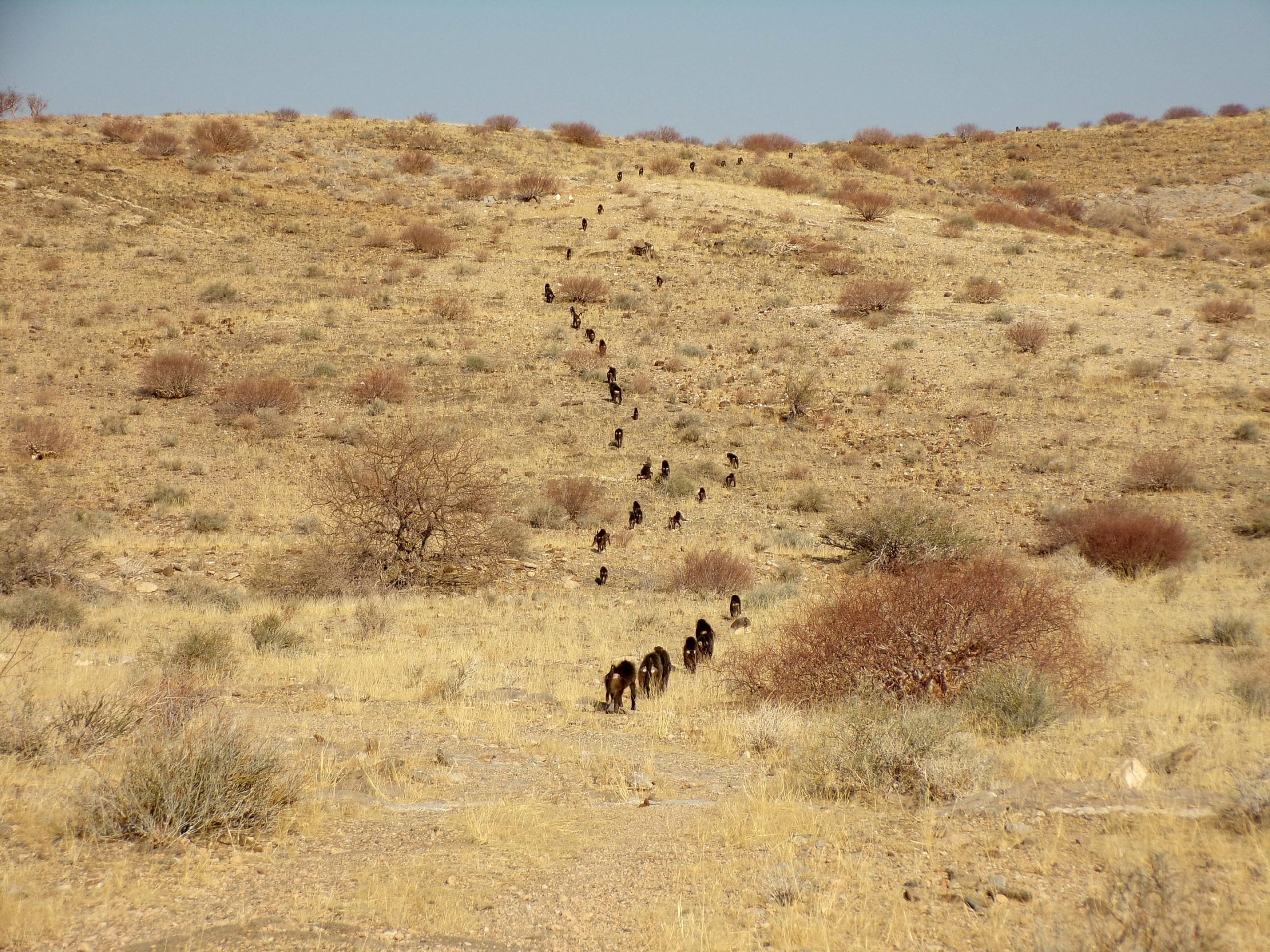
Baboons have long puzzled scientists with their habit of walking in neat lines across the African landscape. Were they protecting the vulnerable, following leaders, or competing for food?
A Swansea University team used high-resolution GPS to track wild chacma baboons and tested these theories.
Why Baboons Walk in Lines
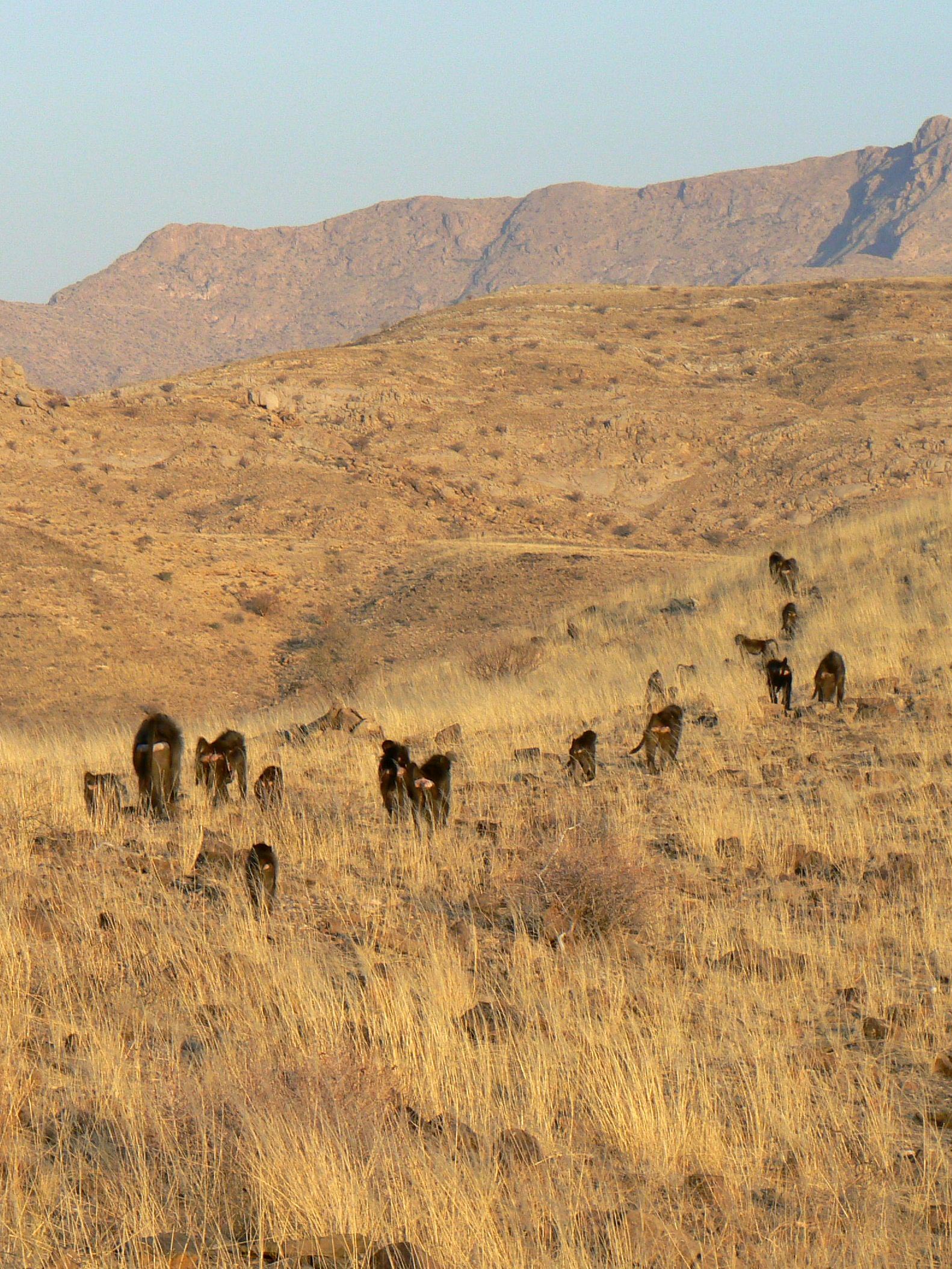
Scientists at Swansea University have found that baboons line up while walking not as a defense tactic or strategic move, but simply to remain near their closest companions.
These primates often move in organized formations called ‘progressions’ when traveling through their habitat. Past research struggled to agree on why they do this. Some suggested the order was random, while others believed it was deliberate, with the most vulnerable animals kept in the middle to reduce danger from predators.
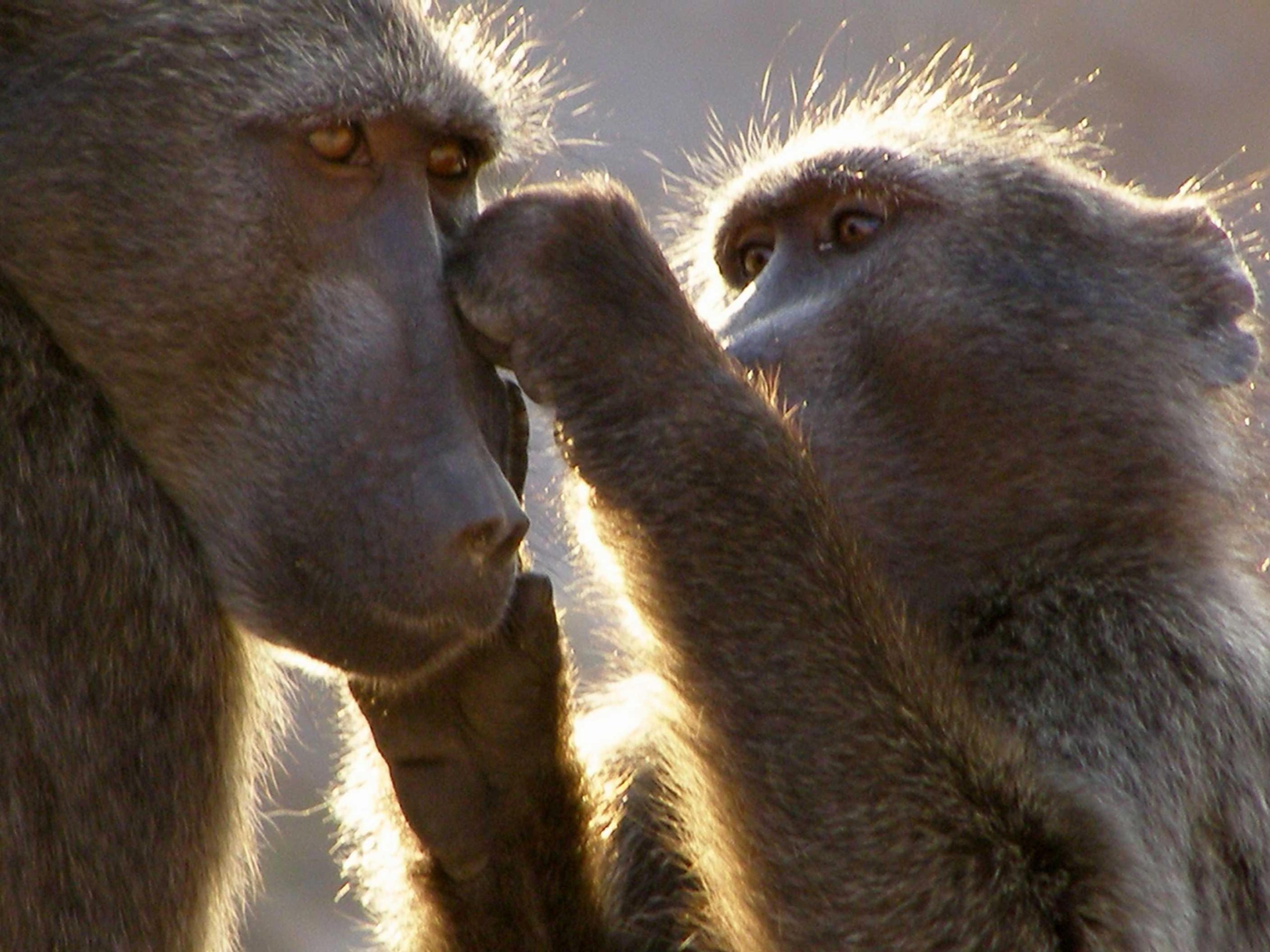
To investigate further, Swansea researchers used high-resolution GPS devices to track a troop of wild chacma baboons (Papio ursinus) living on South Africa’s Cape Peninsula. The results, published in the journal Behavioral Ecology, showed that the patterns of movement were shaped by social connections rather than by efforts to avoid threats.
Testing Four Hypotheses
The team analysed 78 travel progressions over 36 days and showed that the order in which the individual baboons traveled was not random.
The researchers tested four potential explanations for the baboon progression order:
- Protecting the vulnerable (risk hypothesis)
- Competing for resources (competition hypothesis)
- Following leaders (group decision-making hypothesis)
- Patterns emerging from social relationships (social spandrel hypothesis)
After analyzing the data, the researchers found that the baboons’ movement patterns were driven solely by their social relationships.
Not Leaders, Just Friends
Dr. Andrew King, Associate Professor at Swansea University, said: “Surprisingly, the consistent order we see for the baboons we studied isn’t about avoiding danger like we see in prey animals when they position themselves in the middle of their social group, or for better access to food or water like we see in like we see in the movements of plains zebra. Instead, it’s driven by who they’re socially bonded with. They simply move with their friends, and this produces a consistent order.
“In the baboon group we studied, the more socially connected, higher-ranking individuals usually walk in the middle of the group, while lower-ranking baboons are often out in front or at the rear. During these group movements—like heading to a familiar sleeping spot—it’s likely that the group already knows where they’re going. So, the baboons at the front aren’t really leading; they’re just out ahead.”
This map shows the movement of baboons across their habitat, with each dot representing an individual’s location. Colors indicate dominance level—purple (low), pink, orange, and yellow (high)—revealing how individuals of different ranks travel and cluster together. Credit: Dr. Andrew King
The ‘Social Spandrel’ Effect
This finding introduces the concept of a ‘social spandrel’. In buildings, spandrels are the triangular spaces that emerge as by-products when arches are placed side by side. In biology, a spandrel refers to a trait that arises not because it was directly selected for, but as a side effect of something else. In this case, the consistent travel patterns among baboons emerge naturally from their social affiliations with each other, and not as an evolved strategy for safety or success.
Marco Fele, the study’s lead author and PhD student at Swansea University, said: “We know that strong social bonds are important for baboons – they’re linked to longer lives and greater reproductive success. But in this context, those bonds aren’t serving a specific purpose. The travel order we see is simply a by-product of those relationships, not a strategy with immediate benefits. Our study highlights the potential for these kinds of spandrels in collective animal behavior.”
Reference: “Baboon travel progressions as a “social spandrel” in collective animal behaviour” by M Fele, I Fürtbauer, M Lurgi, M Papadopoulou, A M Bracken, C Christensen, M J O’Riain and A J King, 11 March 2025, Behavioral Ecology.
DOI: 10.1093/beheco/araf022
Never miss a breakthrough: Join the SciTechDaily newsletter.
Follow us on Google and Google News.
13 Comments
“They simply move with their friends, and this produces a consistent order.”
Then why don’t we observe groups of 2 or 3 moving across a flat area, spread out as a broad pack instead of a line in the direction of movement?
From personal experience, I would say that the leader takes on the responsibility of finding and breaking spider webs across a game trail and thereby earning the gratitude of those following. 🙂
Moving in a line is just simply more practical. Walking along any uneven terrain makes it difficult to walk alongside each other. Also, following the same route regularly, for instance, to a sleepsite, would eventually develope a path.
Walking in line is the way of least resistance, thus the least effort. If there is no path, it is still the way of least resistance to follow the one in front of you. That is why humans do it. I find the first point of reference for baboon behaviour is usually to interpret it from a human perspective and only then look for other reasons if it doesn’t make sense. They are, after all, primates like us.
It’s to follow the safest route and avoid snakes. The leader has the best eyesight, and if he’s not been bitten, it’s wise to follow his footsteps to reduce risk.
Yet, I have seen videos that show that once the troupe reaches their feeding grounds, despite the risk from snakes, they spread out. Do you have a citation for the claim that the leader has the best eyesight?
Agreed. I was thinking along the same lines that they follow whoever is in front of them because they know that path is safe. I was also thinking about land mines or booby traps and how humans avoid them, you would follow the same path that you saw someone else just walk through because you could reasonably assume it was safe. Multiple humans would end up forming a line, as well. Same concept as avoiding snakes or other threats.
Because their Drill Sergeant said so — and maintain that interval!
They walk single -file to hide their NUMBERS! DUH! 😜😜😜
OK… I’ll see myself out now!
Most interesting is that the dominant baboons are in the center, not at the head of the line. The social relationships extend in both directions around the dominants. It isn’t a hierarchical arrangement. The dominant are not the leaders.
This does not sound like a scientific deduction but an unfounded guess, like something pulled out of your hat. You could as easily conclude that the leaders walk in the middle so that there will be lots of cannon fodder ahead of and behind them. And fossilized human prints showed that they were not walking single file but spread out, rather like friends
walking down a sidewalk.
The “lw status individuals seem to take point, perimeter, and rear positions. That definition of status applied to human societies would be the crazies, warriors, and disagreeable people who fill the same positions. While the leaders are safely ensconced in the middle of the crowd. This might give us an indication of human group conflict where the people most likely to fight are forced into positions where it’s most likely.
Moving in a line is just simply more practical. Walking along any uneven terrain makes it difficult to walk alongside each other. Also, following the same route regularly, for instance, to a sleepsite, would eventually develope a path.
Walking in line is the way of least resistance, thus the least effort. If there is no path, it is still the way of least resistance to follow the one in front of you. That is why humans do it. I find the first point of reference for baboon behaviour is usually to interpret it from a human perspective and only then look for other reasons if it doesn’t make sense. They are, after all, primates like us.
The formation of movement patterns among baboons also depends on numbers. Observe the group over Queenstown E.C. and contrast with the baboons in the Wittenberg mountain. Often,the latter group moves in ranks, young ones in front, followed by nursing mothers,non nursing after that,young males , males in ascending order by age, the senior s bringing up the rear. The most senior male, presumably the father of the flock follows at some distance at the back. This is a shepherd ‘s observation
This doesn’t seem unexpected to me if you view them as social primates (like us) with their own thoughts and feelings.
It’s only surprising if you hold outdated Victorian views of Biology.