
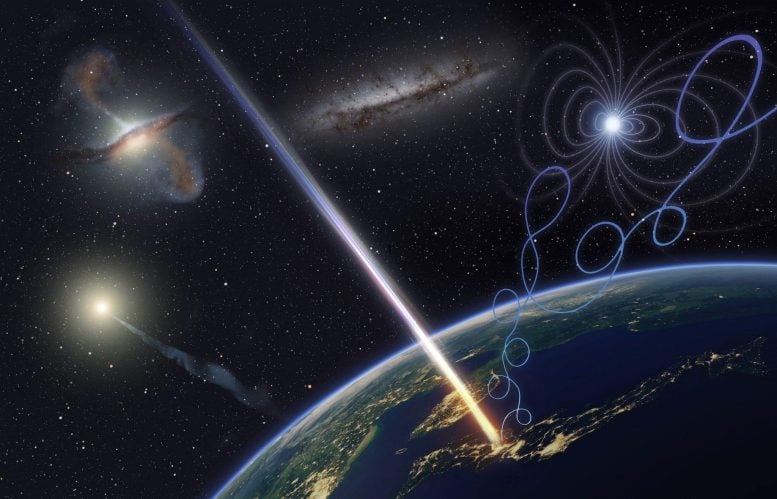
Scientists have discovered that ultraheavy atomic nuclei could explain some of the highest-energy cosmic rays ever observed. The particles may come from extreme events such as neutron-star mergers and collapsing massive stars.
Scientists may have uncovered a new clue behind the origin of the most energetic particles ever detected in the universe.
Ultrahigh-energy cosmic rays are particles from space that slam into Earth with energies far beyond anything produced by human-made particle accelerators. One of the most extreme examples is the “Amaterasu particle,” detected in Utah by the Telescope Array in 2021 and named after the Japanese sun goddess. Its energy rivals that of the famous “Oh-My-God particle” discovered in 1991, but scientists still do not know exactly what it was or where it came from.
New research from Penn State scientists, published in Physical Review Letters, suggests that some of these record-breaking cosmic rays may be made of atomic nuclei heavier than iron. Atomic nuclei are the dense centers of atoms composed of protons and neutrons, containing nearly all of an atom’s mass.
Ultraheavy Nuclei May Explain Extreme Cosmic Rays
The researchers found that these ultraheavy nuclei may lose energy more slowly than protons or lighter nuclei while traveling through intergalactic space. That could allow them to cross enormous cosmic distances and still reach Earth with exceptionally high energies. The work involved scientists from the Yukawa Institute for Theoretical Physics in Japan, Virginia Tech, and several other institutions and could help narrow the search for the cosmic environments capable of accelerating such particles.
“Ultrahigh-energy cosmic rays can only be accelerated by some of the most powerful sources in the universe,” said Kohta Murase, professor of physics and of astronomy and astrophysics in the Penn State Eberly College of Science and the leader of the research team. “When we detect individual cosmic-ray particles such as the Amaterasu particle here on Earth, we can often use their energies, arrival directions, and expected magnetic deflections to infer their possible cosmic sources.”
However, the Amaterasu particle appeared to originate from a giant cosmic void with no obvious source capable of producing ultrahigh-energy cosmic rays.
A 60-Year Mystery in Astrophysics
“The origins and acceleration mechanisms of ultrahigh-energy cosmic rays have been among the biggest mysteries in the field for more than 60 years, since the first example was reported,” Murase said.
These particles carry energies above 100 exa-electron volts, or 100 quintillion electron volts. That makes them about 10 million times more energetic than particles accelerated in the Large Hadron Collider, the world’s most powerful particle accelerator. The Amaterasu particle alone reached roughly 240 exa-electron volts, carrying about the same kinetic energy as a fast-moving tennis ball concentrated into a single particle.
“These highest-energy cosmic rays are thought to come from extreme astrophysical sources, like two neutron stars colliding or a massive star collapsing,” Murase said. “For many cosmic-ray events taken together, their energy distribution, arrival-direction pattern and statistically inferred composition provide important clues about where these particles come from and how they are accelerated.”
Simulating How Particles Travel Across Space
To investigate which particles could survive the journey to Earth at such enormous energies, the researchers ran detailed computer simulations tracking how particles of different masses lose energy while moving through intergalactic space.
“Our research showed that at energies comparable to that of the Amaterasu particle, ultraheavy nuclei lose energy more slowly than protons or intermediate-mass nuclei, making them better able to survive cosmic distances and reach Earth at extreme energies,” Murase said. “We are not saying that all ultrahigh-energy cosmic rays are ultraheavy nuclei. But if some of the highest-energy events are ultraheavy nuclei, that would impact how we search for their sources.”
The study also established new limits on how much these ultraheavy nuclei may contribute to the overall population of ultrahigh-energy cosmic rays detected on Earth.
Black Holes and Neutron Stars as Likely Sources
“The most promising sites for producing and accelerating such ultraheavy nuclei are massive star deaths involving explosive collapse into black holes or strongly magnetized neutron stars, as well as binary neutron-star mergers known to be powerful gravitational-wave emitters,” Murase said.
“These violent cosmic phenomena can also power gamma-ray bursts that are among the most energetic explosions in the universe. A contribution from these sources could also help explain a possible difference seen between the northern and southern skies in the ultrahigh-energy cosmic-ray spectrum. If ultraheavy nuclei contribute significantly at the highest energies, future data should indicate a composition heavier than iron.”
Murase said future observatories, including the proposed AugerPrime project in Argentina and the Global Cosmic Ray Observatory, may be able to test these predictions. Additional studies of black holes and strongly magnetized neutron stars could also help scientists better understand where these extraordinary cosmic rays originate.
Reference: “Ultraheavy Ultrahigh-Energy Cosmic Rays” by B. Theodore Zhang, Kohta Murase, Nick Ekanger, Mukul Bhattacharya and Shunsaku Horiuchi, 7 May 2026, Physical Review Letters.
DOI: 10.1103/221m-gvs3
Never miss a breakthrough: Join the SciTechDaily newsletter.
Follow us on Google and Google News.
3 Comments
I have a friend who believes in aliens. As proof, he offered “Orbs” and had a photo. I asked that he send it to me. There he was with several friends in an evening, outside a university building with ‘orbs’ seemingly alighted on a big tree.
I have not told him his orbs are dew on his camera lens.
Can the universe be so involved ? You can bet the farm on this one . The Torsion Hill Framework: As Modern cosmology stands at a critical juncture where the macroscopic elegance of General Relativity inevitably breaks down at localized boundary extremes, yielding unphysical infinities such as singular black hole metrics. This paper introduces the Torsion Hill Framework, a comprehensive mechanical and structural update to the established relativistic blueprint. Rather than discarding classical macro-geometry, this framework patches its critical metric vulnerabilities by introducing an active, substantive cosmic medium—the Kinetic Static Temporal Field—and defining the fixed boundary laws that govern localized metric equilibrium.By detailing the exact physical mechanisms of the $-1D+T$ Metric Phase Transition, we demonstrate how extreme cosmic compression is balanced by the creation of rigid, negative-dimensional structural anchors. This model provides an airtight, non-singular resolution to high-density cosmic states, establishing a living, scalable matrix designed to advance technology and fulfill the human requirement for systemic answers.Core Operational Matrix1. The Blueprint: General Relativity The foundational architecture of macro-space-time remains structurally sound. The framework fully respects and preserves Einstein’s field equations, reinterpreting relativistic phenomena (Time Dilation, Frame Dragging, and the Cosmic Speed Limit) not as the passive stretching of an empty coordinate void, but as the direct result of physical field friction and mechanical coupling against a moving temporal current.2. The Update: The Torsion Hill Mechanics Where the classical blueprint predicts infinite gravitational collapse, our update deploys a two-stage structural intervention driven by the laws of equilibrium:The Density Cap Threshold (REF-001): Vector stress is distributed across a discrete, geometric standing wave, halting infinite singularity formation.The Metric Inversion Phase Change (REF-006): Under maximum temporal field saturation, positive spatial volume coordinates ($3D$) buckle and invert into a localized negative-dimensional deficit ($-1D$), creating an immovable, non-deformable structural anchor while the temporal constant ($+T$) flows onward uninterrupted.3. The Law of Universal Equilibrium This framework operates on the absolute physical principle that no conclusion to physics can exist without a stabilizing equilibrium. The transition into a $-1D$ spatial anchor is revealed as nature’s definitive mechanical mechanism to handle extreme cosmic pressure, balancing the expansion and evolution of the evolving universe.
Memo 2606011234_Source1.Reinterpretation【()】
Source1.
https://scitechdaily.com/the-universes-most-powerful-particles-may-be-even-stranger-than-scientists-thought/
1.
_The most powerful particles in the universe may be much stranger than scientists thought.
_This is an artist’s rendering depicting ultra-high-energy cosmic rays reaching Earth. According to new research, some of these ultra-high-energy cosmic rays may be composed of atomic nuclei heavier than iron.
ㅡㅡㅡㅡㅡㅡ
【&&&&a1.() I finally learned about the creation principles of the massive universe and the maintenance of spacetime an hour ago. Haha. 2606011236. I briefly noted down a detailed graphic regarding this. I will make it public. 1230.
>>> That is the reason cosmic atoms exist, and the structure left by cosmic atoms from the Big Bang might be a trace of spacetime msbase. Hmm. 1228.
>>> Matter is created from a fractal in which cosmic atoms are infinitely divided into local atoms. Hmm. 1232.
>>> Here, the neutrons existing within the atomic nucleus are msoss.vixxa, which dominate the gravitational field, the mass of spacetime, and
>>> The natural phenomenon of ordinary matter is msbase, which is dominated by an electromagnetic field. And the proton mode of the universe is the vixer.blackhole of sample1.oms.vix.ain.
sample1.
msbase12.qpeoms.2square.vector
oms.vix.a’6,vixx.a(b1,g3,k3,o5,n6)
b0acfd|0000e0
000ac0|f00bde
0c0fab|000e0d
e00d0c|0b0fa0
f000e0|b0dac0
d0f000|cae0b0
0b000f|0ead0c
0deb00|ac000f
ced0ba|00f000
a0b00e|0dc0f0
0ace00|df000b
0f00d0|e0bc0a
】
1-1.
_The background depicts celestial bodies presumed to be sources of these cosmic rays, such as active galactic nuclei and neutron stars with strong magnetic fields.
Scientists have discovered that superheavy nuclei can explain the highest-energy cosmic rays observed to date. These particles may originate from extreme events such as neutron star mergers or the collapse of massive stars.
ㅡㅡㅡㅡㅡㅡ
【&&&&a2.() The maximum size(*) of the superheavy nucleus was the universe. Oh dear. 1244.
>>> The superheavy nucleus mentioned in Source 1 is smaller than the size of galaxies, stars, planets, rocks, or molecules, but such things are merely fractals of cosmic atoms. Oh dear. 1246.
>>> This is an argument based on having found evidence. An atom is composed of protons and neutrons within the nucleus, which are made up of quarks.
>>> If we assume here that the proton is the vixer of sample1.oms.vix.ain, then the vixxa created by the black hole are either neutron stars or possess msoss.charge.zero.magicsum.
>>> msoss.zerosum is unrelated to the size of the atom, no matter how large its mass is—as large as the universe. Therefore, the number of protons vixer, which allows the atomic nucleus to be as large as the universe, appears in sample1. Heh. 1252.
>>>> The core(*) of my argument must be presupposed that atoms ‘must interact with electrons.’ Since a very small electron reacts with a huge proton, the cosmic atom appears with a ‘pop!!!’
>>>> Here, oms.vix.ain, which creates the hadron proton vixer.vixxa group, acts as the fermion field that serves as the atomic nucleus.
>>> Pay attention, everyone!!! If you get distracted, my words will sound like nonsense. Hmm. 1314.
—Historically speaking, no matter how small an electron is, to close a triangle with a proton base and hypotenuse that has the diameter of the universe, one needs a single point of a small electron (boson)… anything, a negative particle, or even a Planck constant particle tsp.qqcell. Hmm. 1300. 1312. 1315.
】
B.1-2.
_Scientists may have discovered new clues regarding the origin of the highest-energy particles found in the universe.
_Ultra-high-energy cosmic rays are a phenomenon in which particles with immense energy—which cannot be produced by human-made particle accelerators—rush from space toward Earth.
_One of the most extreme examples is the “Amaterasu particle,” discovered in 2021 by the Texas Array of Radio Telescopes in Utah and named after the Japanese sun goddess.
1-3.
The energy of this particle rivals the famous “Oh My God particle” discovered in 1991, but scientists still do not know exactly what this particle is or where it came from.
ㅡㅡㅡㅡㅡㅡ
【&&&b1. () You guys are kidding!! Isn’t the Oh My God particle just a flea at most… Is the Oh My Oh My God thing the size of a ping-pong ball?
>>> You just discussed galactic atoms and cosmic atoms… isn’t that really funny?? Heh. Hmm. 1333.34.
>>> We live inside the atom sample1.oms.vix.ain, in a place ruled by black holes. We live inside the nucleus msoss.msbase, where neutron stars swarm. This atom reacts with the super-energy Planck constant tsp(e).qqcell outside the nucleus. Hmm. 1342.
—All infinitesimal fractal elements of the general periodic table are contained within msbase.msoss, possessing the harmony, order, and balance values of the entire universe. 1441.>>> This is the only explanation that describes the universe through a mathematical magicsum.
>>> This content… 1444. …the ambiguous and abstruse elements explained by established religions (Christianity, Buddhism, Islam, etc.) or superscience…
—It is the magicsum theory of msbase.natural.system, msoss, a cosmology dealing with boson particle science in mathematics that deals with pure natural numbers verifiable through intuition, with almost 100 percent of the elements removed. Hmm. 1440.
—
>>> The universe is a world of atoms, and those elements form a magicsum within msbase.msoss. This is the eternal truth. Hmm. 1446.
—However, the approximately 100 elements of the periodic table known to us humans are likely vastly different from the 10 billion elements of the periodic table discovered by highly intelligent aliens from other galaxies. Hmm. 1449.
—No matter how much humans act superior, they are merely dust particles in the universe. Haha. 1452.
As the saying goes, even if one claims to be an ‘absolute ruler of political power, a giant of the scientific community, or a religious leader,’ if they do not know msbase and msoss, they are nothing but dazed fools. Hmm. 2606011455. 1457.
】