
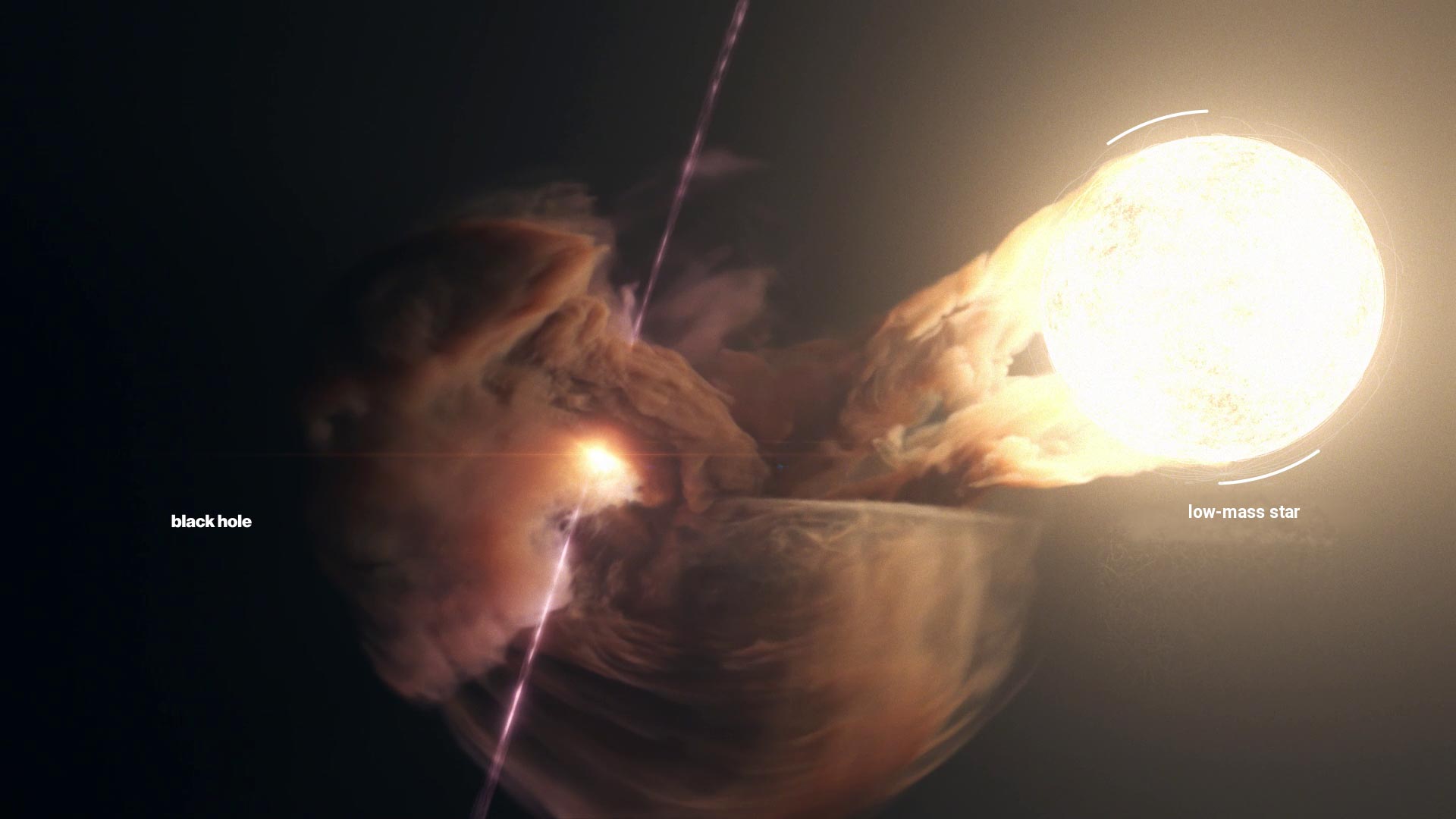
For the first time, researchers have found evidence that even microquasars with low-mass stars can efficiently accelerate particles. This discovery has significant implications for understanding the abundance of gamma rays in the universe and the role of microquasars in cosmic ray production.
- The origin and acceleration of the most energetic cosmic rays remain one of the biggest mysteries in astroparticle physics.
- Microquasar jets are highly efficient at accelerating cosmic particles, but until now, this has only been observed in rare high-mass microquasars.
- Researchers have now detected particle acceleration in the far more common low-mass microquasars, suggesting they contribute much more to the overall cosmic ray content of our galaxy than previously thought.
Mysterious Particles From Space
Earth is constantly bombarded by particles from outer space. While many people are familiar with rocky meteorites that streak across the sky as shooting stars, the smallest particles hold the key to understanding the universe. Subatomic particles like electrons and protons, traveling at incredible speeds from interstellar space and beyond, are among the fastest-moving particles known. These high-energy particles are called cosmic rays.
Despite decades of research, the origins and acceleration mechanisms of the most energetic cosmic rays remain a major mystery in astrophysics. Scientists suspect that fast-moving jets of matter, ejected from black holes, could be prime locations for particle acceleration. However, the exact conditions that allow these particles to reach such extreme speeds are still unclear.
The most powerful jets in our galaxy come from microquasars — systems consisting of a stellar-mass black hole and an ordinary star. As the two orbit each other, the black hole gradually pulls material from its companion. This process triggers the formation of powerful jets near the black hole, launching particles into space at nearly the speed of light.
Do All Microquasars Accelerate Particles?
In the past couple of years, there has been growing evidence that microquasar jets are efficient particle accelerators. It is however unclear how much they contribute, as a group, to the total amount of cosmic rays in the Galaxy. The answer to this question requires understanding if all microquasars are able to accelerate particles or only a lucky few.
Microquasars are usually classified depending on the mass of the star in the system into either “low-mass” or “high-mass” systems, with lower-mass systems being much more abundant. However, up until now evidence of particle acceleration has only been found for high-mass systems. For example, the microquasar SS 433, which was recently revealed to be one of the most powerful particle accelerators in the Galaxy, contains a star with a mass approximately ten times that of the Sun. Consequently, it was generally believed that low-mass microquasars were not powerful enough to produce gamma rays.
A Groundbreaking Discovery with Fermi Data
Dr. Laura Olivera-Nieto from the Max-Planck-Institut für Kernphysik in Heidelberg, Germany (MPIK) and Dr. Guillem Martí-Devesa from the Università di Trieste, Italy have now made a discovery that shakes this paradigm. They used 16 years of data from the Large Area Telescope detector onboard NASA’s satellite Fermi to reveal a faint gamma-ray signal consistent with the position of GRS 1915+105, a microquasar with a star smaller than the Sun. The gamma-ray signal is measured to have energies higher than 10 GeV, indicating that the system could accelerate particles to even higher energies.
The observations favor a scenario in which protons are accelerated in the jets, after which they escape and interact with nearby gas to produce gamma-ray photons. In the paper, published in the Astrophysical Journal Letters, they also use data from the Nobeyama 45-meter radio telescope in Japan, which indicates that there is enough gas material around the source for this scenario.
Implications for Cosmic Ray Studies
This result shows that even microquasars hosting a low-mass star are capable of particle acceleration. Because this is the most numerous class, this finding has significant implications for the estimated contribution of microquasars as a group to the cosmic ray content of our Galaxy. However, more detections and multi-wavelength studies will be required in order to further narrow down why some systems accelerate particles efficiently but not all.
Reference: “Persistent GeV Counterpart to the Microquasar GRS 1915+105” by Guillem Martí-Devesa and Laura Olivera-Nieto, 28 January 2025, The Astrophysical Journal Letters.
DOI: 10.3847/2041-8213/ada14f
Never miss a breakthrough: Join the SciTechDaily newsletter.
Follow us on Google and Google News.