
How Gamma Rays Track the Velocity of the Galactic Microquasar SS 433’s Jets and Uncover Highly Efficient Particle Acceleration.
- The microquasar SS 433 stands out as one of the most intriguing objects within our Milky Way.
- A pair of oppositely directed beams of plasma (“jets”) spirals away perpendicularly from the binary systems disk’s surface at just over a quarter of the speed of light.
- The H.E.S.S. observatory in Namibia has now succeeded in detecting very high energy gamma rays from the jets of SS 433, and identifying the exact location within the jets of one of the galaxy’s most effective particle accelerators.
- Through comparison of gamma-ray images at different energies, the H.E.S.S. collaboration was able to estimate the speed of the jet far from its launch site for the first time, constraining the mechanism that is accelerating the particles so efficiently.
SS 433 stands out as one of the most intriguing objects within our Milky Way. At its core, a black hole draws material from a closely orbiting companion star, creating a hot accretion disk. Notably, a pair of oppositely directed beams of plasma (“jets”) spirals away perpendicularly from the disk’s surface at just over a quarter of the speed of light. The H.E.S.S. observatory in Namibia has now succeeded in detecting very high energy gamma rays from the jets of SS 433, and identifying the exact location within the jets of one of the galaxy’s most effective particle accelerators. Through comparison of gamma-ray images at different energies, scientists from the Max-Planck-Institut für Kernphysik in Heidelberg and the H.E.S.S. collaboration revealed the motion and dynamics of a relativistic jet in our own galaxy, offering valuable insights into these extraordinary astrophysical phenomena. The results are published in the current issue of the journal Science.
Artist’s impression video visualization of the SS 433 system and summary of the main results of the paper. Credit: Science Communication Lab for MPIK/H.E.S.S.
Arthur C. Clarke’s Unique Wonder: SS 433
The science fiction author Arthur C. Clarke selected his own seven wonders of the world in a BBC television series in 1997. The only astronomical object he included was SS 433. It had attracted attention already in the late 1970s due to its X-ray emission and was later discovered to be at the center of a gas nebula that is dubbed the manatee nebula due to its unique shape resembling these aquatic mammals.
The Mystery of SS 433’s Jets
SS 433 is a binary star system in which a black hole, with a mass approximately ten times that of the Sun, and a star, with a similar mass but occupying a much larger volume, orbit each other with a period of 13 days. The intense gravitational field of the black hole rips material from the surface of the star, which accumulates in a hot gas disk that feeds the black hole. As matter falls in toward the black hole, two collimated jets of charged particles (plasma) are launched, perpendicular to the plane of the disk, at a quarter of the speed of light (see figure 1).
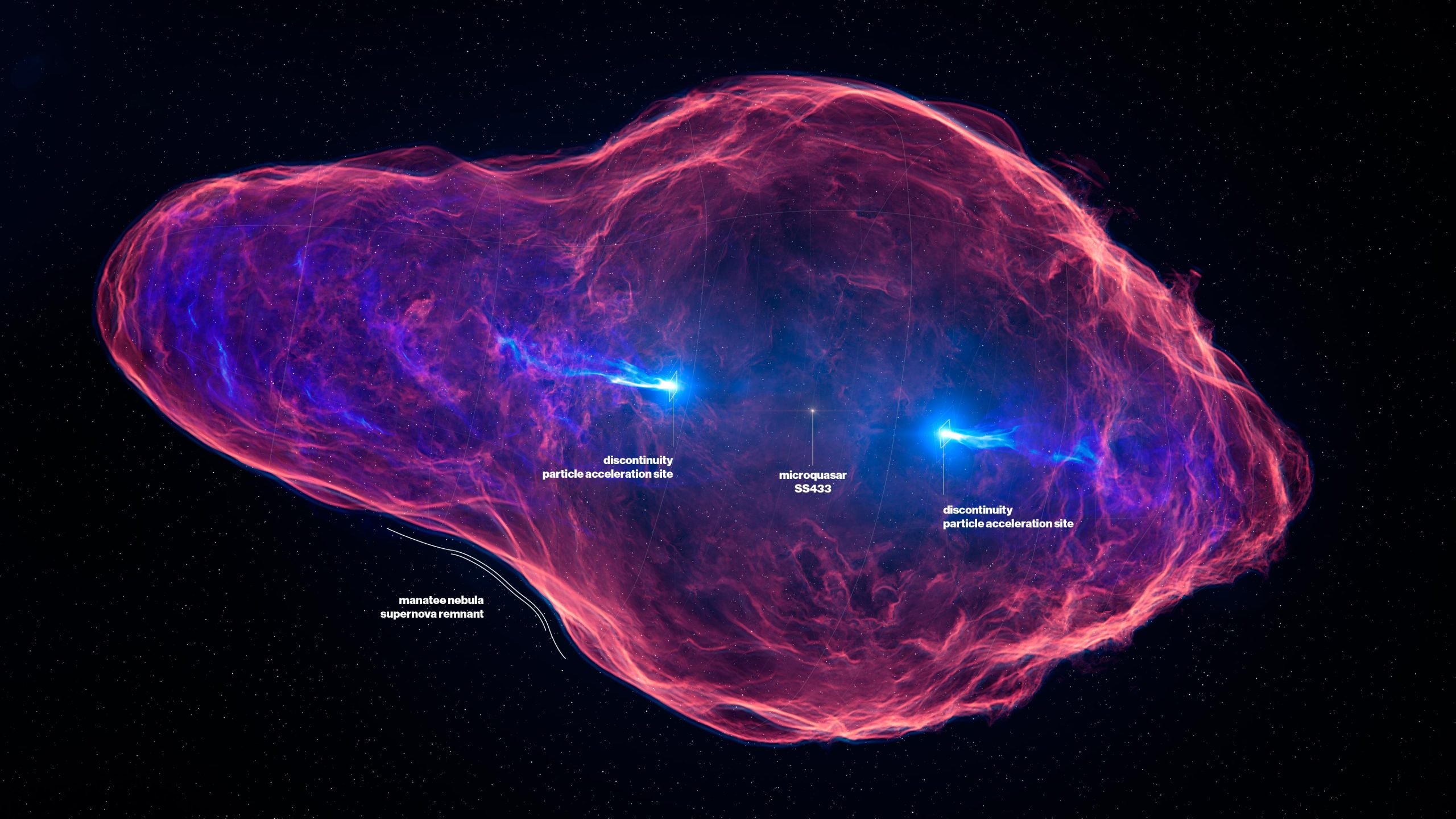
The jets of SS433 can be detected in the radio to x-ray ranges out to a distance of less than one light year either side of the central binary star, before they become too dim to be seen. Yet surprisingly, at around 75 light-years distance from their launch site, the jets are seen to abruptly reappear as bright X-ray sources. The reasons for this reappearance have long been poorly understood.
Similar relativistic jets are also observed emanating from the centers of active galaxies (for example quasars), though these jets are much larger in size than the galactic jets of SS 433. Due to this analogy, objects like SS 433 are classified as microquasars.
Groundbreaking Gamma Ray Detection
Until recently, no gamma ray emission has ever been detected from a microquasar. But this changed in 2018, when the High Altitude Water Cherenkov Gamma-ray Observatory (HAWC), for the first time, succeeded in detecting very-high-energy gamma rays from the jets of SS 433. This means that somewhere in the jets particles are accelerated to extreme energies. Despite decades of research, it is still unclear how or where particles are accelerated within astrophysical jets.
The study of gamma-ray emission from microquasars provides one crucial advantage: while the relevant region of the jets in SS 433 is more than 50 times smaller than those of the closest active galaxy (Centaurus A), SS 433 is located inside the Milky Way a thousand times closer to Earth. As a consequence, the apparent size of the relevant region in the jets of SS 433 in the sky is much larger and thus its properties are easier to study with the current generation of gamma-ray telescopes.
Pinpointing Gamma Ray Emission
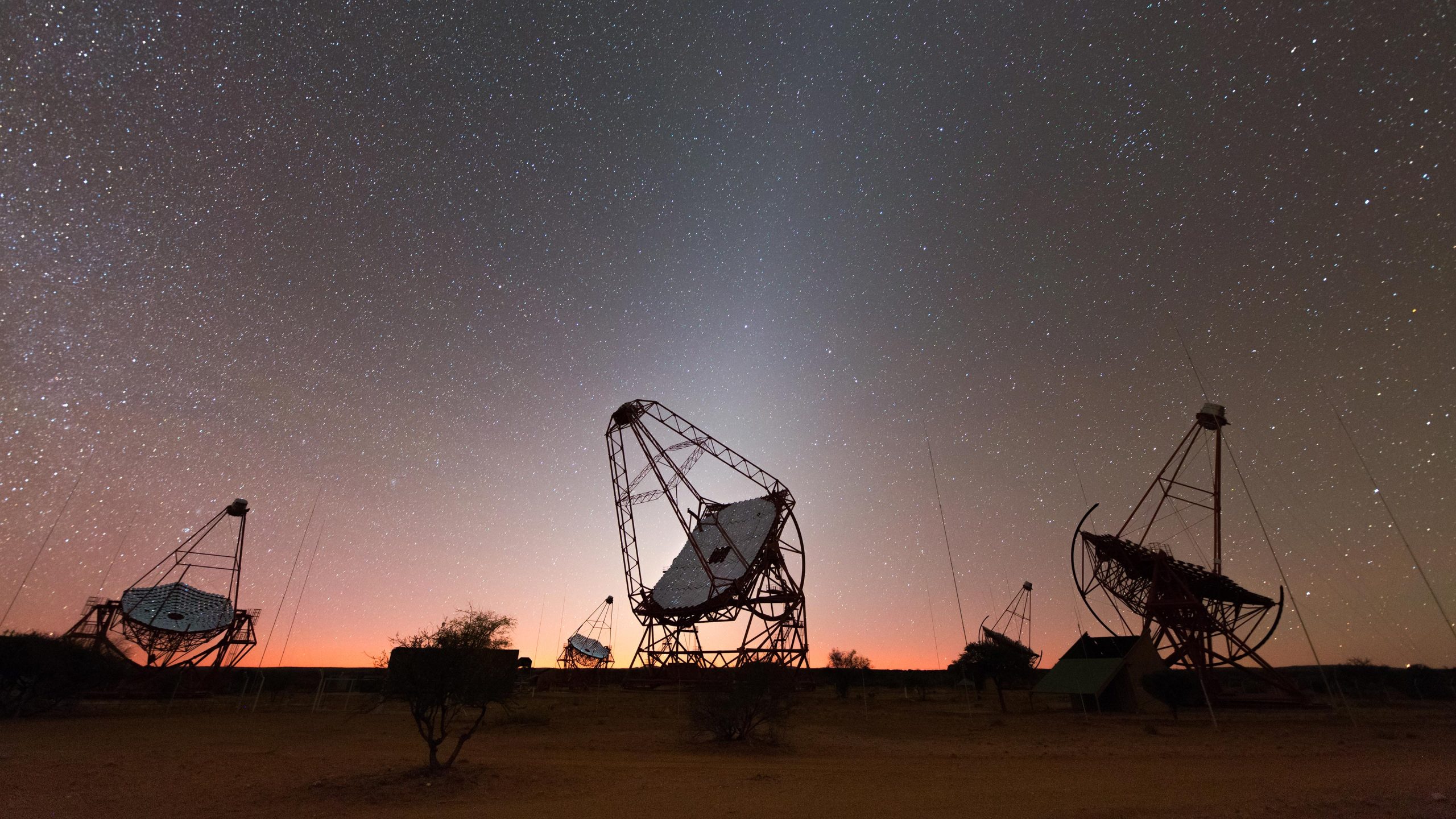
Prompted by the HAWC detection, the H.E.S.S. Observatory initiated an observation campaign of the SS 433 system. This campaign resulted in around 200 hours of data and a clear detection of gamma-ray emission from the jets of SS 433. The superior angular resolution of the H.E.S.S. telescopes in comparison to earlier measurements allowed the researchers to pinpoint the origin of the gamma-ray emission within the jets for the first time, yielding intriguing results:
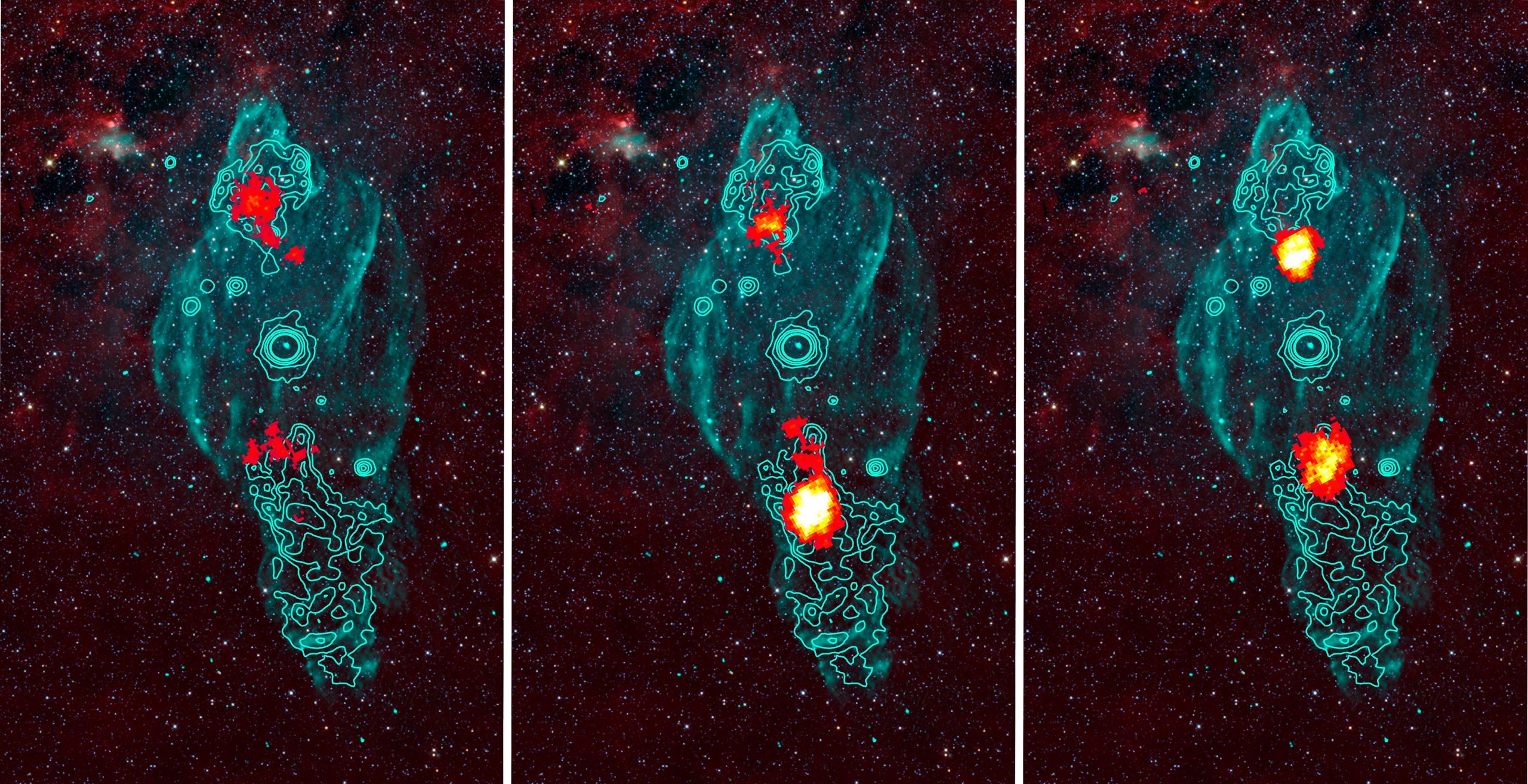
While no gamma-ray emission is detected from the central binary region, emission abruptly appears in the outer jets at a distance of about 75 light-years either side of the binary star, in accordance to previous X-ray observations.
However, what surprised the astronomers most, was a shift in the position of the gamma-ray emission when viewed at different energies.
The gamma-ray photons with the highest energies of more than 10 teraelectron-volts, are only detected at the point where the jets abruptly reappear (see figure 2c). By contrast, the regions emitting gamma rays with lower energies appear further along each jet (see figure 2).
“This is the first-ever observation of energy-dependent morphology in the gamma-ray emission of an astrophysical jet,” remarks Laura Olivera-Nieto, from the Max-Planck-Institut für Kernphysik in Heidelberg, who was leading the H.E.S.S. study of SS 433 as part of her doctoral thesis. “We were initially puzzled by these findings. The concentration of such high energy photons at the sites of the X-ray jets’ reappearance means efficient particle acceleration must be taking place there, which was not expected.”
The Science Behind the Phenomenon
The scientists did a simulation of the observed energy dependence of the gammy-ray emission and were able to achieve the first-ever estimate of the velocity of the outer jets. The difference between this velocity and the one with which the jets are launched suggests that the mechanism that accelerated the particles further out is a strong shock- a sharp transition in the properties of the medium. The presence of a shock would then also provide a natural explanation for the x-ray reappearance of the jets, as accelerated electrons also produce x-ray radiation.
“When these fast particles then collide with a light particle (photon), they transfer part of their energy – which is how they produce the high-energy gamma photons observed with H.E.S.S. This process is called the inverse Compton effect,” explains Brian Reville, group leader of the Astrophysical Plasma Theory group at the Max Planck Institute for Nuclear Physics in Heidelberg.
Unveiling Particle Acceleration in SS 433
“There has been a great deal of speculation about the occurrence of particle acceleration in this unique system — not anymore: the H.E.S.S. result really pins down the site of acceleration, the nature of the accelerated particles, and allows us to probe the motion of the large-scale jets launched by the black hole,” points-out Jim Hinton, Director of the Max Planck Institute for Nuclear Physics in Heidelberg and Head of the Non-thermal Astrophysics Department.
“Just a few years ago, it was unthinkable that ground-based gamma-ray measurements could provide information about the internal dynamics of such a system” adds coauthor Michelle Tsirou, a postdoctoral researcher at DESY Zeuthen.
However, nothing is known about the origin of the shocks at the sites where the jet reappears. “We still don’t have a model that can uniformly explain all the properties of the jet, as no model has yet predicted this feature” explains Olivera-Nieto. She wants to devote herself to this task next — a worthwhile goal, as the relative proximity of SS 433 to Earth offers a unique opportunity to study the occurrence of particle acceleration in relativistic jets. It is hoped that the results can be transferred to the thousand-times larger jets of active galaxies and quasars, which would help solve the many puzzles concerning the origin of the most energetic cosmic rays.
Reference: “Acceleration and transport of relativistic electrons in the jets of the microquasar SS 433” by H.E.S.S. Collaboration*†, F. Aharonian, F. Ait Benkhali, J. Aschersleben, H. Ashkar, M. Backes, V. Barbosa Martins, R. Batzofin, Y. Becherini, D. Berge, K. Bernlöhr, B. Bi, M. Böttcher, C. Boisson, J. Bolmont, M. de Bony de Lavergne, J. Borowska, M. Bouyahiaoui, M. Breuhaus, R. Brose, A. M. Brown, F. Brun, B. Bruno, T. Bulik, C. Burger-Scheidlin, S. Caroff, S. Casanova, R. Cecil, J. Celic, M. Cerruti, T. Chand, S. Chandra, A. Chen, J. Chibueze, O. Chibueze, G. Cotter, S. Dai, J. Damascene Mbarubucyeye, A. Djannati-Ataï, A. Dmytriiev, V. Doroshenko, K. Egberts, S. Einecke, J.-P. Ernenwein, M. Filipovic, G. Fontaine, M. Füßling, S. Funk, S. Gabici, S. Ghafourizadeh, G. Giavitto, D. Glawion, J.-F. Glicenstein, G. Grolleron, L. Haerer, J. A. Hinton, W. Hofmann, T. L. Holch, M. Holler, D. Horns, M. Jamrozy, F. Jankowsky, A. Jardin-Blicq, V. Joshi, I. Jung-Richardt, E. Kasai, K. Katarzyński, R. Khatoon, B. Khélifi, S. Klepser, W. Kluźniak, Nu. Komin, K. Kosack, D. Kostunin, A. Kundu, R. G. Lang, S. Le Stum, F. Leitl, A. Lemière, J.-P. Lenain, F. Leuschner, T. Lohse, A. Luashvili, I. Lypova, J. Mackey, D. Malyshev, D. Malyshev, V. Marandon, P. Marchegiani, A. Marcowith, G. Martí-Devesa, R. Marx, A. Mehta, A. Mitchell, R. Moderski, L. Mohrmann, A. Montanari, E. Moulin, T. Murach, K. Nakashima, M. de Naurois, J. Niemiec, A. Priyana Noel, S. Ohm, L. Olivera-Nieto, E. de Ona Wilhelmi, M. Ostrowski, S. Panny, M. Panter, R. D. Parsons, G. Peron, D. A. Prokhorov, G. Pühlhofer, M. Punch, A. Quirrenbach, P. Reichherzer, A. Reimer, O. Reimer, H. Ren, M. Renaud, B. Reville, F. Rieger, G. Rowell, B. Rudak, H. Rueda Ricarte, E. Ruiz-Velasco, V. Sahakian, H. Salzmann, A. Santangelo, M. Sasaki, J. Schäfer, F. Schüssler, U. Schwanke, J. N. S. Shapopi, H. Sol, A. Specovius, S. Spencer, L. Stawarz, R. Steenkamp, S. Steinmassl, C. Steppa, K. Streil, I. Sushch, H. Suzuki, T. Takahashi, T. Tanaka, A. M. Taylor, R. Terrier, M. Tsirou, N. Tsuji, T. Unbehaun, C. van Eldik, M. Vecchi, J. Veh, C. Venter, J. Vink, T. Wach, S. J. Wagner, F. Werner, R. White, A. Wierzcholska, Yu Wun Wong, M. Zacharias, D. Zargaryan, A. A. Zdziarski, A. Zech, S. Zouari and N. Żywucka, 25 January 2024, Science.
DOI: 10.1126/science.adi2048
Never miss a breakthrough: Join the SciTechDaily newsletter.
Follow us on Google and Google News.
9 Comments
It has long fascinated me as a patent examiner, now retired, that people can see bent spacetime as brilliant and yet somehow also undeniable, as in undeniably obvious, with no valid alternative. The excuse is quite authoritarian and socially engineered, as no one can completely rule out a variable “c,” but reverse social engineers can easily pretend there’s some mysterious gravity theory that lets objects of different masses fall at different rates, and then victoriously disprove it in hundreds of different ways, and consequently pretend to have proven Einstein’s gravity correct too many times to even count. Only alternative I know is to go back to some kind of universe with space and time not married by an imaginary constancy in “c,” meaning replace constant “c” with light bending, not space or time bending, in other words if light in a vacuum bends due to gravity then it’s due to changes in speed just like every other object following a bent path in gravity – namely the outside edge travels a bit further than the inside edge. It has nothing to do with questioning time dilation and length contraction in SR, particularly since SR is properly seen as a flat space theory. No idea why anyone would want their name associated with such easily an disproved gravity notion other than to get credit for a hanging a golden figleaf award on Einstein’s gravity.
correction: No idea why anyone would want their name associated with such an easily disproved gravity notion as one with different masses falling a different rates, other than to get credit for hanging a golden authoritarian figleaf on Einstein’s gravity.
“an easily disproved gravity notion as one with different masses falling at different rates”
It’s always described as a quantum gravity notion. Applied to two bodies dropped side-by-side it seems too anti-entanglement to be quantum gravity, however.
There is an inescapable aspect of quantizing gravity that could be related to a complete lack of entanglement, but that would be the idea that there can exist a gravity source that is a combination of being so distant and so low in mass that it is for all intents and purposes entirely undetectable and thus easily ignored, like people who won’t fall for Einstein’s bent spacetime genius.
Hang on, i thought gamma rays, like all of the electromagnetic spectrum, travel at the speed of light. Why does your article speak of gamma rays being “accelerated” to one sixth of the speed of light. Was my high school physics teacher wrong or is this sensationalis reporting of a nothing story?
People on Earth are counting on the brave scientists to solve that mistery. Until that happens no one will be able to sleep at night.
Have to say the graphics of the image is great, if you were to see with the eye only the areas of light emitting would be visible, having a data simulation image breakdown of the areas where partials are being accelerated shows the full effect explaining most questions detection. I use the image for screen saver picture.
Existing theories are in trouble since day one. Speed of light can not bi the highest speed in the Universe, it just doesn’t make sense. There wouldn’t be any chance of any communication between any entity in the whole Universe, and that is surely not the case.
This website is very helpful for students it’s amazing
Universe seems to call for a zero-mass carrier of gravity information that quantizes energy differently than light, creating a different wave-particle relationship, one unlike that seen with electro-magnetism. The size-scale (action locus) of a gravity information carrier needs to be completely independent of the carrier energy. Putting it simply, individual light carriers need increased energy if they are to be more finely focused, gravity carriers do not. Another thing about quantizing gravity is it has to make gravity more realistic, it has to give it limits and it appears these limits always have intriguing realistic cognitive equivalents, in contrast to electromagnetic theory.