

Playing football and soccer is widely recognized for its potential to lead to concussions and other head injuries. However, a question arises regarding tennis: At what speed would a tennis ball need to travel to potentially cause a traumatic brain injury?
Researchers from
, a nationally ranked private university in Dallas, found that tennis ball head injuries are possible, but rare. Their detailed computational study – utilizing the same technique widely used to predict what head injuries might occur in a car accident – has been published in the ASME Journal of Applied Mechanics.
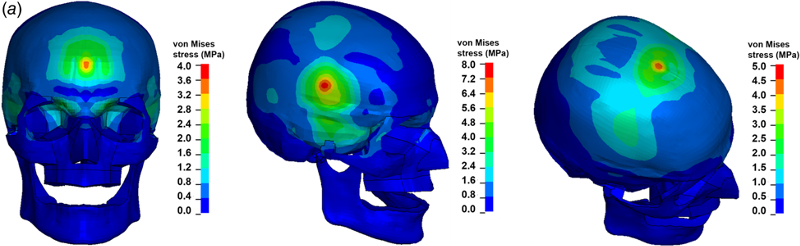
Xin-Lin Gao, a mechanical engineering professor at SMU, and Yongqiang Li, a former SMU PhD student who worked with Gao, used computer modeling of the human form and a tennis ball to determine what would happen to a man’s head if it was hit by a tennis ball at different speeds, locations and angles.
They found:
- Mild traumatic brain injuries, or concussions, are rare, but can happen when the velocity of the tennis ball is higher than 40 meters per second. To put that in perspective, that’s faster than a cheetah can run.
- A ball striking the side of the head was most likely to cause a head injury, compared to being struck in the forehead or the top of the head.
- Head injuries were also more common when the ball hit someone at a 90-degree angle, versus a 30- or 60-degree angle.
- But spinning of the ball was not found to have any significant impact on causing a head injury.
“Understanding and protecting against head injuries induced by tennis ball impacts is very important, given that tennis is a worldwide sport with tens of millions of participants every year,” Gao said.
Gao and Li, who is now an associate professor at the Nanjing University of Aeronautics and Astronautics, were specifically focused on determining if a tennis ball could cause a head injury that was severe enough to be classified as a traumatic brain injury — when a forceful bump, blow or jolt to the head or body causes a disruption to the normal function of the brain.
Concussions are classified as “mild” traumatic brain injuries because they aren’t life-threatening. But they can cause lasting problems for weeks or months, such as headaches, dizziness, and difficulty with concentration.
More research is needed for women and children, though lead researcher Gao said the findings would likely be similar for both groups.
How the study was done
For this study, the researchers used two so-called finite element (FE) models: one of a tennis ball and one of a man’s head.
This head model was provided by the Global Human Body Models Consortium, which makes realistic 3D models of men, women, and children that can be used for crash simulations. Researchers regularly use these (FE) models of the head to investigate potential brain injuries to head impacts.
Gao and Li created a computer-generated tennis ball based on experiments with real ones.
A simple way to understand finite element modeling is to look at it as separating a large mathematical problem into a series of smaller ones, or finite elements. This makes the overall problem easier to investigate.
Widely popular with engineers, finite element modeling can, for instance, be used by automaking manufacturers to assess the potential for human injuries from a crash with one of their vehicles.
The SMU study used FE models to predict how the brain would behave when subjected to external forces. The researchers did this by giving a computer system called LS-DYNA several mathematical algorithms that represented characteristics of the ball or the man’s head. For example, an algorithm made for testing rubber elasticity – known as the Ogden hyperelastic model – was used to represent the behavior of brain tissues.
Based on these types of equations, LS-DYNA created 3D simulations of what would happen in real life.
The measurements taken from these simulations are what allowed the researchers to determine if the force of a tennis ball – going at different speeds or hitting a different part of the head – was enough to cause a man’s brain tissue to bang against his skull, leading to a concussion or worse.
To make sure their findings were accurate, Gao and Li validated them with previous TBI research, like experiments on human cadavers and observations of people with known concussions.
Gao and his research team have also published studies on head injuries induced by golf ball strikes and ballistic impacts.
Reference: “Head Injuries Induced by Tennis Ball Impacts: A Computational Study” by Yongqiang Li and Xin-Lin Gao, 3 November 2023, Journal of Applied Mechanics.
DOI: 10.1115/1.4063814
Never miss a breakthrough: Join the SciTechDaily newsletter.
Follow us on Google and Google News.
1 Comment
Playing tennis involves many abrupt as well as extended body movements. I believe a greater risk on the tennis court is a fall and hitting the head on the hard cement surface.