
Close Menu
    Facebook X (Twitter) Instagram
    SciTechDaily
    • Biology
    • Chemistry
    • Earth
    • Health
    • Physics
    • Science
    • Space
    • Technology
    Facebook X (Twitter) Pinterest YouTube RSS
    SciTechDaily
    Home»Space»The Whirlpool Galaxy, Spiral Galaxy M51
    Space

    The Whirlpool Galaxy, Spiral Galaxy M51

    By Jet Propulsion LaboratoryFebruary 27, 2013No Comments2 Mins Read
    Facebook Twitter Pinterest Telegram LinkedIn WhatsApp Email Reddit
    Share
    Facebook Twitter LinkedIn Pinterest Telegram Email Reddit
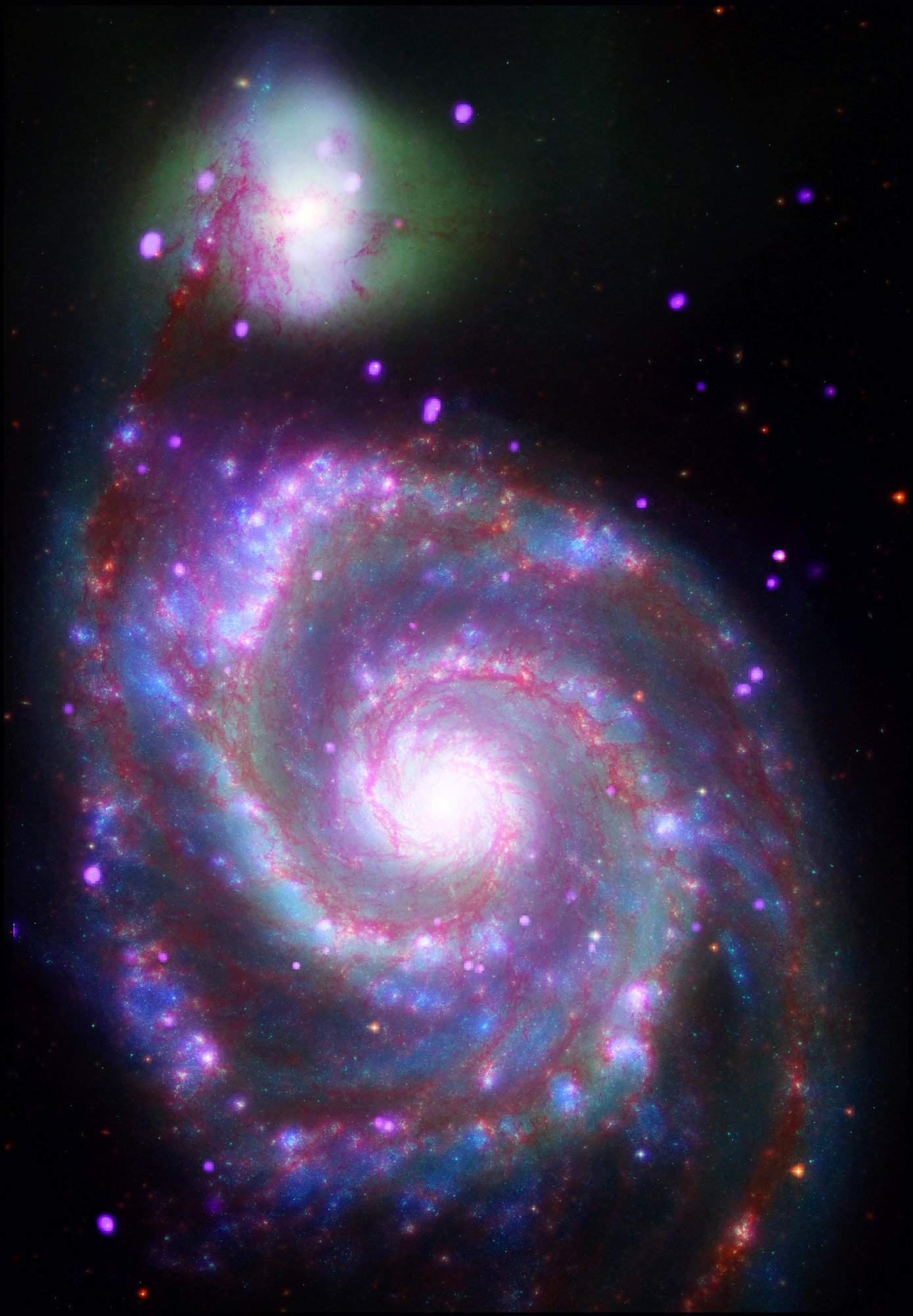
    The Whirlpool Galaxy Spiral Galaxy M51
    Spiral Galaxy M51, which is also known as the Whirlpool Galaxy and is located about 30 million light-years from Earth. Credit: X-ray: NASA/CXC; UV: NASA/JPL-Caltech; Optical: NASA/ESA/STScI/AURA; IR: NASA/JPL-Caltech/ Univ. of Ariz.

    This JPL image of the day shows Spiral Galaxy M51, which is also known as the Whirlpool Galaxy and is located about 30 million light-years from Earth.

    M51, whose name comes from being the 51st entry in Charles Messier’s catalog, is considered to be one of the classic examples of a spiral galaxy. At a distance of about 30 million light-years from Earth, it is also one of the brightest spirals in the night sky.

    A composite image of M51, also known as the Whirlpool Galaxy, shows the majesty of its structure in a dramatic new way through several of NASA’s orbiting observatories. X-ray data from NASA’s Chandra X-ray Observatory reveals point-like sources (purple) that are black holes and neutron stars in binary star systems. Chandra also detects a diffuse glow of hot gas that permeates the space between the stars. Optical data from the Hubble Space Telescope (green) and infrared emission from the Spitzer Space Telescope (red) both highlight long lanes in the spiral arms that consist of stars and gas laced with dust. A view of M51 with the Galaxy Evolution Explorer telescope shows hot, young stars that produce lots of ultraviolet energy (blue).

    The textbook spiral structure is thought to be the result of an interaction M51 is experiencing with its close galactic neighbor, NGC 5195, which is seen just above. Some simulations suggest M51’s sharp spiral shape was partially caused when NGC 5195 passed through its main disk about 500 million years ago. This gravitational tug of war may also have triggered an increased level of star formation in M51. The companion galaxy’s pull would be inducing extra starbirth by compressing gas, jump-starting the process by which stars form.

    Never miss a breakthrough: Join the SciTechDaily newsletter.
    Follow us on Google and Google News.

    Astronomy JPL
    Share. Facebook Twitter Pinterest LinkedIn Email Reddit

    Related Articles

    NASA Lunar Crater Radio Telescope: Illuminating the Cosmic Dark Ages

    May Skywatching Tips: A Rocky Planet Round-Up and a Super Blood Moon Eclipse

    New All-Sky Map of Milky Way’s Outer Reaches Released – Could Offer a New Test of Dark Matter Theories

    Jupiter, Mars, Saturn and Other NASA Skywatching Tips for April 2021

    NASA Analysis: Earth Is Safe From Asteroid Apophis Impact for at Least 100 Years

    Record-Breaking Jet of Particles Spied From a Supermassive Black Hole in the Early Universe

    NASA’s Planetary Defense: “Potentially Hazardous Asteroid” Predicted to Safely Pass by Earth on March 21

    NASA Skywatching Tips for March 2021 [Video]

    New Clues to Remains of Star That Exploded Just Outside Our Galaxy

    Leave A Reply Cancel Reply

    • Facebook
    • Twitter
    • Pinterest
    • YouTube

    Don't Miss a Discovery

    Subscribe for the Latest in Science & Tech!

    Trending News

    The Universe Is Expanding Too Fast and Scientists Can’t Explain Why

    “Like Liquid Metal”: Scientists Create Strange Shape-Shifting Material

    Early Warning Signals of Esophageal Cancer May Be Hiding in Plain Sight

    Common Blood Pressure Drug Shows Surprising Power Against Deadly Antibiotic-Resistant Superbug

    Scientists Uncover Dangerous Connection Between Serotonin and Heart Valve Disease

    Scientists Discover a “Protector” Protein That Could Help Reverse Hair Loss

    Bone-Strengthening Discovery Could Reverse Osteoporosis

    Scientists Uncover Hidden Trigger Behind Stem Cell Aging

    Follow SciTechDaily
    • Facebook
    • Twitter
    • YouTube
    • Pinterest
    • Newsletter
    • RSS
    SciTech News
    • Biology News
    • Chemistry News
    • Earth News
    • Health News
    • Physics News
    • Science News
    • Space News
    • Technology News
    Recent Posts
    • Scientists Overcome Major Quantum Bottleneck, Potentially Transforming Teleportation and Computing
    • Quantum Physics’ Strangest Problem May Hold the Key to Time Itself
    • Scientists Create “Liquid Gears” That Spin Without Touching
    • The Simple Habit That Could Help Prevent Cancer
    • Forgotten Medicinal Plant Shows Promise in Fighting Dangerous Superbugs
    Copyright © 1998 - 2026 SciTechDaily. All Rights Reserved.
    • Science News
    • About
    • Contact
    • Editorial Board
    • Privacy Policy
    • Terms of Use

    Type above and press Enter to search. Press Esc to cancel.