

Dogs Can Tell the Difference Between Intentional and Unintentional Human Actions
Over our long shared history, dogs have developed a range of skills for bonding with human beings. Their ability to make sense of human actions, demonstrated by every “sit,” “lay down,” and “roll over,” is just one such skill. But whether dogs understand human intentions, or merely respond to outcomes, remains unclear. The ability to recognize another’s intentions – or at least conceive of them – is a basic component of Theory of Mind, the ability to attribute mental states to oneself and others, long regarded as uniquely human. Do dogs have this basic component of Theory of Mind, the ability to tell the difference between something done on purpose and something done by accident?
To answer this question, a team of researchers in Germany conducted an experiment that examined how dogs reacted when food rewards were withheld, both intentionally and unintentionally. They found that dogs respond differently depending on whether the actions of the experimenter were intentional or unintentional. This, the researchers say, shows that dogs can distinguish between actions that were done on purpose or accidentally.
The “Unable vs. Unwilling” Experiment Design
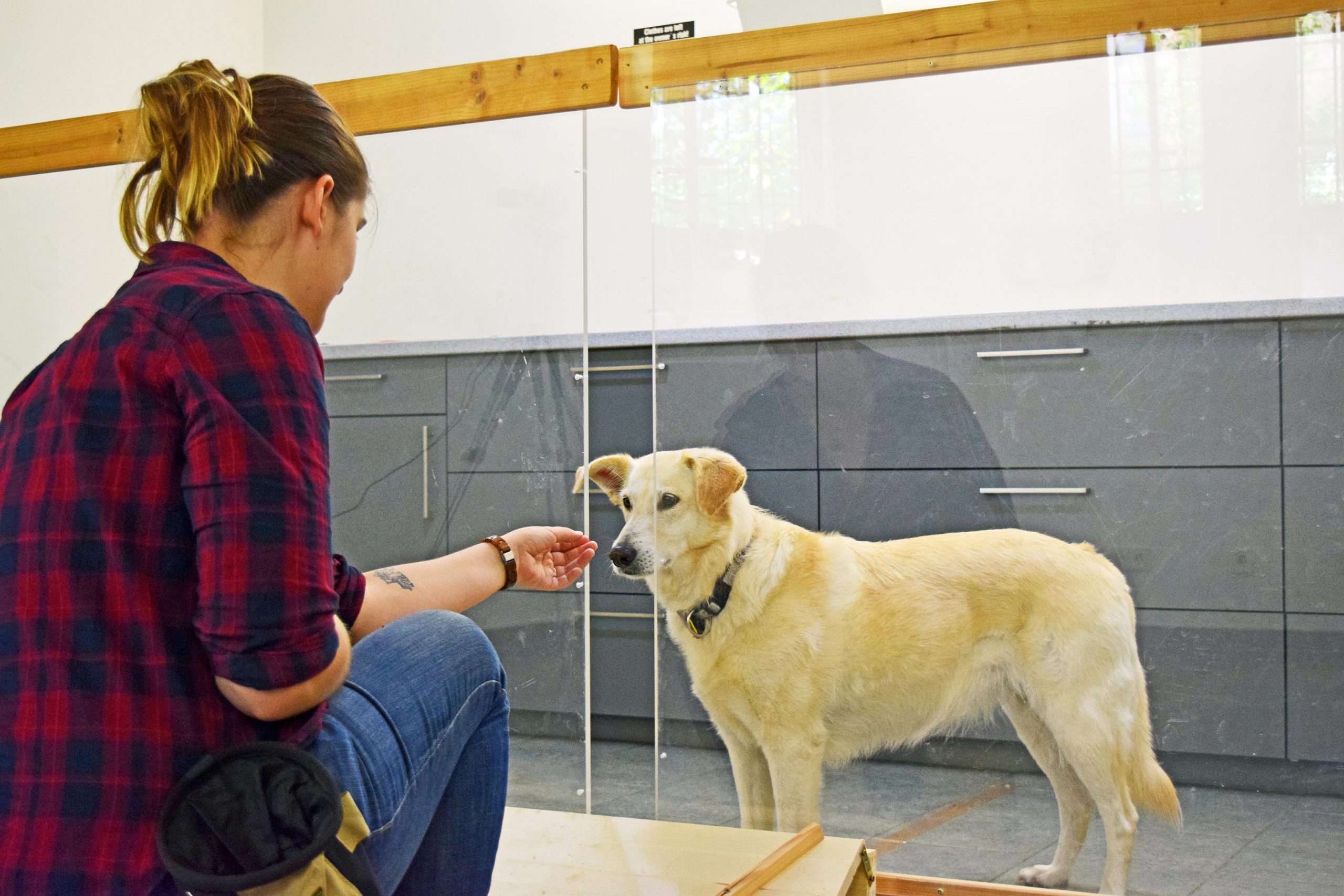
To reach their conclusions, the researchers conducted an experiment using the “unable vs. unwilling” paradigm. This works by examining whether test subjects react differently towards a human experimenter who either intentionally (the unwilling condition) or unintentionally (the unable condition) withholds rewards from them. Despite being an established paradigm in studies of human and animal cognition, the unable vs. unwilling paradigm had never been previously used to investigate dogs.
The experiment was conducted with 51 dogs, each of which was tested under three conditions. In each condition, the dog was separated from the human tester by a transparent barrier. The basic situation was that the experimenter fed the dog pieces of dog food through a gap in the barrier. In the “unwilling” condition, the experimenter suddenly withdrew the reward through the gap in the barrier and placed it in front of herself. In the “unable-clumsy” condition, the experimenter brought the reward to the gap in the barrier and “tried” to pass it through the gap but then “accidentally” dropped it. In the “unable-blocked” condition, the experimenter again tried to give the dog a reward, but was unable to because the gap in the barrier was blocked. In all conditions, the reward remained on the tester’s side of the barrier.
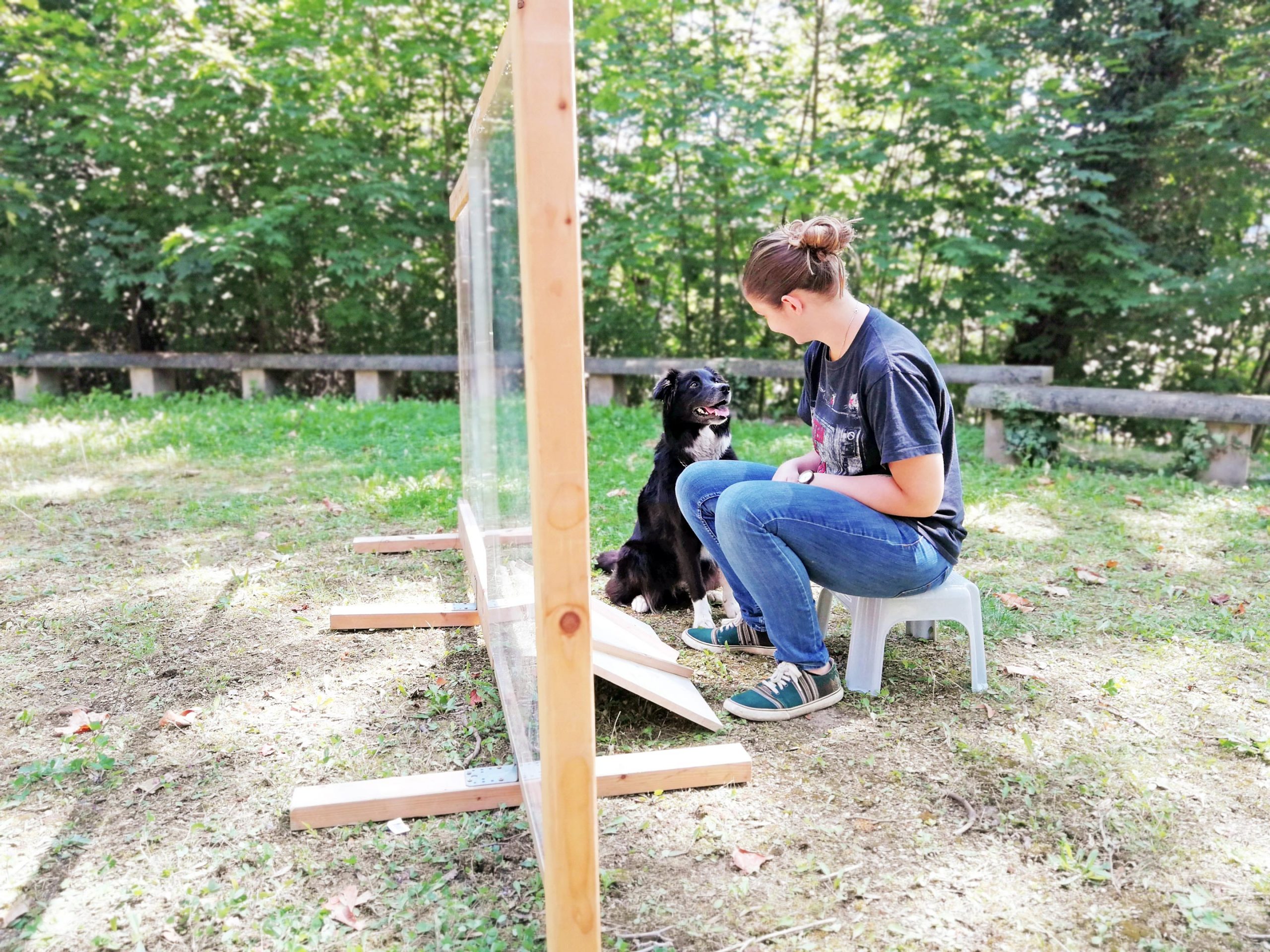
“If dogs are indeed able to ascribe intention-in-action to humans,” says Dr. Juliane Bräuer, “we would expect them to show different reactions in the unwilling condition compared to the two unable conditions. As it turns out, this is exactly what we observed.”
The primary behavior measured by the researchers was the time dogs waited before approaching the reward they were denied. The researchers predicted that, if dogs are able to identify human intentions, they would wait longer before approaching the reward in the unwilling condition, where they were not supposed to have the reward, than in the two unable conditions in which the reward was, in fact, meant for them.
Not only did the dogs wait longer in the unwilling condition than in the unable conditions, they were also more likely to sit or lie down – actions often interpreted as appeasing behaviors – and stop wagging their tails.
“The dogs in our study clearly behaved differently depending on whether the actions of a human experimenter were intentional or unintentional,” says Britta Schünemann, the first author of the study. “This suggests that dogs may indeed be able to identify humans’ intention-in-action,” adds Hannes Rakoczy from the University of Göttingen.
Cautious Interpretation, Promising Insight
The team acknowledges that their findings may be met with skepticism and that further study is needed to address alternative explanations, such as behavioral cues on the part of experimenters or knowledge transfer from prior dog training.
“Nevertheless,” the paper concludes, “the findings present important initial evidence that dogs may have at least one aspect of Theory of Mind: The capacity to recognize intention-in-action.”
Reference: “Dogs distinguish human intentional and unintentional action” by Britta Schünemann, Judith Keller, Hannes Rakoczy, Tanya Behne and Juliane Bräuer, 1 September 2021, Scientific Reports.
DOI: 10.1038/s41598-021-94374-3
Never miss a breakthrough: Join the SciTechDaily newsletter.
Follow us on Google and Google News.
3 Comments
Is heartbreaking those wonderful dogs have been and still are used in most cruel “medical” experiments. Lately just find out how that hell person fauci use dogs in experiments to be eaten alive by some kind of flies.
I dont see how this experiment is accurate due to the fact that the food handlers moves were not genuine as they were pre planned moves with planned intentions and alterior motives focused on one thing (the experiment)!
As a behaviourist this is hard to read Quite simply, these dogs will have an anticipatory response to a static treat, and prior learnt behaviours will be exhibited to receive the treat (such as a sit or wait).
If a treat is dropped the movement of the treat will be more exciting so of course they will move around the partition sooner and of course they will move sooner if their view is blocked. It doesn’t mean they possess the theory of mind, I’m quite shocked by this to be honest!