
What was once a predictably frozen Arctic winter is now shockingly unrecognizable.
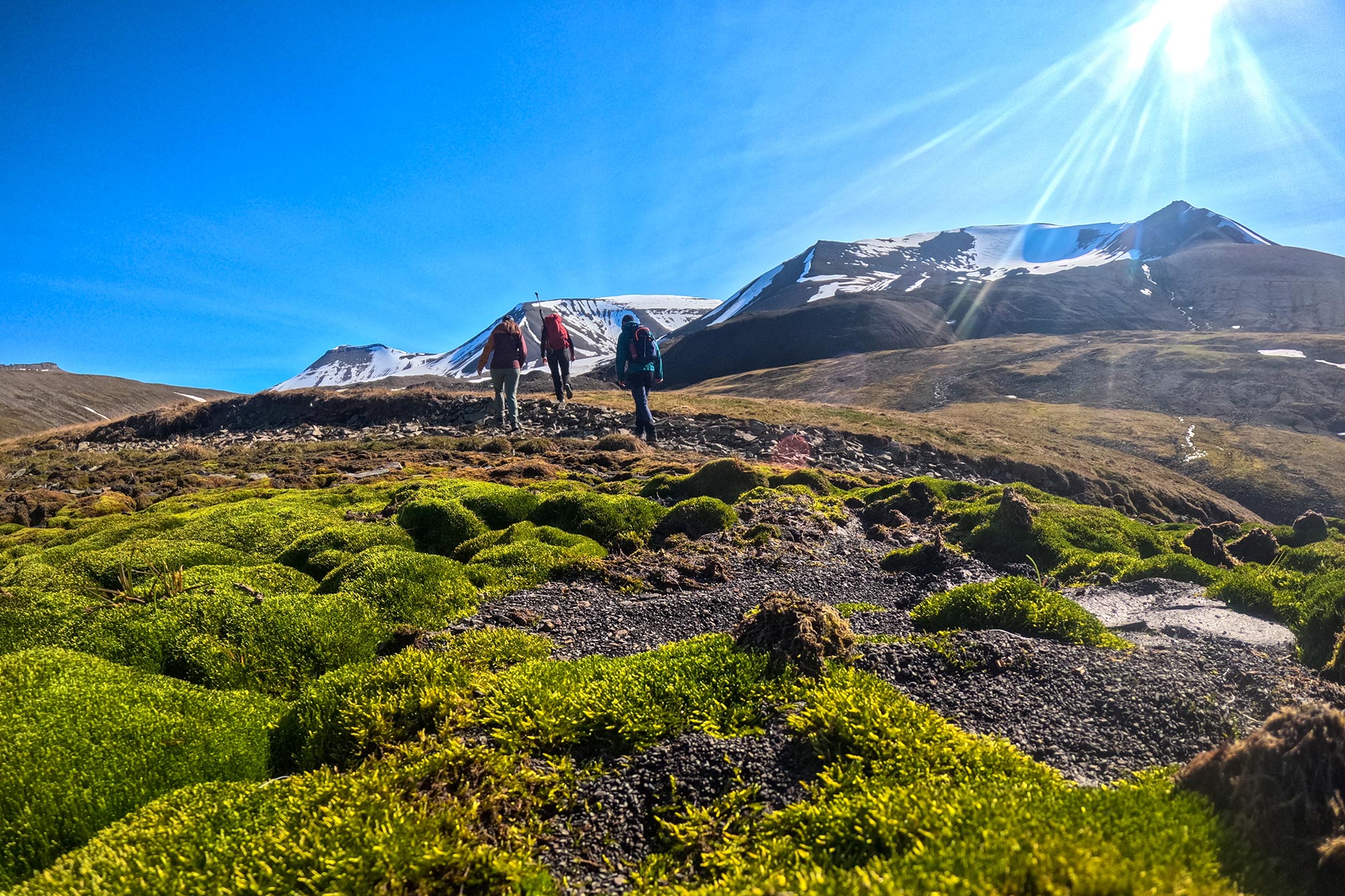
In February 2025, a scientific team in Svalbard expected to study fresh snowfall—but instead found rain, bare tundra, blooming flowers, and meltwater lakes. Their heavy-duty cold-weather gear proved unnecessary as temperatures soared past freezing, exposing the Arctic’s new winter reality.
Arctic Winter Transformed: A Startling Firsthand Encounter
A new commentary in Nature Communications, led by Dr. James Bradley, Reader in Environmental Science at Queen Mary University of London, highlights an alarming transformation unfolding in the Arctic winter. During a research trip to Svalbard in February 2025, Bradley and his team were met not with snow and ice, but with unusually warm temperatures, melting snow, and blooming vegetation.
Svalbard is warming at a pace six to seven times faster than the global average, and its winters are changing even more quickly, with seasonal temperatures rising nearly twice as fast as the yearly mean. The commentary argues that these dramatic shifts are no longer rare anomalies but are becoming a regular part of the Arctic’s evolving climate, upending the long-standing expectation that winters in the region would remain frozen and predictable.
Packed for Ice, Met with Rain
“Standing in pools of water at the snout of the glacier, or on bare, green tundra, was shocking and surreal,” Dr. Bradley describes his experience. “The thick snowpack covering the landscape vanished within days. The gear I packed felt like a relic from another climate.”
The team, expecting extreme cold, had prepared with insulated clothing, thermal layers, and heavy gloves. Instead, they ended up working on the glacier in the rain with their bare hands.
Laura Molares Moncayo, a PhD student at Queen Mary and the Natural History Museum and a co-author on the study, added: “The goal of our fieldwork campaign was to study freshly fallen snow. But over a two-week period, we were only able to collect fresh snow once, as most of the precipitation fell as rain. This lack of snowfall in the middle of winter undermines our ability to establish a representative baseline for frozen-season processes. The unexpected melt not only disrupted our sampling plan, but also made us question how safe or feasible winter fieldwork really is under such rapidly changing conditions.”
Arctic Tipping Point: From Prediction to Reality
This firsthand experience corroborates long-standing projections about Arctic amplification, but it also underscores the alarming speed at which these changes are taking hold. The crossing of the 0°C melting threshold has a transformative impact on the physical environment, the dynamics of local ecosystems, and the very methodology of conducting scientific research in the Arctic during winter.
The implications of these rapid winter changes for the Arctic ecosystem are far-reaching. Winter warming events can disrupt everything from microbial carbon cycling to the survival of Arctic wildlife. These events may also create a feedback loop, accelerating permafrost thaw, microbial carbon degradation, and the release of greenhouse gases across the Arctic. The observed meltwater pooling above frozen ground, forming vast temporary lakes and reducing snow cover to zero in large areas, further exposes the bare ground surface and leads to widespread blooms of biological activity.
Climate Policy Must Catch Up
The commentary calls for urgent action and highlights critical policy implications. “Climate policy must catch up to the reality that the Arctic is changing much faster than expected, and winter is at the heart of that shift,” states Dr. Bradley.
The commentary urgently calls for increased investment in wintertime Arctic monitoring, highlighting a significant lack of data and understanding regarding Arctic systems during this fastest-changing season. More observations and experimentation are crucial, not only to establish baselines but also to project future impacts. Furthermore, the authors stress that policymaking must shift from reactive to anticipatory strategies, recognising winter as a critical season of risk. The challenges already faced by well-equipped scientific bases due to mid-winter warming underscore the immense pressure this might place on remote Indigenous Arctic communities, their infrastructure, transport, and emergency responses.
The Future of Arctic Science in Jeopardy
The unexpected conditions during fieldwork, including the thin and slushy snow that hindered snowmobile access to field sites, forced researchers to reconsider how and even whether they can continue winter science as usual. This also presents new safety concerns, including rescue efforts and the ability for the researchers to retreat quickly to the safety of the research station if they encounter polar bears while working in the field.
The commentary, “Svalbard winter warming is reaching melting point,” serves as a stark reminder of the accelerating pace of climate change in the Arctic, emphasising that these anomalies are, in fact, the new Arctic reality.
The article involves authors from Queen Mary University of London, the Mediterranean Institute of Oceanography in Marseille, France, The Natural History Museum in London, University of Naples Federico II in Italy, the CNR Institute of Polar Science in Italy.
The Unknown Impact of a Rapidly Changing Arctic
“We are still unaware of the consequences that these recurring events are bringing to Arctic ecosystems, especially during the winter period, where conditions are more complex and data is scarce,” said Donato Giovannelli, an geomicrobiologist at the University of Naples Federico II in Italy and one of the senior authors on the paper. “We might have been too cautious with our messages. Irreversible changes to the Arctic climate are happening in front of our own eyes.”
Reference: “Svalbard winter warming is reaching melting point” by James A. Bradley, Laura Molares Moncayo, Gabriella Gallo, Jacopo Brusca, Tessa Viglezio, Jacopo Pasotti and Donato Giovannelli, 21 July 2025, Nature Communications.
DOI: 10.1038/s41467-025-60926-8
Never miss a breakthrough: Join the SciTechDaily newsletter.
Follow us on Google and Google News.
9 Comments
“The unexpected conditions during fieldwork, including the thin and slushy snow that hindered snowmobile access to field sites, forced researchers to reconsider how and even whether they can continue winter science as usual.”
Get some chains and learn how to put them on a 4WD vehicle. Earth has had cycles like this in the past, this is not a new pattern.
Worldwide population growth needs to stop now. The bottom line is that human beings are the root cause for climate change
Climate change is a myth. The Earth always had these cycles
Climate change is not a problem for the earth. A planet can handle extremes. At one time earth was a ball of molten lava.
Climate change is a problem for human beings who have been on earth for a relatively short period of time, and can only thrive in reasonably narrow bands of climate conditions.
Your argument that “earth had these cycles” is a distraction designed to ignore the very obvious signs of climate change. There’s not much debate about it among journal-published climate scientists – not because there’s some conspiracy afoot, but because the signs are clear.
“…, and can only thrive in reasonably narrow bands of climate conditions.”
How do you define “narrow?” Humans have colonized the Earth from the coldest Arctic to the hottest (dry) Sahara and (wet) Amazon, even before technology made it easier. As to thriving, the availability of food is more limiting than the temperature. One cannot grow food in ice or permafrost, thus limiting the number of people that can be supported in polar climates, and typically restricting them to living on the coast. The high Heat Indexes of tropical areas are not only NOT a barrier to growing food, but according to Sir David Attenborough, while the tropics are only about 2% of the land area, they support 50% of the known species, many not found anywhere else.
Recent LIDAR evidence suggests that the Amazon basin once supported many more people than currently. We don’t yet know what curtailed that culture. However, from my perspective, humans have demonstrated an ability to adapt to every climate on Earth, providing that food can be obtained, not just within some narrow temperature bands.
Is there an optimal range for humans? Certainly. That is true of every organism, not just humans. Warmer climate can be adapted to by migration or technology. There is plenty of room for people in Siberia and what is currently the boreal forests of North America. Humanity is not in any particular danger from a trend of +1 deg C per century GMT, and even less so with technology and energy allowing ‘climate-controlled’ buildings and vehicles.
https://scitechdaily.com/lost-amazon-civilization-built-a-revolutionary-farming-system-and-archaeologists-have-just-uncovered-it/
How do you propose stopping the growth? What will happen to the businesses and workers who specialize in meeting the needs of children?
Since The King of the USA is making it Great Again by sacking thousands of people formerly of use and value to US society, who cares about businesses and workers caring about the needs of children?
As for scientists studying Arctic winters, soon there’ ll be no need for them which will save the USA lots more dosh not wasted on scientific research.
Please, Rob! “Of use and value?” I have seen the government-sector employment explode during my lifetime. There was once a time when the relatively low pay was compensated by job security. Then the pay was increased to match the private sector, and even more were hired. It isn’t just a coincidence that Reagan joked that the most feared statement for a citizen to hear is, “We’re from the government and we’re here to help you.” There is plenty of evidence that the government has grown fat and lazy at the taxpayer’s expense! There is not only redundancy, but also unnecessary people who justify their jobs by passing even more restrictions and regulations, that are frequently ineffective, let alone unnecessary. “The best government is the least government.”
What is “soon?” The last time I did a back-of-envelope calculation I came up with an estimate of about 10-20,000 years for Greenland to melt back to what it was during the Eemian. That is longer than civilization has existed. People have been claiming that an Arctic free of ice was imminent, for decades, and it hasn’t happened.
Hyperbole may make you sound wise and sophisticated, but it contributes little to an informed discussion. “In God we trust. All other bring facts.”