
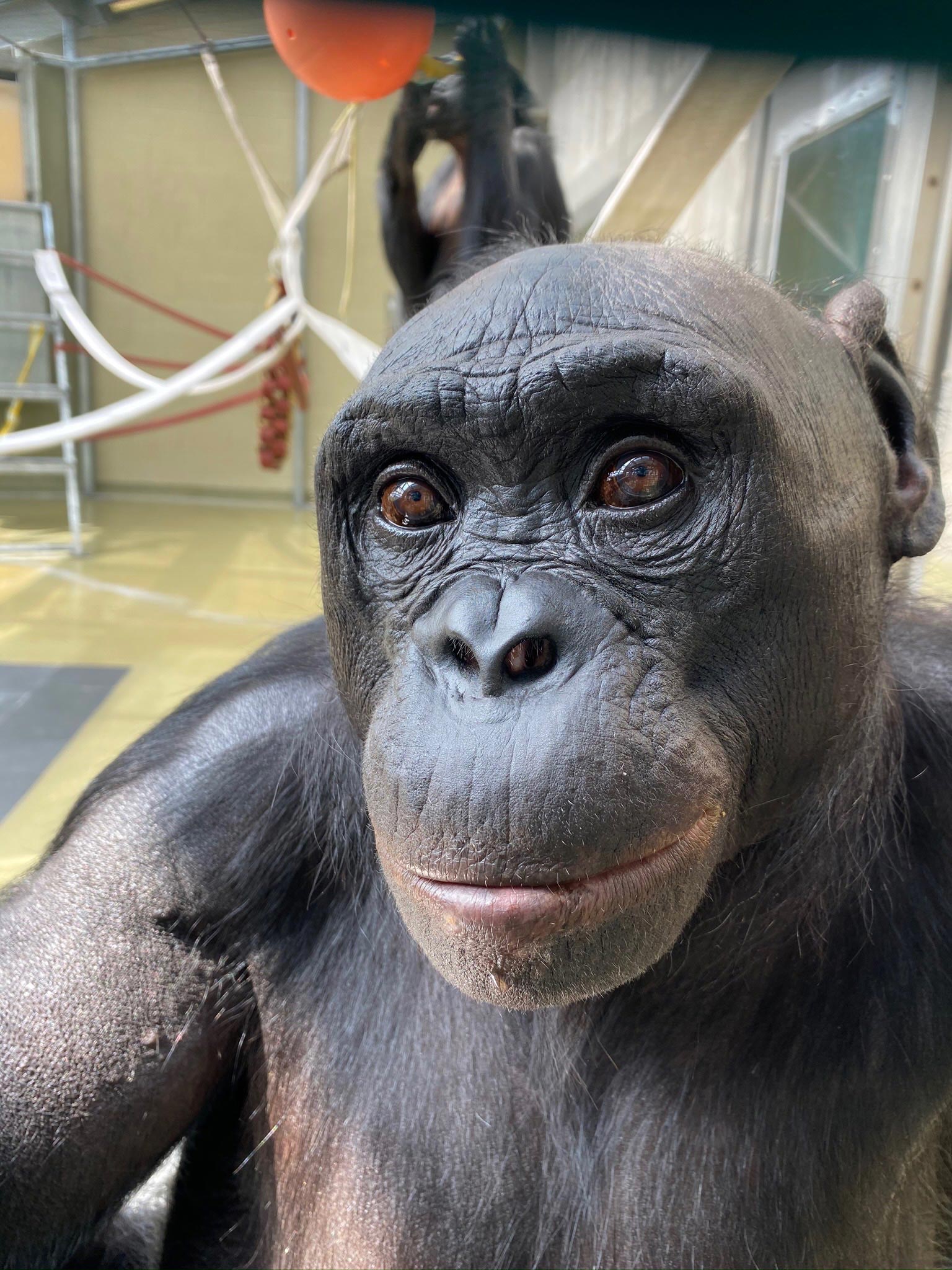
A bonobo demonstrated the ability to track imaginary objects in controlled tests, challenging the belief that imagination is uniquely human and hinting at deep evolutionary roots.
In a set of carefully designed experiments modeled on children’s tea parties, researchers at Johns Hopkins University found that an ape could engage in pretend play. The results mark the first controlled demonstration that an ape can imagine objects that are not actually there, a skill long considered uniquely human.
Across three separate tests, the bonobo interacted with invisible juice and imaginary grapes in a consistent and reliable way. The performance challenges longstanding assumptions about the limits of animal cognition.
The researchers conclude that the ability to understand pretend objects falls within the mental capacities of at least one enculturated ape. They suggest this ability could trace back 6 to 9 million years to a common ancestor shared by humans and other apes.
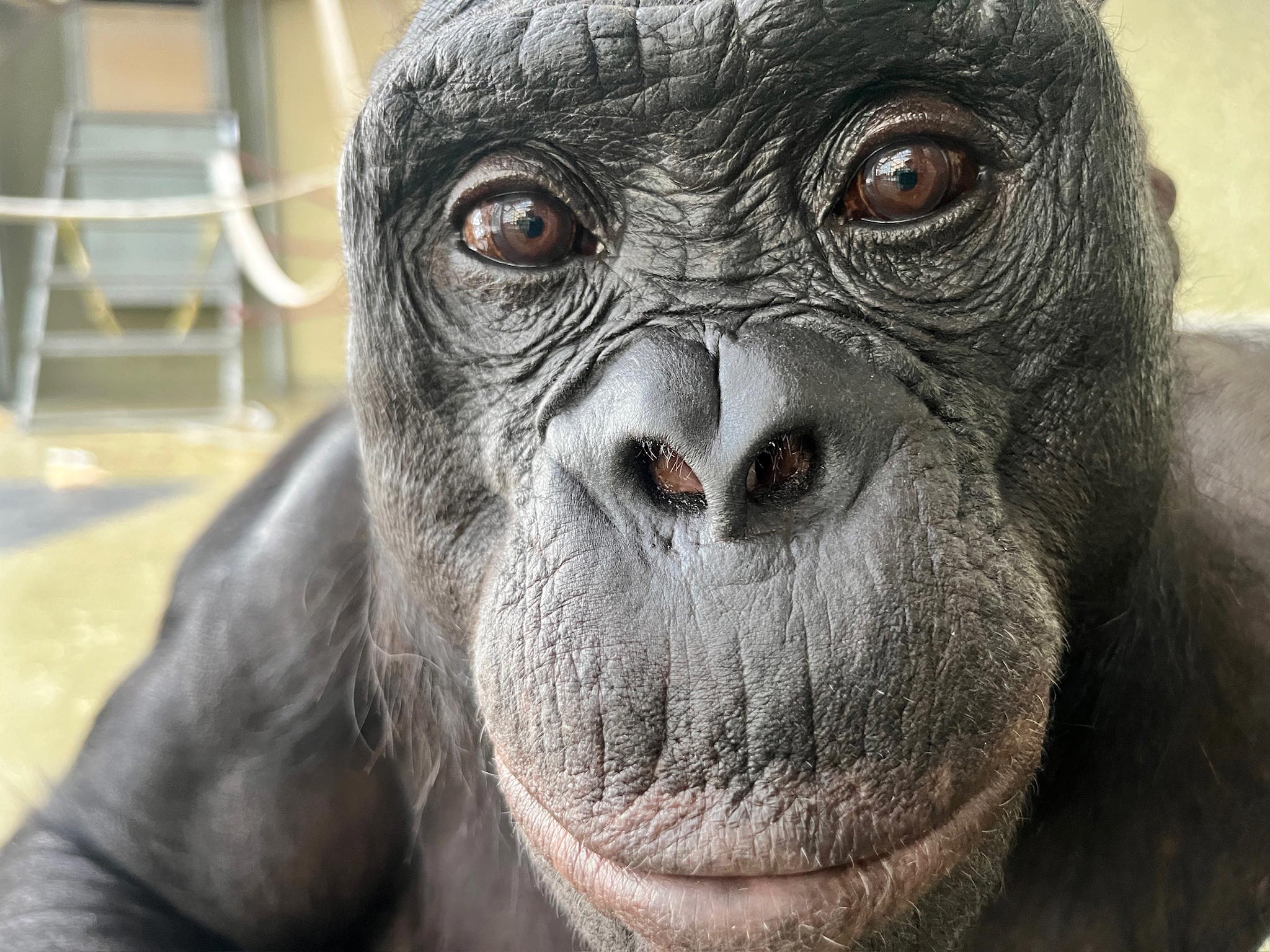
Ape Imagination Upends Human Uniqueness in Science Study
“It really is game-changing that their mental lives go beyond the here and now,” said co-author Christopher Krupenye, a Johns Hopkins assistant professor in the Department of Psychological and Brain Sciences who studies how animals think. “Imagination has long been seen as a critical element of what it is to be human, but the idea that it may not be exclusive to our species is really transformative.
“Jane Goodall discovered that chimps make tools, and that led to a change in the definition of what it means to be human, and this, too, really invites us to reconsider what makes us special and what mental life is out there among other creatures.”
The study was published on February 5 in Science.
In a series of tea party-like experiments, Johns Hopkins University researchers demonstrate for the first time that apes can use their imagination and play pretend, an ability thought to be uniquely human. Credit: Johns Hopkins University
Pretend Play in Human Children and Animal Anecdotes
Human children begin engaging in make-believe activities such as tea parties by around age two. Even infants as young as 15 months show signs of surprise when someone pretends to pour out a cup and then acts as if it still contains a drink.
Until now, no controlled experiments had tested whether nonhuman animals could truly understand pretense, despite scattered reports from both wild and captive settings.
In the wild, for instance, young female chimpanzees have been seen carrying sticks in ways that resemble how mothers hold infants. In captivity, one chimpanzee appeared to drag invisible blocks across the floor after previously playing with real wooden ones.
Testing Bonobo Kanzi With Tea Party Experiments
Krupenye and co-author Amalia Bastos, a former Johns Hopkins postdoctoral fellow now lecturing at Scotland’s University of St. Andrews, set out to examine this question under controlled conditions.
They designed a series of tea party-style tasks for Kanzi, a 43-year-old bonobo living at Ape Initiative. Kanzi had previously been described as engaging in pretend behavior and can respond to spoken questions by pointing.
During each session, Kanzi sat across from an experimenter at a table arranged with either empty pitchers and cups or bowls and jars.
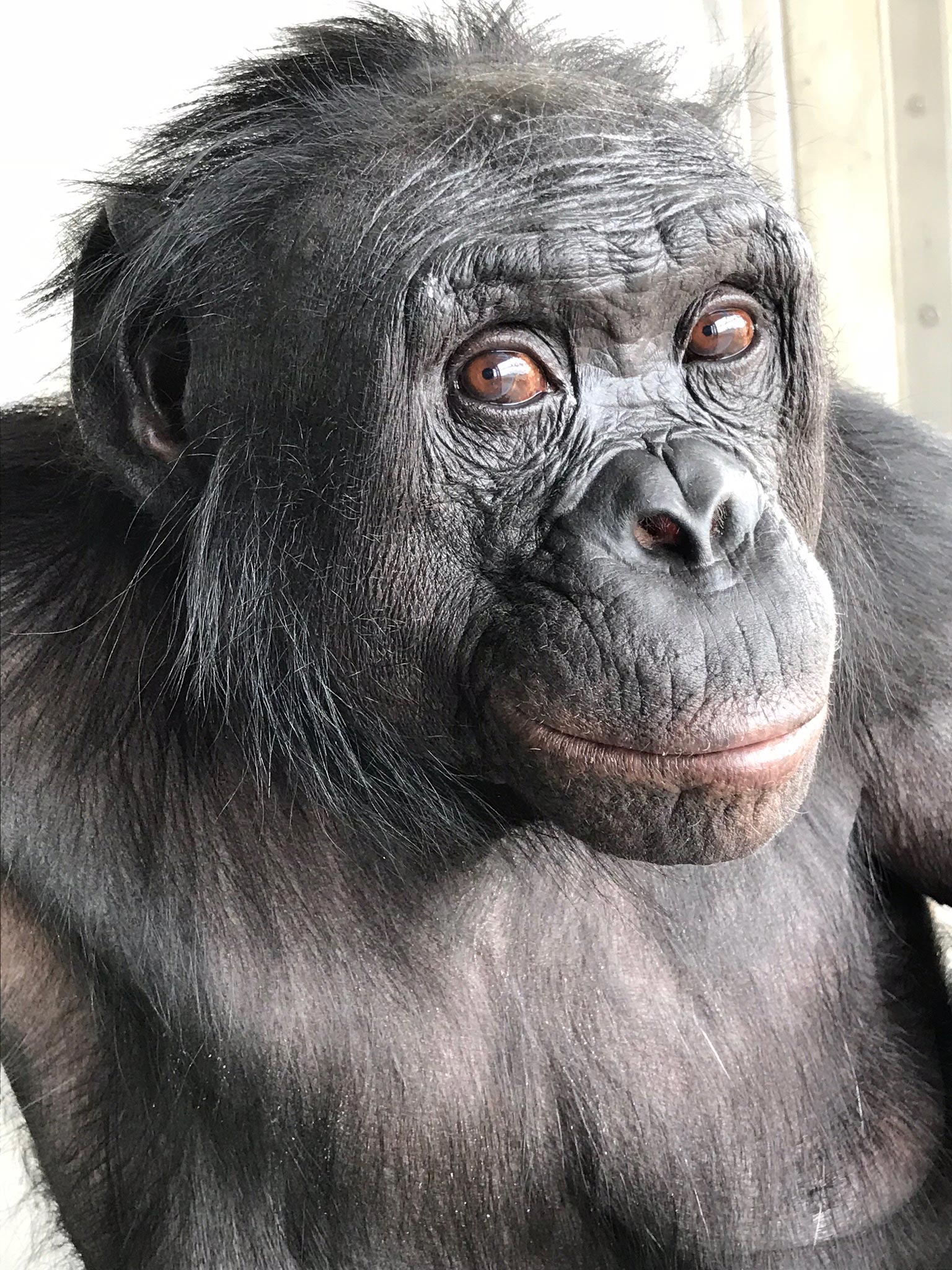
Kanzi Identifies Pretend Juice in Controlled Cognition Test
In the first experiment, two clear cups and an empty transparent pitcher were placed on the table. The experimenter acted as if they were pouring imaginary juice into both cups, then pretended to empty one of them. After this demonstration, Kanzi was asked, “Where’s the juice?”
Most of the time, Kanzi pointed to the cup that was supposed to still contain the pretend juice. He continued to choose correctly even when the position of the cups was changed.
To rule out the possibility that Kanzi believed there might be real liquid inside the cup, the researchers conducted a second test. This time, one cup contained actual juice, while the other held only imaginary juice. When asked which he wanted, Kanzi almost always selected the cup with real juice.
Bonobo Demonstrates Pretend Play, Revealing Evolutionary Roots of Imagination
In a third task, the researchers repeated the setup using grapes instead of juice. The experimenter pretended to take a grape from an empty container and place it into one of two jars, then acted as if they had emptied one jar. When asked, “Where’s the grape?” Kanzi again indicated the correct location of the pretend grape. Although he did not answer correctly every single time, his responses were consistently above chance.
“It’s extremely striking and very exciting that the data seem to suggest that apes, in their minds, can conceive of things that are not there,” Bastos said. “Kanzi is able to generate an idea of this pretend object and at the same time know it’s not real.”
The researchers say the work opens the door to further investigations into whether other apes or species can engage in pretend play or mentally track imaginary items. They are also interested in studying additional aspects of imagination, including whether apes can think about future events or consider what others might be thinking.
“Imagination is one of those things that in humans gives us a rich mental life. And if some roots of imagination are shared with apes, that should make people question their assumption that other animals are just living robotic lifestyles constrained to the present,” Krupenye said. “We should be compelled by these findings to care for these creatures with rich and beautiful minds and ensure they continue to exist.”
Reference: “Evidence for representation of pretend objects by Kanzi, a language-trained bonobo” by Amalia P. M. Bastos and Christopher Krupenye, 5 February 2026, Science.
DOI: 10.1126/science.adz0743
Never miss a breakthrough: Join the SciTechDaily newsletter.
Follow us on Google and Google News.
28 Comments
Perhaps he thinks it is invisible juice, not play juice, and doesn’t want to try it.
It probably shouldn’t surprise us that a species with so few genetic differences can think.
And yet many people can’t think.
Only seeing imaginary things and no concept of reality.
thanks for this
Given that most primates have brain development until about 3 years of age or so, and, a 2 year old sapiens and a 2 year old chimpanzee are not that far apart…
….its not surprising that a chimpanzee is capable of what a 2 year old sapiens is, such imagination.
When animals play, that involves imagination.
🙂
Interesting !!
Some of these scientists are so stupid. My cat plays with her imaginary friends all the time.
I agree abt the cat as mine does too. Also the exercise about the juice could also, or in part, be attributed to non-human animals’ very high sense of smell.
Agreed! My pomeranian gets a tiny mouthful of Kibbles ‘n Bits and slings that bite worth down onto the floor, making the round ball-like kibble pieces bounce up into the air, where he catches and bounces them around and across the room, with his little butt up in the air, barking and pouncing to throw and catch his food, playing with it, pretending like he’s hunting and catching it, or something… it’s the cutest, funniest, sweetest, most innocent and playful thing to watch. I don’t think anyone could resist smiling at seeing this. … =) … Point being, he is absolutely pretending/playing pretend when he does this every morning, and he is not an unusual or atypical example… animals/pets do this kind of stuff (playing pretend) all the time! What kinds of animals do these scientists usually ‘observe’??
He passed away in 2025, you should revise the “just did this” part
He passed away in 2025
I have a Great Dane who used to have a cockatoo friend (Jimbo) that would land on his back and walk up to her nose and my Great Dane Hannah would walk him over to his favorite ficus houseplant and drop him off.
Sadly Jimbo died over a year ago but Hannah still will occasionally pose as if Jimbo was landing on her and then walk over as if dropping him off.
She’s imagining him and remembering an old friend.-
Editors should consider revising this headline. Kanzi passed away, so the “just did” part reads poorly.
Don’t these scientists understand evolution? If humans have some trait like imagination that is useful evolutionarily (and we wouldn’t have it if it weren’t useful), then it had to have existed, to perhaps a smaller degree, by our ancestors. To believe that an important and complicated ability such as imagination spontaneously arose in just humans, without precursors, is magical thinking. Anyone who has the smallest understanding of evolution would know this and not be surprised by it. I think it’s a neat experiment, but the result shouldn’t have been any surprise!
That is different.That is different. Animals, especially the young, play at hunting and even play at being prey. The behavior elicited from this old booboo was not demonstrating a survival skill, but was pretending to believe a counterfactual.
Your mom is also brilliant, btw.
More solid evidence that Bonobos are preferable to – and smarter than – trumpanzees.
Good one
I have seen sleeping dogs apparently having dreams of running. The legs faintly move in that manner. Dreams are all about imagination in the abstract (invisible). Do dogs have REM sleep?
And how much money was used to “discover” this? Kanzi spent 44 years in captivity for research. What have we learned? We really need an upgrade.
It’s worth it if it’s able to convince more people to treat them better.
Pretty soon , they’ll discover , we have talking apes
Well I have been texting ever since the scientists saved me from the Jungle and gave me a mobile phone.
I hope they discovered something more critical to advancing humanity that imaginary juice tracking to jsutify keeping the guy locked up in a cage his entire life. What a travesty.
Not hugely surprised, considering apes’ extreme shock and enjoyment of witnessing sleight-of-hand and other magic tricks.
Most pets seem to do imaginary play with imaginary things. I think the difference is they tend to be young and do it at ADHD speed whereas apes probably do it in a slower more deliberated way that looks more meaningful to us.
One of our dogs we had was particularly clever at theorising things.
Is the difference whether it comes from imitation: seeing another or a thing or physical action? A cobra likes to follow movement. A cat pretends to follow motion with a preference to “freeze” it. The bird can use a twig and likely visualizes it as an extension of the beak. Sharing imagination is about repeating something read or witnessed. One doesn’t repeat the flightpath of an aircraft unless they’ve read about it, “visualize” its characteristics, or possibly have observed the real craft take off and hover. Sharing imagination is the definition a journalist or scientist doesn’t explain.
Must have been horrible to be put through these test whist being imprisoned in that horrible cage. That’s how we respect other intelligence and emotionally aware creature for our stupid tests that are irrelevant to anything other than the mistreatment of them. This is what they call progress???
🧠💨💥