
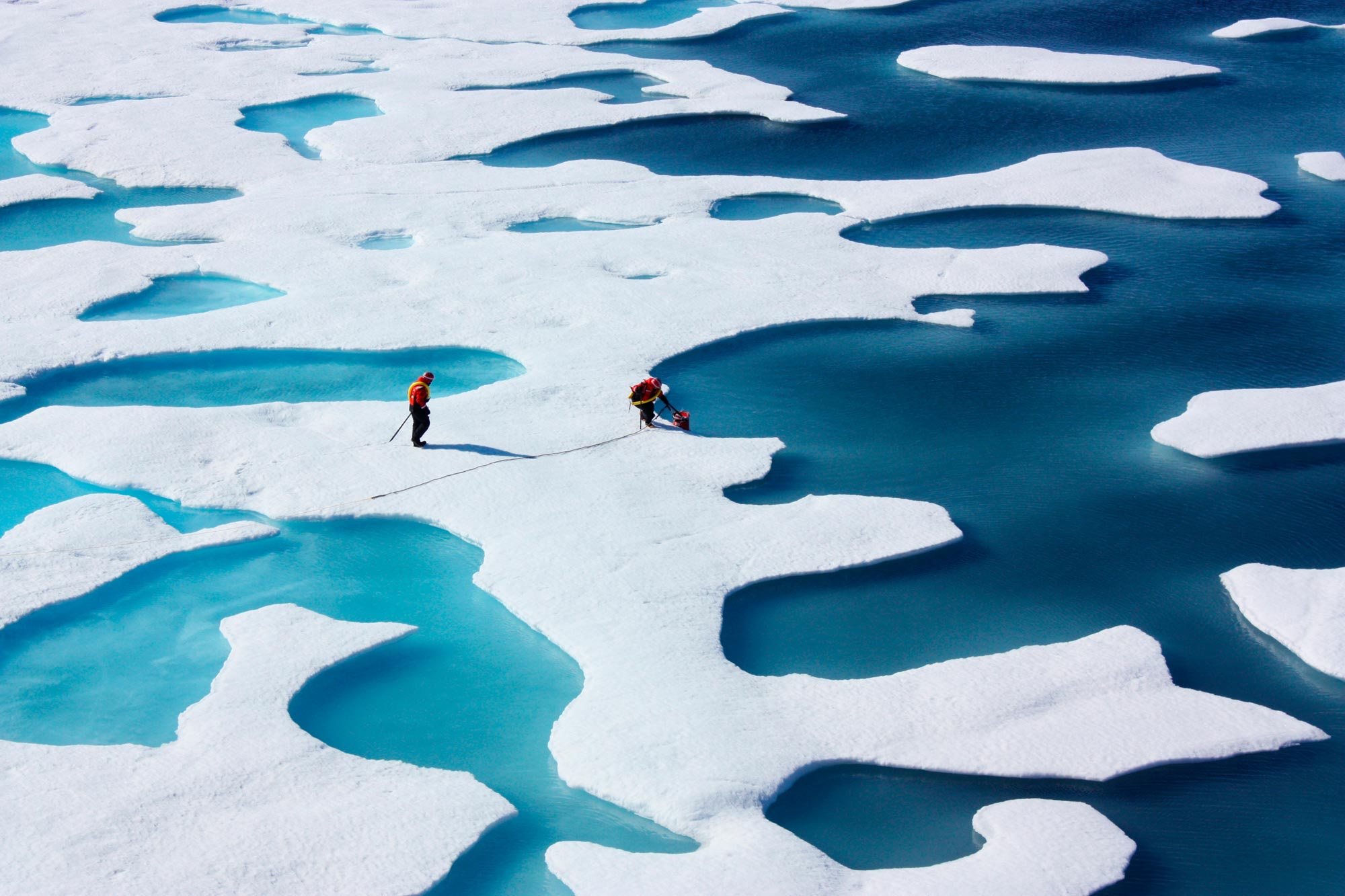
Scientists have unveiled a powerful new method for predicting Arctic sea ice months in advance, just as climate change drives rapid ice loss.
Arctic sea ice plays a powerful role in regulating Earth’s climate. By reflecting sunlight and cooling the planet, it helps shape ocean currents, atmospheric circulation, and extreme weather patterns far beyond the polar regions. As climate change accelerates the loss of this ice, scientists increasingly rely on real-time tracking of sea ice extent (SIE) — the area of water with a minimum concentration of sea ice — to assess the health of the Arctic ice system.
A New Way to Predict September Sea Ice
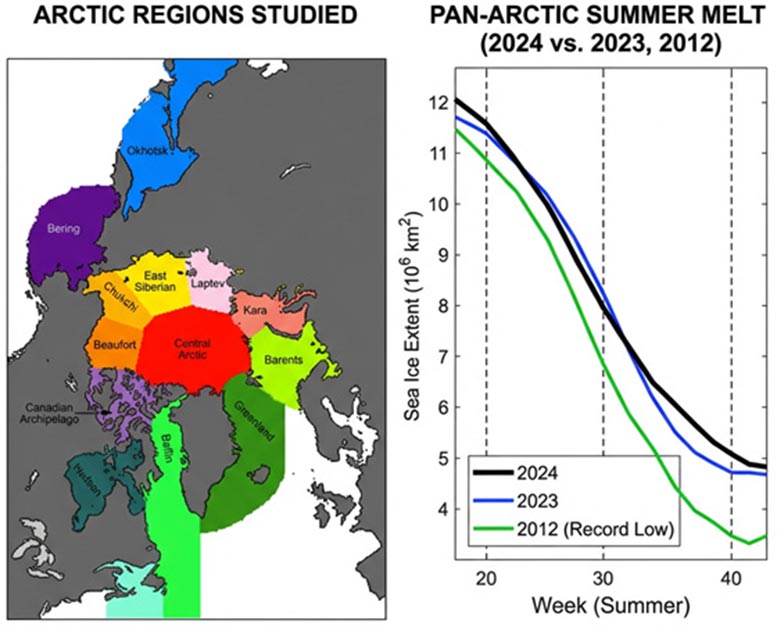
Reporting today (February 3) in Chaos, published by AIP Publishing, a research team from the United States and the United Kingdom described a method that delivers accurate, real-time predictions of Arctic SIE. Their work focuses on September, when Arctic sea ice reaches its annual minimum, making it a key benchmark for understanding long-term ice decline.
Why Accurate Ice Forecasts Matter
“Indigenous Arctic communities depend on the hunting of species like polar bears, seals, and walruses, for which sea ice provides essential habitat,” said author Dimitri Kondrashov. “There are other economic activities, such as gas and oil drilling, fishing, and tourism, where advance knowledge of accurate ice conditions reduces risks and costs.”
Reliable sea ice forecasts can help communities and industries plan ahead in a rapidly changing Arctic environment.
How the Prediction Model Works
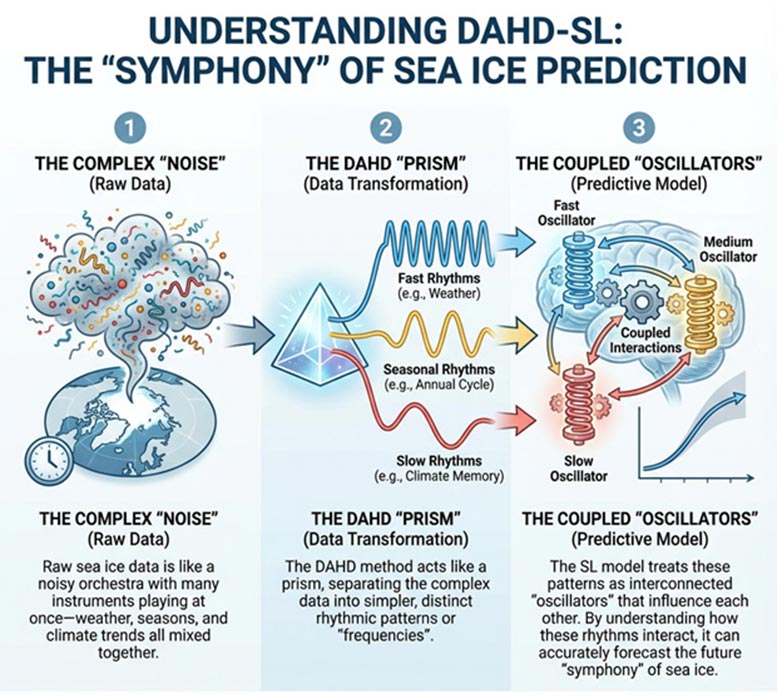
Instead of treating sea ice change as a single process, the researchers modeled it as the result of multiple interacting forces that operate on different timescales. These include long-term climate memory, regular seasonal patterns, and fast-changing weather conditions. To identify how these factors influence one another, the team analyzed average daily SIE data from the National Snow and Ice Data Center dating back to 1978.
Tested in Real Time and Against the Past
The researchers tested their model both in real time during September 2024 and by applying it to September data from previous years. The results showed that the method reliably captured changes ranging from subseasonal to seasonal timescales. When forecasting SIE one to four months in advance, the model consistently performed better than existing prediction approaches.
Improving Short-Term Arctic Forecasts
Long-range climate projections are generally more stable than short-term forecasts, which are often disrupted by rapidly changing weather. By integrating detailed regional information into their model, the researchers were able to significantly improve short-term predictions of sea ice and related weather patterns.
“The model includes several large Arctic regions composing [the] pan-Arctic,” said Kondrashov. “Despite large differences in sea ice conditions from year to year in different regions, the model can pick it up reasonably accurately.”
What Comes Next for Arctic Sea Ice Prediction
The team plans to refine the model further by adding more atmospheric and oceanic variables, including air temperature and sea level pressure. These factors can drive rapid changes and short-term fluctuations that are not yet fully captured. The researchers expect that incorporating them will lead to even more reliable predictions of Arctic sea ice during the summer months.
Reference: “Accurate and robust real-time prediction of September Arctic sea ice” by Dmitri Kondrashov, Ivan Sudakow, Valerie Livina and Qingping Yang, 3 February 2026, Chaos: An Interdisciplinary Journal of Nonlinear Science.
DOI: 10.1063/5.0295634
Never miss a breakthrough: Join the SciTechDaily newsletter.
Follow us on Google and Google News.
3 Comments
“… a powerful new method for predicting Arctic sea ice months in advance, just as climate change drives rapid ice loss.”
A problem with that statement is that the minimum for Arctic coverage occurred 13-years ago!
“By reflecting sunlight and cooling the planet, it [ice] helps shape ocean currents, atmospheric circulation, and extreme weather patterns far beyond the polar regions.”
This is an oblique reference to the hypothesis about what is usually called “Arctic Amplification.” For starters, the Arctic has reduced solar illumination for half the year. During the other half, while the illumination reaches up to 24-hours in length, and ice melts, the claim is made commonly about the “dark water” absorbing sunlight more than snow/ice. The thing is, snow is a diffuse reflector, scattering light in all directions, thus looking bright not matter where it is observed. However, water is a specular reflector that reflects light in a thin sheaf where the angle of reflection equals the angle of incidence. Thus, one can only see the reflected light, which varies from about 10% to 100% above the Arctic Circle (depending on the angle of incidence), if looking towards the sun and at approximately the same angle as the angle of incidence; except for the condition of rough water, all other viewing positions do not allow an observer to see the reflected light. Thus, many falsely assume that all the light is absorbed because the naive observer assumes that if they don’t see light, as they do with snow, it is being absorbed. At best, the concern about Arctic Amplification is overstated.
“The results showed that the method RELIABLY captured changes ranging from subseasonal to seasonal timescales. When forecasting SIE one to four months in advance, the model consistently PERFORMED BETTER THAN existing prediction approaches.”
The original article stated, “their technique is generally accurate.” Nowhere in this SciTechDaily or the source article, do they provide a numerical assessment of the previous or current accuracy. Obviously, then, they also don’t provide an assessment of the uncertainty of the accuracy.
It is generally accepted as a truism that mathematics is the language of science. When I read articles that only address a topic in qualitative terms (rarely defined) and no numbers for measurements are presented, I have to wonder just how good the science is. I have to wonder because no objective assessments are provided.
To cool down the apocalyptic ardor:
https://notrickszone.com/2024/04/15/antarctica-is-colder-icier-now-than-any-time-in-5000-years-the-last-warm-period-was-1000-years-ago/Les températures moyennes annuelles de surface de l’Antarctique occidental ont baissé de plus de -1,8°C (-0,93°C par décennie) entre 1999 et 2018 ( Zhang et al., 2023 ).
Non seulement l’Antarctique occidental, mais la majeure partie du continent a également connu un refroidissement de plus de 1 °C au cours du XXIe siècle. Voir, par exemple, la tendance au refroidissement d’environ 1 °C par décennie pour l’Antarctique oriental (2000 à 2018) illustrée dans la figure ES1 (à droite).
https://eike-klima-energie.eu/2026/01/22/kurzmeldungen-aus-klima-und-energie-ausgabe-02-2026/
Annonce du 16 janvier 2026 :
L’Antarctique refuse d’obéir à la propagande.
Il y a vingt ans, Al Gore sortait son film « Une vérité qui dérange », un récit sur la fonte imminente des deux calottes glaciaires polaires, qui lui valut le prix Nobel. Deux décennies plus tard, la banquise antarctique est plus étendue qu’à l’époque du tournage du film.
Depuis le début de la surveillance satellitaire à la fin des années 1970, la banquise antarctique se caractérise par des fluctuations plutôt que par un déclin monotone, restant stable, voire s’étendant, sur de longues périodes. Cette variabilité demeure une caractéristique du système polaire austral, influencée par les conditions de vent, la circulation océanique et les courants atmosphériques.