
Groups of normal cbiells can sense far into their surroundings, helping explain cancer cell migration. Understanding this ability could lead to new ways to limit tumor spread.
The tale of the princess and the pea describes someone so sensitive that she can detect a single pea beneath layers of bedding. In the biological world, certain cells show a similar heightened sensitivity. Cancer cells, in particular, have an extraordinary ability to detect and respond to their surroundings far beyond their immediate environment.
Now, scientists have discovered that even normal cells can achieve this extended sensing ability—by working together.
A study published in PNAS by engineers at Washington University in St. Louis reveals new insights into how cells perceive what lies beyond their immediate environment. These findings deepen understanding of cancer cell migration and could help identify new molecular targets to halt tumor spread.
How cells extend their sensing range
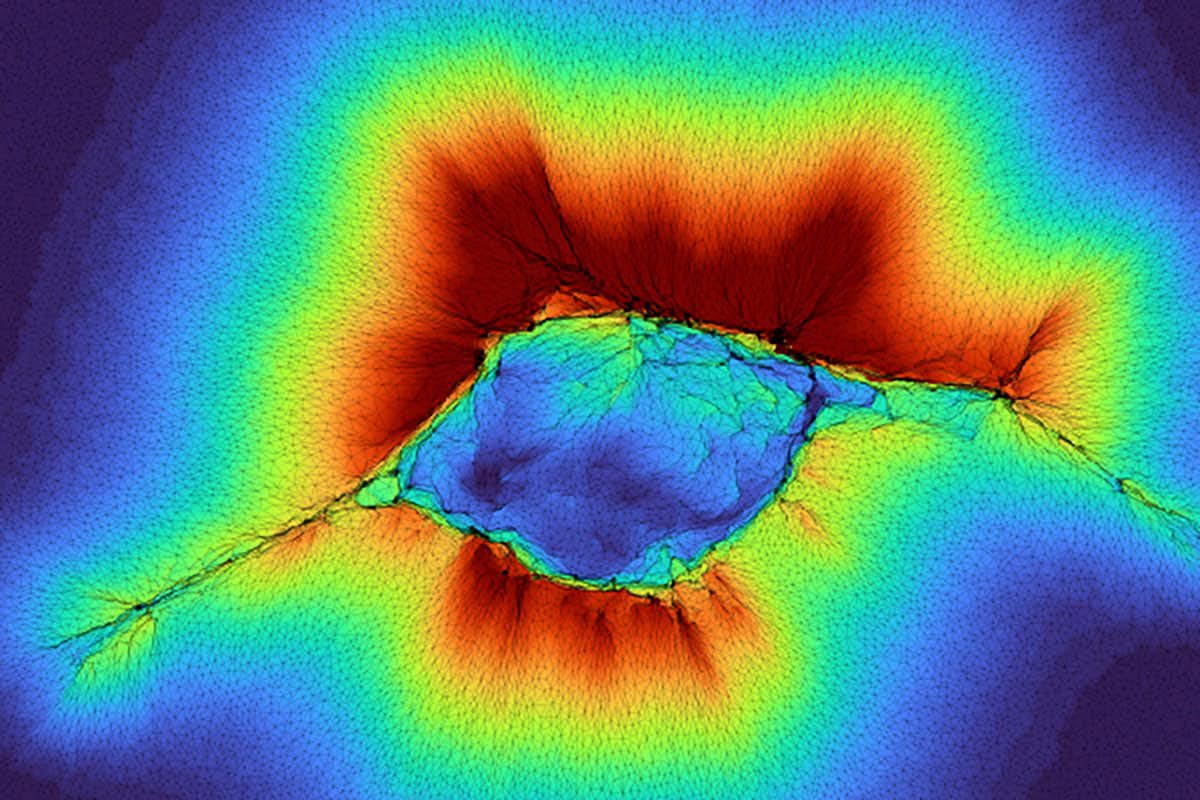
Amit Pathak, professor of mechanical engineering and materials science at the McKelvey School of Engineering, described this process as “depth mechano-sensing”—the ability of cells to perceive structures beneath the surfaces they adhere to. In earlier research, Pathak and his team discovered that abnormal cells with “high front-rear polarity” (a feature typical of cells in motion) can detect their surroundings up to 10 microns beyond the layer they are attached to.

This extended sensing occurs as the cell reshapes the surrounding fibrous collagen, allowing it to probe deeper into the extracellular matrix (ECM) and “feel” what lies ahead—whether a dense tumor, soft tissue, or bone. A single abnormal cell can gauge the stiffness of the ECM and navigate based on this mechanical feedback.
Collective sensing among normal cells
The new research shows that a collective of epithelial cells, found on the surface of tissue, can do the same and then some, working together to muster enough force to “feel” through the fibrous collagen the layer as far as 100 microns away.
“Because it’s a collective of cells, they are generating higher forces,” said Pathak, who authored the research along with PhD student Hongsheng Yu.
According to their models, this occurs in two distinct phases of cell clustering and migration. What those clustering cells “feel” will impact migration and dispersal.
Implications for cancer research and treatment
The extra sensing power of cancer cells means that they can get out of the tumor environment and evade detection, migrating freely thanks to their enhanced sense of what’s ahead, even in a soft environment. Researchers’ next step will be understanding how that works, and if certain regulators allow for the range. Those regulators could be potential targets for cancer therapy. If a cancer cell can’t “feel” its way forward, its toxic spread may be put in check.
Reference: “Emergent depth-mechanosensing of epithelial collectives regulates cell clustering and dispersal on layered matrices” by Hongsheng Yu and Amit Pathak, 11 September 2025, Proceedings of the National Academy of Sciences.
DOI: 10.1073/pnas.2423875122
Funding for this research was provided by the National Institutes of Health (NIH) (R35GM128764) and National Science Foundation, Civil, Mechanical and Manufacturing Innovation (2209684).
Never miss a breakthrough: Join the SciTechDaily newsletter.
Follow us on Google and Google News.
1 Comment
My name is Esmail Kargar, and I am contacting you to present a new cancer-treatment concept based on hormonal regulation and immune-strengthening mechanisms.
My approach focuses on:
Reducing cortisol,
Increasing dopamine and reward-related hormones,
Targeted lifestyle modulation,
which collectively enhance the immune system’s natural ability to control and eliminate cancer cells.
This method is designed to boost the effectiveness of chemotherapy and radiotherapy, improve patient resilience, and potentially reduce mortality when applied early.
I kindly request that your scientific team review this conceptual model or direct me to the appropriate department for evaluation.
Given the potential impact on patient survival, I would deeply appreciate guidance on the next steps for scientific assessment.
Let us work together to save many patients from otherwise certain death.
Thank you for your time and consideration.
Best regards,
Esmail Kargar
Iran