
A new manganese(I) complex sets a record for the longest excited-state lifetime, opening the door to future large-scale applications in photochemistry.
Chemical reactions are often powered by heat, but scientists have increasingly turned to light as an energy source because it allows reactions to be guided with remarkable precision. This light-based process is called photochemistry.
Until recently, photochemical reactions depended on rare and costly metals such as ruthenium, osmium, or iridium, which also pose environmental challenges during extraction. Now, researchers at Johannes Gutenberg University Mainz (JGU) have created a groundbreaking metal complex that uses manganese—an element that is both abundant and inexpensive.
“This metal complex sets a new standard in photochemistry: it combines a record-breaking excited-state lifetime with simple synthesis,” stated Professor Katja Heinze from the JGU Department of Chemistry. “It thus offers a powerful and sustainable alternative to the noble metal complexes that have long dominated light-driven chemistry.”
Their findings were recently published in Nature Communications.
Single-step synthesis and strong absorption
Although manganese is more than 100,000 times more common on Earth than ruthenium, its use in photochemistry has long been limited. This was largely due to the complex, multi-step synthesis process, often requiring nine or ten stages, and the very short lifetime of its excited state.
“The newly developed manganese complex overcomes both challenges,” explained Dr. Nathan East, a former doctoral student in the Heinze group who carried out the original synthesis. The new material is synthesized directly from commercially available starting materials – in just a single synthesis step.
In addition to manganese, the researchers use a ligand, which allows the properties of the complex to be tuned.
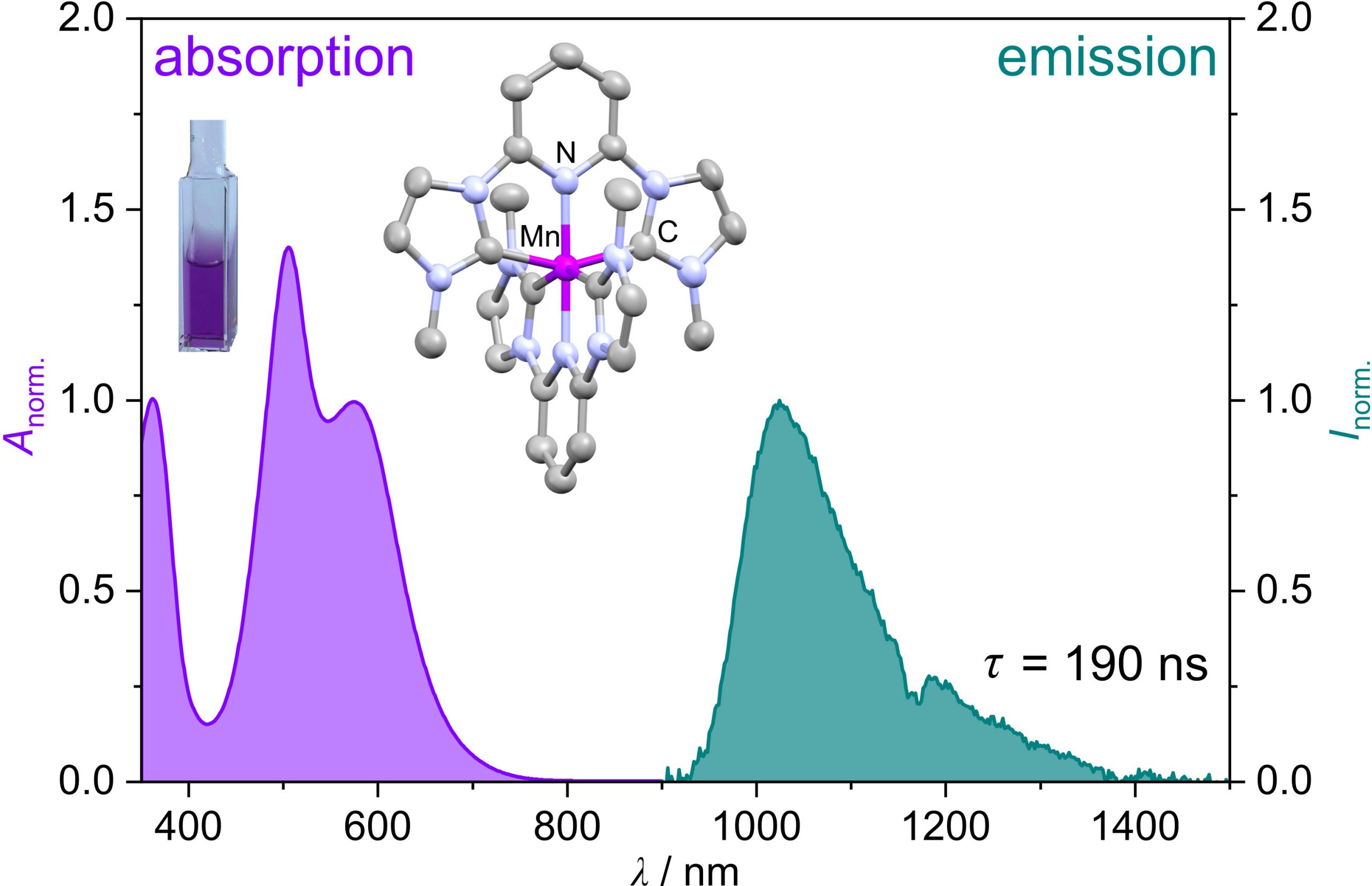
“The combination of a colorless manganese salt and the colorless ligand in solution immediately produces a deep purple color, just like ink. This is a very unusual color for a manganese complex, which showed us that something unique was happening,” added Sandra Kronenberger, who further investigated this novel manganese complex as a doctoral student in the Heinze group at the Max Planck Graduate Center (MPGC).
The resulting manganese complex not only looks impressive, it also exhibits remarkable properties: “Its light absorption is exceptionally strong, meaning the probability of capturing a light particle is very high – the complex thus uses light very efficiently,” explained Dr. Christoph Förster, who supported the project with quantum chemical calculations.
Excited state lifetime exceeds the 190-nanosecond mark
“The lifetime of the complex of 190 nanoseconds is also remarkable. This is two orders of magnitude longer than any previously known complexes containing common metals such as iron or manganese,” said lead scientist and spectroscopist Dr. Robert Naumann, who characterized the dynamics of the excited state of the complex using luminescence spectroscopy.
In photochemistry, the catalyst, in this case the manganese complex, is excited by light. When it encounters another molecule through diffusion, it transfers an electron to it. Since it can take nanoseconds for the particles to find each other, the excited state must last as long as possible.
But does the complex actually do what the researchers hope it will, i.e., transfer an electron to another molecule? “We were able to detect the initial product of the photoreaction – the electron transfer that occurred – and thus prove that the complex reacts as desired,” summarized Professor Katja Heinze.
This discovery expands the boundaries of sustainable photochemistry. Thanks to its scalable one-step synthesis, efficient light absorption, robust photophysical behavior, and long-lasting excited state, the new manganese-containing material paves the way for future large-scale applications of photoreactions. This could be important for future applications, for example, for sustainable hydrogen production.
Reference: “A manganese(I) complex with a 190 ns metal-to-ligand charge transfer lifetime” by Sandra Kronenberger, Robert Naumann, Christoph Förster, Nathan R. East, Jan Klett and Katja Heinze, 22 August 2025, Nature Communications.
DOI: 10.1038/s41467-025-63225-4
Never miss a breakthrough: Join the SciTechDaily newsletter.
Follow us on Google and Google News.
1 Comment
The toxicity of iridium and ruthenium is very low, similar to gold, and both are lower than manganese. The phrase “rare and toxic elements like iridium and ruthenium” is wrong.