

Physicists from the University of Pennsylvania, working with colleagues at Arizona State University, are examining the limitations of a framework that aims to unify the laws of physics throughout the universe.
There are two great pillars of thought that don’t quite fit together in physics. The Standard Model of particle physics accounts for all known fundamental particles and three of the four fundamental forces: electromagnetism, the strong nuclear force, and the weak nuclear force. In contrast, Einstein’s general relativity explains gravity as a feature of the geometry of spacetime.
These two models, however, do not work well together, says Jonathan Heckman, a theoretical physicist at the University of Pennsylvania. While the Standard Model describes forces as particle-based fields, general relativity interprets gravity as a smooth curvature of spacetime. As Heckman puts it, gravity “doesn’t fit into physics’ Standard Model.”
In a recent study, Heckman, along with Rebecca Hicks, a Ph.D. student in Penn’s School of Arts & Sciences, and their collaborators, took a different approach to string theory. Rather than asking what the theory can predict, they focus on what it fundamentally cannot produce. Their findings highlight one unusual particle that might be detected at the Large Hadron Collider (LHC). If this particle is observed, Heckman says, it would put string theory “in enormous trouble.”
String theory: the good, the bad, the energy-hungry
For many years, physicists have tried to develop a single theory that unites quantum mechanics, which governs the behavior of subatomic particles, with gravity, which is treated as a dynamic force in general relativity but remains poorly understood in quantum terms, according to Heckman.
One of the leading candidates for bridging this divide is string theory. It proposes that all particles, including a theoretical particle responsible for gravity, are actually tiny, vibrating strings. This idea offers the promise of a unified framework that can describe all forces and forms of matter.
“But one of the challenges with string theory is that it depends on complex, high-dimensional mathematics and a vast range of possible universes, which makes it extremely difficult to test through experiments,” Heckman explains. The theory also requires more than the familiar four dimensions (x, y, z, and time) to remain consistent with the mathematics.
“Most forms of string theory include a total of 10 or 11 spacetime dimensions,” says Hicks. “The extra dimensions are thought to be compacted or ‘curled up’ at scales so small that we can’t directly observe them.”
Adding to the complexity, string theory’s most distinctive properties only become apparent at extremely high energy levels. “These are energies far greater than anything we typically deal with or can produce using today’s particle colliders,” Heckman says.
Hicks compares the situation to trying to see details on a distant object. At ordinary, low energies, strings behave like familiar point-like particles—much like how a rope viewed from far away appears as a single, smooth line. “But if you zoom in by increasing the energy, you begin to see what’s really going on—strings vibrating and interacting,” she says. “At lower energies, those fine details are invisible, and all we observe are the basic particles we already know.”
That’s why physicists searching for evidence of string theory rely on pushing particle colliders like the LHC to higher and higher energy levels, hoping to observe these strings directly, rather than just their lower-energy manifestations as ordinary particles.
Why serve string theory a particle it likely won’t be able to return?
Testing a theory often means searching for predictions that confirm its validity. But a more powerful test, Heckman says, is finding exactly where a theory fails. If scientists discover that something a theory forbids actually exists, the theory is fundamentally incomplete or flawed.
Because string theory’s predictions are vast and varied, the researchers instead asked if there’s a simple particle scenario that string theory just can’t accommodate.
They zeroed in on how string theory deals with particle “families,” groups of related particles bound together by the rules of the weak nuclear force, responsible for radioactive decay. Typically, particle families are small packages, like the electron and its neutrino sibling, that form a tidy two-member package called a doublet. String theory handles these modest particle families fairly well, without issue.
However, Heckman and Hicks identified a family that is conspicuously absent from any known string-based calculation: a five-member particle package, or a 5-plet. Heckman likens this to trying to order a Whopper meal from McDonald’s, “no matter how creatively you search the menu, it never materializes.”
“We scoured every toolbox we have, and this five-member package just never shows up,” Heckman says.
But what exactly is this elusive 5-plet?
Hicks explains it as an expanded version of the doublet, “the 5-plet is its supersized cousin, packing five related particles together.”
Physicists encapsulate this particle family in a concise mathematical formula known as the Lagrangian, essentially the particle-physics cookbook. The particle itself is called a Majorana fermion, meaning it acts as its own antiparticle, akin to a coin that has heads on both sides.
Identifying such a particle would directly contradict what current string theory models predict is possible, making the detection of this specific particle family at the LHC a high-stakes test, one that could potentially snap string theory.
Why a 5-plet hasn’t been spotted and the vanishing-Track clue
Hicks cites two major hurdles for spotting these 5-plet structures: “production and subtlety.”
In a collider, energy can literally turn into mass; Einstein’s E = mc² says that enough kinetic oomph (E) can be converted into the heft (m) of brand-new particles, so the heavier the quarry the rarer the creation event.
“The LHC has to slam protons together hard enough to conjure these hefty particles out of pure energy,” Hicks explains, citing Einstein’s E = mc², which directly links energy (E) to mass (m). “As the masses of these particles climb toward a trillion electron volts, the chance of creating them drops dramatically.”
How to falsify string theory on a collider. Credit: Raphael Martinez / University of Pennsylvania
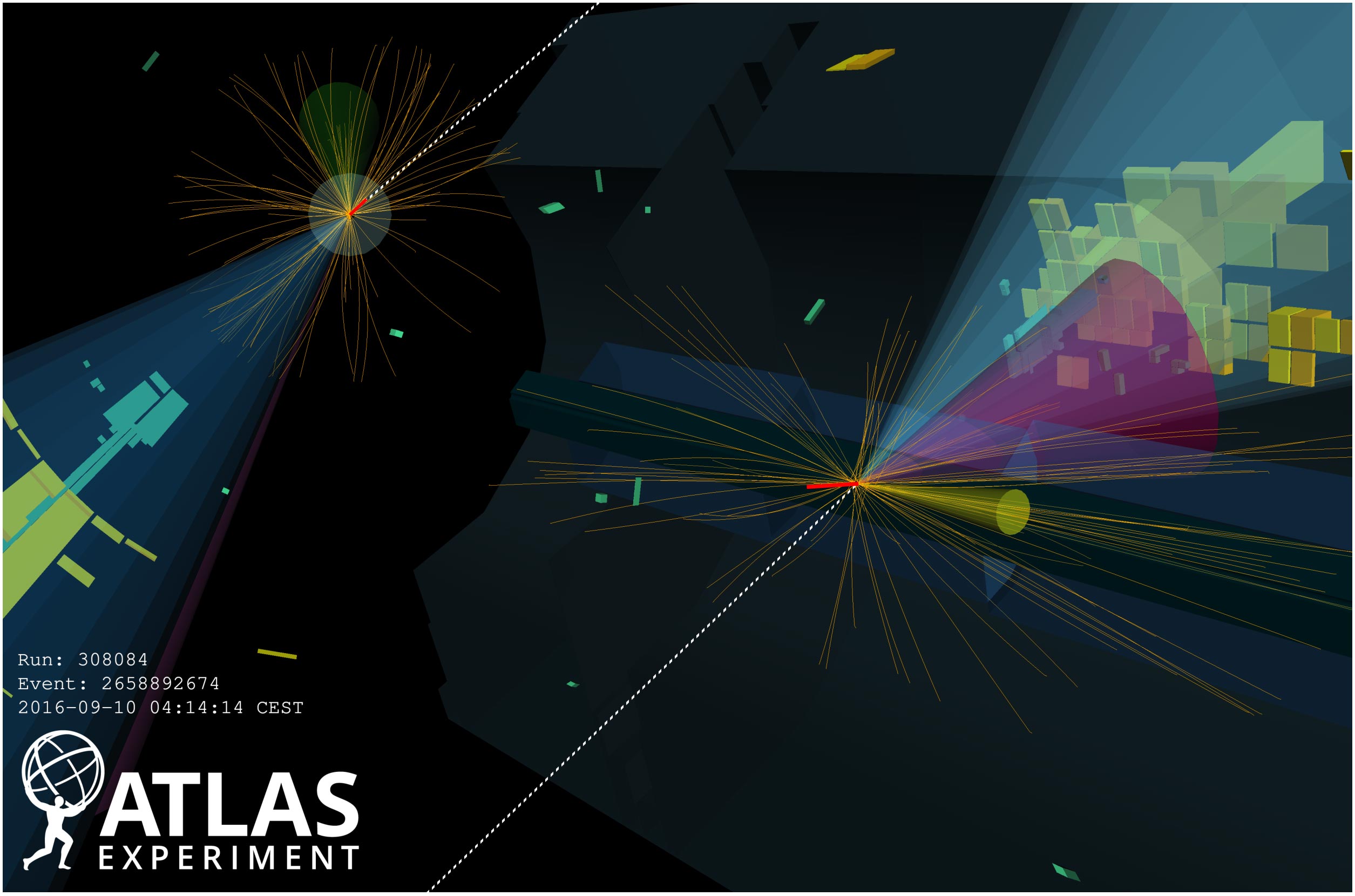
Even if produced, detection is challenging. The charged particles in the 5-plet decay very quickly into nearly invisible products. “The heavier states decay into a soft pion and an invisible neutral particle, zero (X0),” Hicks says. “The pion is so low-energy it’s basically invisible, and X0 passes straight through. The result is a track that vanishes mid-detector, like footprints in snow suddenly stopping.”
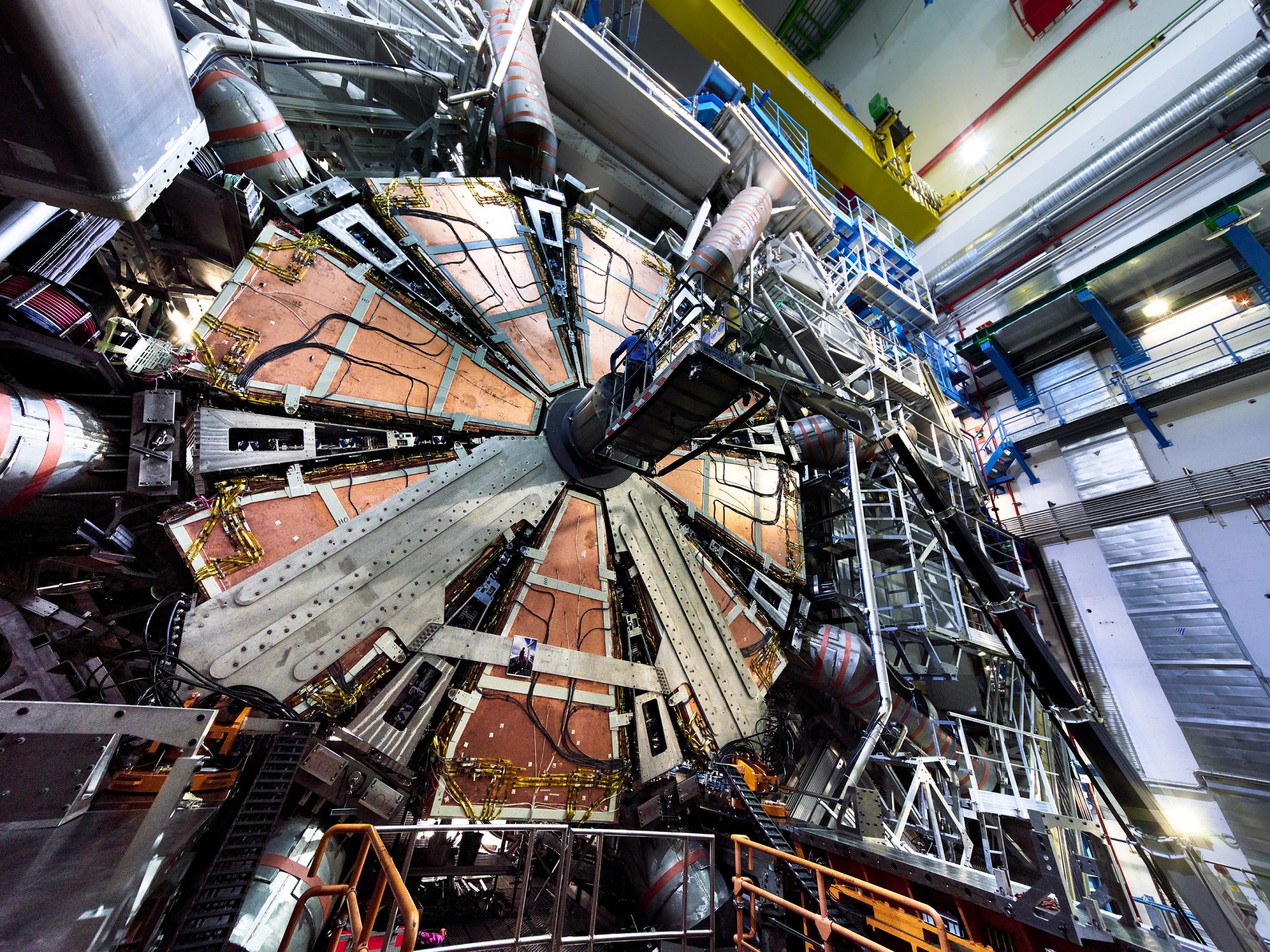
Those signature tracks get picked up by LHC’s ATLAS (short for A Toroidal LHC ApparatuS) and CMS (Compact Muon Solenoid), house-sized “digital cameras” wrapped around the collision center. They sit at opposite collision points and operate independently, giving the physics community two sets of eyes on every big discovery. Penn physicists like Hicks are part of the ATLAS Collaboration, helping perform the searches that look for quirky signals like disappearing tracks.
Why a 5-plet matters for dark matter
Hicks says finding the 5-plet isn’t only important for testing string theory, pointing to another exciting possibility: “The neutral member of the 5-plet could explain dark matter, the mysterious mass shaping up most of our universe’s matter.”
Dark matter constitutes roughly 85 percent of all matter in the universe, yet scientists still don’t know what exactly it is.
“If the 5-plet weighs around 10 TeV—about 10,000 proton masses—it neatly fits theories about dark matter’s formation after the Big Bang,” Hicks says. “Even lighter 5-plets could still play a role as part of a broader dark matter landscape.”
“If we detect a 5-plet, it’s a double win,” says Hicks. “We’d have disproven key predictions of string theory and simultaneously uncovered new clues about dark matter.”
What the LHC has already ruled out
Using existing ATLAS data from collider runs, the team searched specifically for 5-plet signals.“We reinterpreted searches originally designed for ‘charginos’—hypothetical charged particles predicted by supersymmetry—and looked for 5-plet signatures,” Hicks says of the team’s search through the repurposed ATLAS disappearing-track data. “We found no evidence yet, which means any 5-plet particle must weigh at least 650–700 GeV, five times heavier than the Higgs boson.”
For context, Heckman says, “This early result is already a strong statement; it means lighter 5-plets don’t exist. But heavier ones are still very much on the table.”
Future searches with upgraded LHC experiments promise even sharper tests. “We’re not rooting for string theory to fail,” Hicks says. “We’re stress-testing it, applying more pressure to see if it holds up.”
“If string theory survives, fantastic,” Heckman says. “If it snaps, we’ll learn something profound about nature.”
Reference: “How to falsify string theory at a collider” by Matthew Baumgart, Panagiotis Christeas, Jonathan J. Heckman and Rebecca J. Hicks, 27 May 2025, Physical Review Research.
DOI: 10.1103/PhysRevResearch 7.023184
This work received support from the Department of Energy (awards DE-SC0019470 and DE-SC0013528), the U.S.-Israel Binational Science Foundation (Grant No. 2022100), and the National Science Foundation.
Never miss a breakthrough: Join the SciTechDaily newsletter.
Follow us on Google and Google News.
4 Comments
This Forbidden Particle Could Break String Theory。
VERY GOOD!
Please ask researchers to think deeply:
If string theory can be broken, is string theory pseudoscience or is your observation and understanding incorrect?
Many people do not believe that so-called peer-reviewed publications have been systematically disseminating pseudoscience. If the researcher believes the evidence, please browse https://zhuanlan.zhihu.com/p/1925124100134790589 and https://zhuanlan.zhihu.com/p/1928738508329169149 (If the link is not blocked).
String Theory (more accurately, the String Hypothesis) was not falsifiable, and that was its well-known weakness. There is no conspiracy here; everything is transparent and understood.
If anything, this article serves as a masterclass in how to properly falsify a theory or hypothesis.
Well, let us brace ourselves for the worst then, shall we?
I just want a warp drive so we can travel to other star systems fastly.