
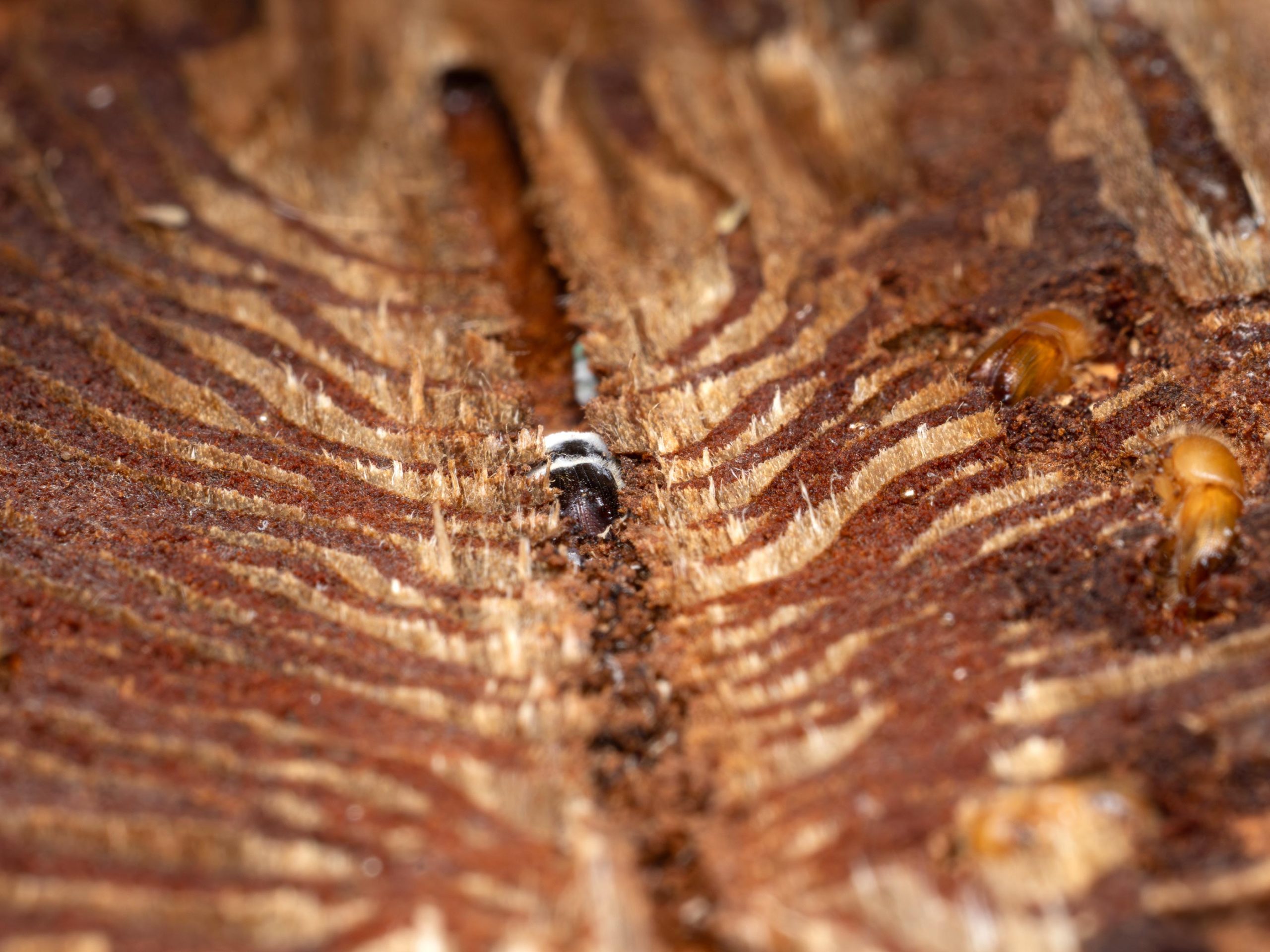
Spruce bark beetles hijack their host tree’s chemical defenses, transforming them into potent weapons against fungal threats. But a fungus has evolved a way to deactivate those defenses, tipping the balance back in the tree’s favor.
Spruce trees are packed with phenolic compounds, natural chemicals that help protect them from harmful fungi. Scientists at the Max Planck Institute for Chemical Ecology in Jena set out to understand how these defenses move through the forest food web. Their focus was the spruce bark beetle (Ips typographus), an insect that consumes these compounds while feeding on tree tissue. The researchers asked an intriguing question: could the beetles reuse the tree’s own chemical defenses to protect themselves from fungal infections?
Bark Beetles Strengthen Tree Defenses for Their Own Use
To find out, the team used advanced analytical tools, including mass spectrometry and nuclear magnetic resonance (NMR), to identify the defensive chemicals produced by spruce trees and track what happens to them inside the beetles. They discovered that bark beetles feeding on spruce trees absorb defensive compounds from the phloem, especially phenolic glycosides such as stilbenes and flavonoids.
Inside the beetle, these substances do not remain unchanged. Instead, the insects chemically modify them into aglycones, compounds that lack sugar molecules and are far more toxic to microbes. These transformed chemicals have stronger antimicrobial properties and help shield the beetles from fungal threats. “We did not expect the beetles to be able to convert the spruce’s defenses into more toxic derivatives in such a targeted way,” said lead author Ruo Sun from the Department of Biochemistry.
How a Fungus Disarms the Beetles’ Chemical Shield
The researchers then turned their attention to Beauveria bassiana, a fungus known for infecting insects. “Although this fungus has not been effective in controlling bark beetles in the past, we found strains that had naturally infected and killed them. We therefore wanted to investigate more closely how they were able to successfully infect the beetles,” Ruo Sun explains.
Detailed chemical and enzyme studies revealed that the fungus has a precise two-step strategy to neutralize the beetles’ defenses. First, it performs glycosylation, a process that adds a sugar back onto the toxic aglycones. Next comes methylation, which attaches a methyl group to that sugar. The final products, called methylglycosides, are harmless to Beauveria bassiana.
Surprisingly, this detoxification process actually makes infection easier, especially in beetles that previously fed on spruce tissue rich in phenolic compounds. These modified chemicals also resist breakdown by beetle enzymes that would normally restore their toxicity.
Gene Experiments Confirm the Detox Pathway
To confirm how important this mechanism is, the scientists disabled the genes responsible for methylglycosylation in Beauveria bassiana. Fungi lacking these genes were much less successful at infecting bark beetles, showing that the detoxification pathway is essential for overcoming the beetles’ chemical defenses.
A Forest Arms Race With Real-World Implications
The findings reveal how tree defenses can be repeatedly transformed as they pass from plants to insects and then to pathogens, shaping an ongoing evolutionary struggle among trees, pests, and fungi. “We have demonstrated that a bark beetle can co-opt a tree’s defensive compounds to make defenses against its own enemies. However, since one of the enemies, the fungus Beauveria bassiana, has developed the ability to detoxify these antimicrobial defenses, it can successfully infect the bark beetles and thus actually help the tree in its battle against bark beetles,” summarizes study leader Jonathan Gershenzon.
Toward Better Biological Control of Bark Beetles
This research could improve biological pest control strategies. “Now that we know which strains of the fungus tolerate the bark beetle’s antimicrobial phenolic compounds, we can use these strains to combat bark beetles more efficiently,” says Ruo Sun. The study also highlights the need to consider whether pests have developed resistance or detoxification methods when biological pesticides are used.
Looking ahead, the team plans to explore how common this methylglycosylation pathway is across different strains of Beauveria bassiana and other fungi that attack bark beetles. They also want to learn how this chemical strategy interacts with other traits that influence how effective these pathogens are in real forest environments.
Reference: “Detoxification of conifer antimicrobial defenses promotes entomopathogenic fungus infection of bark beetles” by Ruo Sun, Baoyu Hu, Yoko Nakamura, Michael Reichelt, Xingcong Jiang, Katrin Luck, Christian Paetz and Jonathan Gershenzon, 29 December 2025, Proceedings of the National Academy of Sciences.
DOI: 10.1073/pnas.2525513122
Never miss a breakthrough: Join the SciTechDaily newsletter.
Follow us on Google and Google News.