
Close Menu
    Facebook X (Twitter) Instagram
    SciTechDaily
    • Biology
    • Chemistry
    • Earth
    • Health
    • Physics
    • Science
    • Space
    • Technology
    Facebook X (Twitter) Pinterest YouTube RSS
    SciTechDaily
    Home»Space»This Glittering Ball of Stars Is 160,000 Light-Years Away – And Hiding a Wild Secret
    Space

    This Glittering Ball of Stars Is 160,000 Light-Years Away – And Hiding a Wild Secret

    By ESA/HubbleJuly 14, 2025No Comments2 Mins Read
    Facebook Twitter Pinterest Telegram LinkedIn WhatsApp Email Reddit
    Share
    Facebook Twitter LinkedIn Pinterest Telegram Email Reddit
    NGC 1786
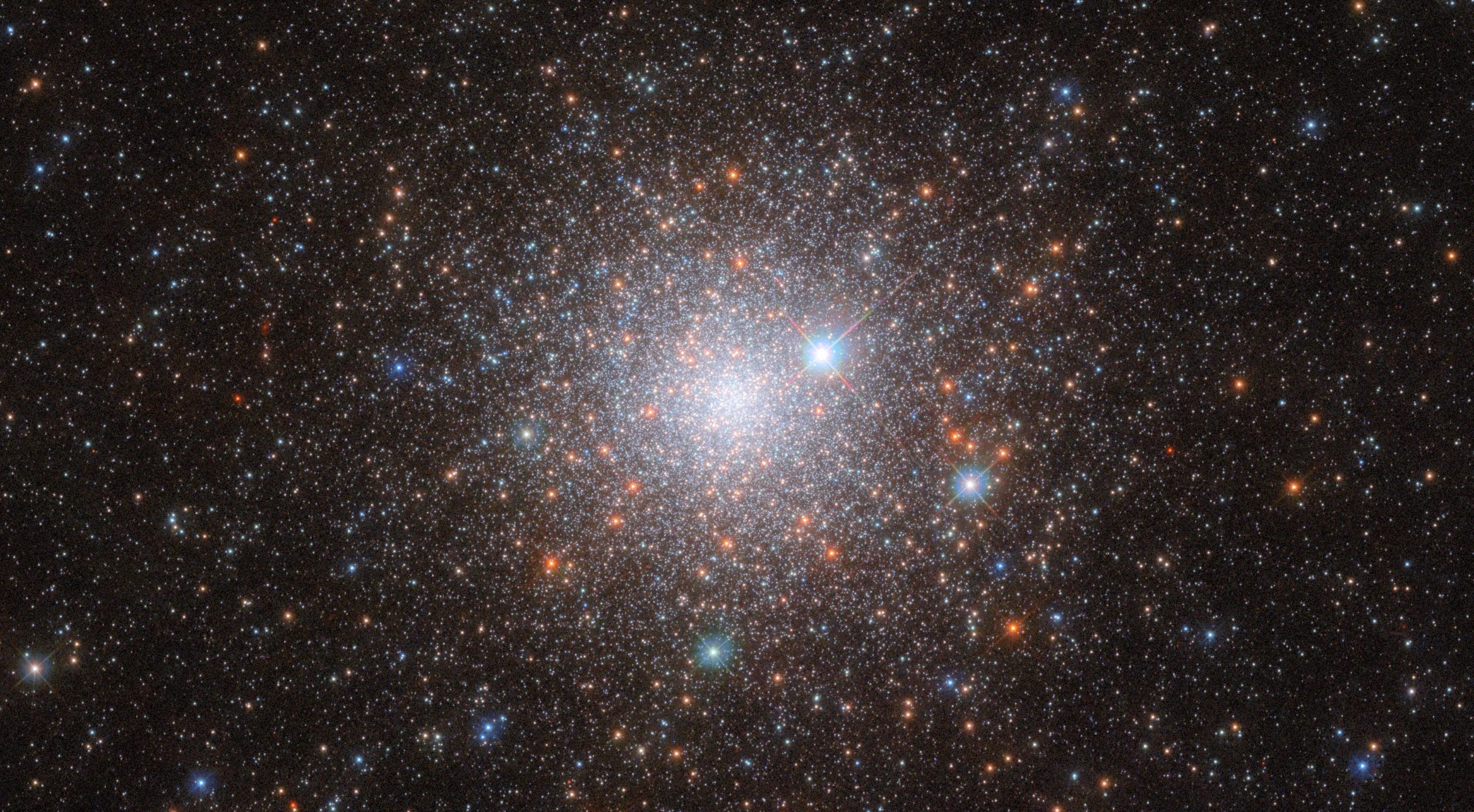
    NGC 1786’s mixed-age stars suggest globular clusters aren’t one-generation wonders, offering fresh clues to galaxy formation far beyond the Milky Way. Credit: ESA/Hubble & NASA, M. Monelli, Acknowledgement: M. H. Özsaraç

    Hubble’s razor-sharp view of NGC 1786, a globular cluster in the Large Magellanic Cloud, lets astronomers peer 160,000 light-years back to study some of the universe’s oldest stars.

    By comparing these ancient stellar time capsules in dwarf galaxies to similar clusters in the Milky Way, researchers test whether multiple generations of stars are a cosmic norm. The findings promise new clues to the formative histories of both our neighbor galaxies and our own.

    Cosmic Spotlight on NGC 1786

    Hubble’s latest featured images turns our attention to NGC 1786, a dense ball of stars known as a globular cluster. It sits inside the Large Magellanic Cloud (LMC), a small satellite galaxy orbiting the Milky Way about 160,000 light-years from Earth. Located in the southern constellation Dorado and first recorded by astronomer John Herschel in 1835, NGC 1786 now shines in unprecedented detail thanks to the Hubble Space Telescope.

    Comparative Study of Ancient Clusters

    The image is part of a project that contrasts the oldest globular clusters in three nearby dwarf galaxies (the LMC, the Small Magellanic Cloud, and the Fornax dwarf spheroidal galaxy) with their counterparts in the Milky Way. Our own galaxy contains more than 150 of these spherical, tightly bound star groups, and Hubble’s sharp vision has revealed them with remarkable clarity. Because globular clusters are extremely stable and endure for billions of years, astronomers treat them as “galactic time capsules,” preserving stars from the earliest chapters of each galaxy’s history.

    Tracing Multiple Stellar Generations

    Astronomers once thought that the stars in a globular cluster all formed together at about the same time, but the study of the old globular clusters in our galaxy has uncovered multiple populations of stars with different ages. In order to use globular clusters as historical markers, we must understand how they form and where these stars of varying ages come from.

    This observing program examined old globular clusters like NGC 1786 in these external galaxies to see if they, too, contain multiple populations of stars. This research can tell us more not only about how the LMC was originally formed, but the Milky Way Galaxy, too.

    Never miss a breakthrough: Join the SciTechDaily newsletter.
    Follow us on Google and Google News.

    Astronomy European Space Agency Hubble Space Telescope Popular
    Share. Facebook Twitter Pinterest LinkedIn Email Reddit

    Related Articles

    Hubble’s Newest Discovery Isn’t a Star, It’s a Window Into the Dark Universe

    Hubble Views Spiral Galaxy NGC 5793

    Hubble Captures the Best Ever Image of the Antennae Galaxies

    Hubble Captures Face-On Image of Messier 61

    Hubble Views an Ongoing Cosmic Collision

    Hubble Views Newborn Stars in Galaxy IC 5052

    New XDF Image, The Deepest-Ever View of the Universe

    Hubble Zooms in on the Center of M4

    Hubble Image of Peculiar Galaxy Pair Arp 116

    Leave A Reply Cancel Reply

    • Facebook
    • Twitter
    • Pinterest
    • YouTube

    Don't Miss a Discovery

    Subscribe for the Latest in Science & Tech!

    Trending News

    Mezcal “Worm” in a Bottle Mystery: DNA Testing Reveals a Surprise

    New Research Reveals That Your Morning Coffee Activates an Ancient Longevity Switch

    This Is What Makes You Irresistible to Mosquitoes

    Shockingly Powerful Giant Octopuses Ruled the Seas 100 Million Years Ago

    Scientists Stunned by New Organic Molecules Found on Mars

    Rewriting Dinosaur Evolution: Scientists Unearth Remarkable 150-Million-Year-Old Stegosaur Skull

    Omega-3 Supplements Linked to Cognitive Decline in Surprising New Study

    First-of-Its-Kind Discovery: Homer’s Iliad Found Embedded in a 1,600-Year-Old Egyptian Mummy

    Follow SciTechDaily
    • Facebook
    • Twitter
    • YouTube
    • Pinterest
    • Newsletter
    • RSS
    SciTech News
    • Biology News
    • Chemistry News
    • Earth News
    • Health News
    • Physics News
    • Science News
    • Space News
    • Technology News
    Recent Posts
    • Male Birth Control Breakthrough: Scientists Find Way To Turn Sperm Production Off and Back On
    • A Common Vitamin Could Hold the Key to Treating Fatty Liver Disease
    • New Research Shows Vitamin B12 May Hold the Key to Healthy Aging
    • Scientists Map Thousands of Brain Connections With RNA Barcodes
    • This Gene Tweak Turns Strawberries Into Healthier, Tastier Superfruit
    Copyright © 1998 - 2026 SciTechDaily. All Rights Reserved.
    • Science News
    • About
    • Contact
    • Editorial Board
    • Privacy Policy
    • Terms of Use

    Type above and press Enter to search. Press Esc to cancel.