
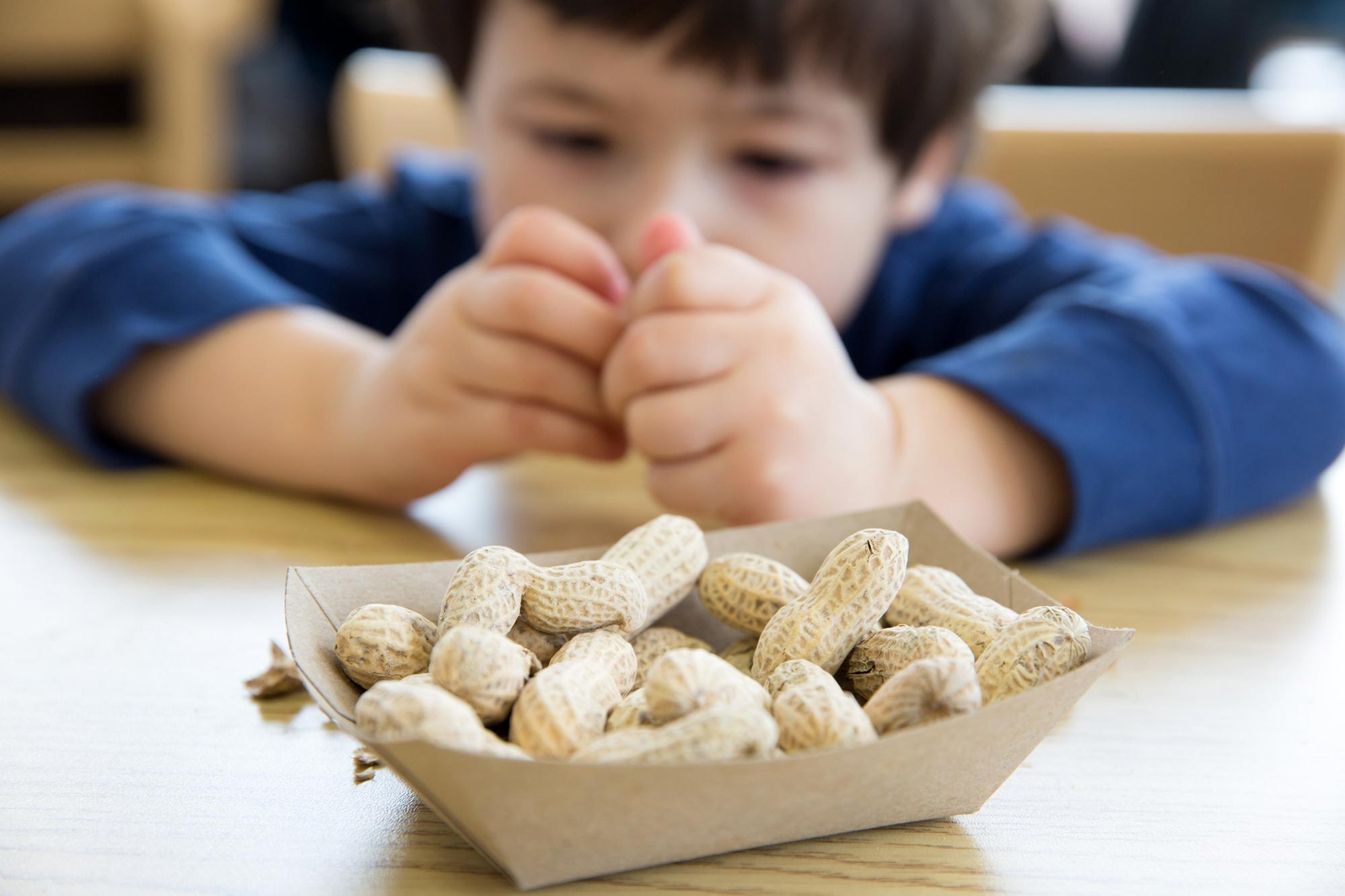
A groundbreaking study has shown that children with high-threshold peanut allergies can build tolerance by consuming increasing amounts of peanut butter over 18 months.
Unlike current FDA-approved treatments, which focus on preventing severe reactions from accidental exposure, this method allowed 100% of participants in the treatment group to safely eat the equivalent of three tablespoons of peanut butter.
A Simple Peanut Allergy Solution?
Gradually increasing daily doses of store-bought, home-measured peanut butter over 18 months allowed 100% of children with peanut allergies — who could already tolerate at least half a peanut — to safely eat three tablespoons of peanut butter without a reaction, researchers report. This simple and accessible treatment approach could help nearly half of children with peanut allergies, specifically those who can already tolerate small amounts of peanut, but previously had no treatment options.
The study, funded by the National Institutes of Health’s National Institute of Allergy and Infectious Diseases (NIAID) and published in NEJM Evidence, addresses a gap in allergy treatment.
A New Hope for High-Threshold Allergy Sufferers
“Children with high-threshold peanut allergy couldn’t participate in previous food allergy treatment trials, leaving them without opportunities to explore treatment options,” said NIAID Director Jeanne Marrazzo, M.D., M.P.H. “Today’s report focuses on this population and shows that a very safe and accessible form of therapy could be liberating for many of these children and their families.”
The food allergy treatments currently approved by the Food and Drug Administration were tested in children with low-threshold peanut allergy, who cannot tolerate the equivalent of even half a peanut. These treatments are designed to decrease the likelihood of a reaction to a small amount of peanut despite efforts to avoid it, as might occur with accidental exposure. This approach is not relevant to the estimated 800,000 U.S. children who may have high-threshold peanut allergy, leaving them with only one management strategy prior to the new report: peanut avoidance.
A Trial to Change the Game
To address this need, researchers tested whether a low-cost, convenient treatment strategy could help children with high-threshold peanut allergy tolerate a much greater amount of peanut protein than they already did. The mid-stage trial involved 73 children ages 4 to 14 years. Based on parent or guardian report, nearly 60% of the children were white, 19% were Asian, 1.4% were Black, and 22% were more than one race. The study team assigned the children at random to either test the new treatment strategy or continue avoiding peanut.
Those in the peanut-ingestion group began with a minimum daily dose of 1/8 teaspoon of peanut butter. They gradually increased their dose every eight weeks up to 1 tablespoon of peanut butter or an equivalent amount of a different peanut product, such as peanut flour or candies. Dose increases took place under medical supervision at the study site. None of the children in the peanut-ingestion group needed epinephrine to treat severe allergic reactions during home dosing, and only one child needed epinephrine during a supervised dosing visit at the study site.
Promising Results Without Major Reactions
After undergoing the treatment regimen, the peanut-consuming children participated in an oral food challenge carefully supervised by the study team to see how much peanut butter they could eat without an allergic reaction. All 32 children who participated in the challenge could tolerate the maximum amount of 9 grams of peanut protein, the equivalent of 3 tablespoons of peanut butter. By contrast, only three of the 30 children in the avoidance group who underwent the oral food challenge after a similar amount of time in the trial could tolerate 9 grams of peanut protein. Three additional children in the avoidance group tolerated a challenge dose at least two doses greater than the amount they could tolerate at the start of the study.
The trial took place during the COVID-19 pandemic, and some families preferred to avoid indoor close contact with others at that time, so some children did not return to the study site for the oral food challenge. Using a common statistical technique to account for those missing challenge results, 100% of the ingestion group and 21% of the avoidance group tolerated at least two doses greater than they could at the outset.
Sustained Tolerance Beyond the Trial
Children in the peanut-ingestion group who could tolerate 9 grams of peanut protein during the oral food challenge consumed at least 2 tablespoons of peanut butter weekly for 16 weeks, then avoided peanuts entirely for eight weeks. At that point, they were asked to return to the study site for a final oral food challenge.
Twenty-six of the 30 treated children (86.7%) who participated in the final challenge continued to tolerate 9 grams of peanut protein, indicating they had achieved sustained unresponsiveness to peanuts. The three children in the avoidance group who could eat 9 grams of peanut protein without a reaction at the earlier challenge were considered to have developed natural tolerance to peanuts. Analyzing these outcomes and including all 73 children who began the trial, regardless of whether they participated in the final challenge, investigators found that 68.4% of the peanut-ingestion group achieved sustained unresponsiveness, while only 8.6% of the avoidance group developed natural tolerance.
Could This Work for Other Allergies?
Based on these encouraging results, the investigators want to learn if the same treatment strategy would work for food allergens other than peanuts. Future follow-up is needed to determine the therapy’s effectiveness at inducing long-lasting tolerance of peanuts.
Explore Further: A Spoonful of Peanut Butter a Day? New Study Uncovers a Surprising Allergy Solution
Reference: “Randomized trial of high dose, home measured peanut oral immunotherapy in children with high threshold peanut allergy” by Scott H. Sicherer, M.D., Supinda Bunyavanich, M.D., M.P.H., M.Phil., M. Cecilia Berin, Ph.D., Tracy Lo, R.N., Marion Groetch, M.S., R.D.N., Allison Schaible, M.S., R.D.N., Susan A. Perry, R.N., Lisa M. Wheatley, M.D., M.P.H., Patricia C. Fulkerson, M.D., Ph.D., Helena L. Chang, M.S., Mayte Suárez-Fariñas, Ph.D., Hugh A. Sampson, M.D. and Julie Wang, M.D., 10 February 2025, NEJM Evidence.
DOI: 10.1056/EVIDoa2400306
Scott H. Sicherer, M.D., and Julie Wang, M.D., led the trial, which took place at the Elliot and Roslyn Jaffe Food Allergy Institute in Mount Sinai Kravis Children’s Hospital, New York. Dr. Sicherer is the director of the Institute and the Elliot and Roslyn Jaffe Professor of Pediatric Allergy and Immunology. He is also chief of the Division of Allergy and Immunology in the Department of Pediatrics and medical director of the Clinical Research Unit in the ConduITS Institute for Translational Sciences at Icahn School of Medicine at Mount Sinai. Dr. Wang is a professor of pediatric allergy and immunology in the Elliot and Roslyn Jaffe Food Allergy Institute.
More information about the clinical trial, called the CAFETERIA study, is available at ClinicalTrials.gov under study identifier NCT03907397.
Never miss a breakthrough: Join the SciTechDaily newsletter.
Follow us on Google and Google News.
1 Comment
This makes sense and is in line with other desensitization methods. Would like to see some confirmatory work before parents start giving peanut butter to their allergic kids willy-nilly. IGg will usually trump IGe response, you just have to build the antibodies slowly.