

Close Menu
    Facebook X (Twitter) Instagram
    SciTechDaily
    • Biology
    • Chemistry
    • Earth
    • Health
    • Physics
    • Science
    • Space
    • Technology
    Facebook X (Twitter) Pinterest YouTube RSS
    SciTechDaily
    Home»Technology»This Spinning Device Could Turn Ocean Waves Into Endless Clean Energy
    Technology

    This Spinning Device Could Turn Ocean Waves Into Endless Clean Energy

    By The University of OsakaMarch 20, 20261 Comment4 Mins Read
    Facebook Twitter Pinterest Telegram LinkedIn WhatsApp Email Reddit
    Share
    Facebook Twitter LinkedIn Pinterest Telegram Email Reddit
    Large Ocean Wave Crests and Breaks
    A floating device with a spinning flywheel could dramatically improve how we capture energy from ocean waves. Credit: Shutterstock

    Ocean waves offer a massive and steady source of renewable energy, but capturing that power efficiently has remained a stubborn challenge.

    A researcher at the University of Osaka has explored a new solution: a gyroscopic wave energy converter that uses a spinning flywheel inside a floating platform to generate electricity.

    Ocean Waves Offer Vast Untapped Energy

    Ocean waves are among the most plentiful and reliable sources of renewable energy on Earth. However, turning that constant motion into usable electricity has proven difficult. Most existing wave energy systems work efficiently only under specific conditions, which limits their usefulness in the ever changing ocean environment. This has created a need for more flexible and effective technologies.
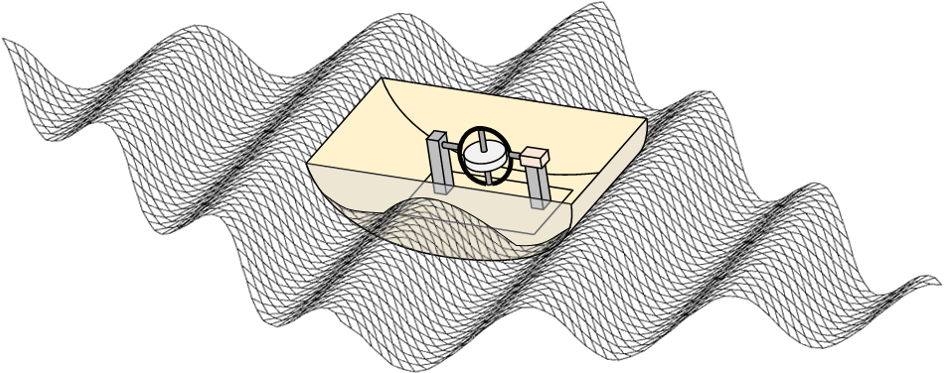
    Gyroscopic Wave Energy Converter
    Schematic diagrams of a gyroscopic wave energy converter. Credit: Figure adapted from T. Iida, Journal of Fluid Mechanics, Cambridge University Press, 2026.

    New Gyroscopic Wave Energy Converter Design

    A researcher from the University of Osaka has investigated a new type of system designed to overcome these limitations. The device, known as a gyroscopic wave energy converter (GWEC), was evaluated for its ability to support large-scale power generation. The results of this work were published in the Journal of Fluid Mechanics.

    The GWEC produces electricity using a spinning flywheel housed within a floating structure. As the platform moves with the waves, the flywheel converts that motion into energy. Because the system relies on gyroscopic behavior, it can be adjusted to capture energy efficiently across a wide range of wave frequencies instead of just a narrow band.
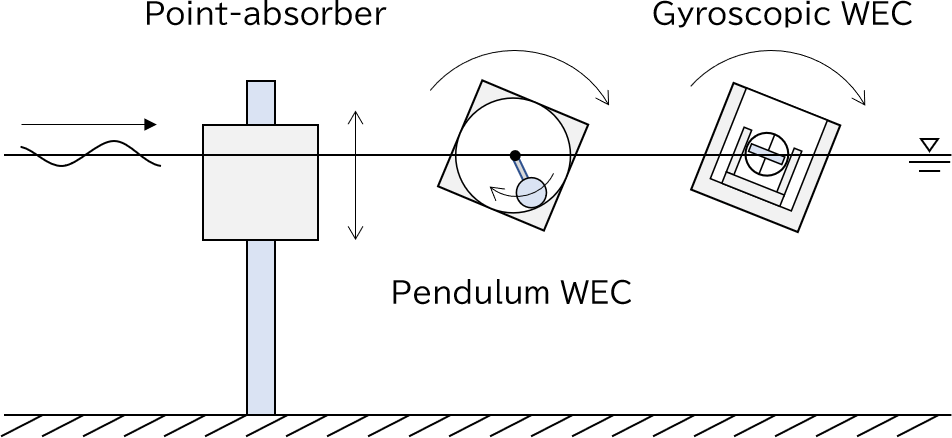
    WEC Comparison
    Comparison among different types of WEC: a point-absorber, pendulum-type WEC, and gyroscopic WEC. Credit: Figure adapted from T. Iida, Journal of Fluid Mechanics, Cambridge University Press, 2026.

    How Gyroscopic Precession Generates Power

    The key mechanism behind the device is gyroscopic precession, which occurs when a spinning object responds to an external force. When waves cause the floating structure to pitch (move up and down), the spinning flywheel changes its orientation through precession (changing the direction it is spinning in). This motion is linked to a generator, allowing the system to produce electricity.

    “Wave energy devices often struggle because ocean conditions are constantly changing,” says Takahito Iida, author of the study. “However, a gyroscopic system can be controlled in a way that maintains high energy absorption, even as wave frequencies vary.”
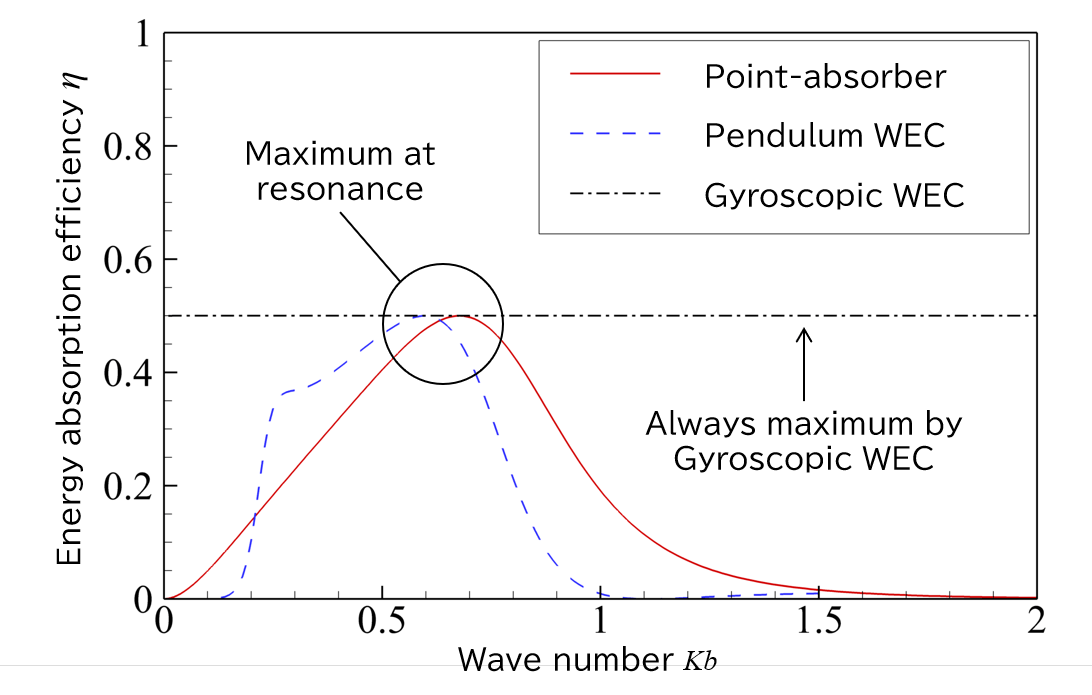
    Energy Absorption Efficiency Gyroscopic WEC
    Energy absorption efficiency 𝜂 versus wave number 𝐾𝑏 for different types of WEC. Credit: Figure adapted from T. Iida, Journal of Fluid Mechanics, Cambridge University Press, 2026.

    Modeling Efficiency Across Wave Conditions

    To understand how the system performs, researchers used linear wave theory to model the interactions among ocean waves, the floating platform, and the gyroscope. By examining these relationships, they identified the best settings for the flywheel’s speed and the generator’s operation. Their analysis showed that, when properly tuned, the GWEC can reach the theoretical maximum energy absorption efficiency of one-half at any wave frequency.

    “This efficiency limit is a fundamental constraint in wave energy theory,” explains Iida. “What is exciting is that we now know that it can be reached across broadband frequencies, not just at a single resonant condition.”

    Simulations Support Real World Performance

    The team tested these findings with numerical simulations in both the frequency and time domains. Additional time-domain simulations included nonlinear gyroscopic effects to assess potential limitations. The results showed that the device maintains strong efficiency near its resonance frequency, meaning it performs best when its motion aligns with the natural rhythm of the waves.

    By demonstrating how to fine-tune the gyroscope for optimal performance, the study outlines a clear path toward more adaptable wave energy systems. As the demand for dependable renewable energy grows, innovations like this could help tap into the enormous energy potential of the oceans.

    Reference: “Linear analysis of a gyroscopic wave energy converter: absorbing half of the wave energy over broadband frequencies” by Takahito Iida, 17 February 2026, Journal of Fluid Mechanics.
    DOI: 10.1017/jfm.2026.11172

    Never miss a breakthrough: Join the SciTechDaily newsletter.
    Follow us on Google and Google News.

    Energy Fluid Dynamics Fluid Mechanics Green Energy University of Osaka
    Share. Facebook Twitter Pinterest LinkedIn Email Reddit

    Related Articles

    30x Improvement in Renewable Energy Solution Inspired by Croissant Making

    New Wind Turbines With Multiple Rotors Show Clear Advantages in Computer Models

    Scientists Discover a More Efficient Way to Turn Heat Into Electrical Energy

    New High-Performance Photovoltaic Solar Cells That Work Indoors

    Transformative Device Generates Energy From the Cold Night Sky, When Solar Doesn’t Work

    Low-Cost Device Generates Electricity Naturally in the Dark

    Hybrid-Solid Electrolysis Cell System – A New Strategy for Efficient Hydrogen Production

    New Aluminum Batteries Increase the Range of UUVs Tenfold

    Floating Nuclear Power Plant that is Safer and Cheaper

    1 Comment

    1. Eric M. Jones on March 21, 2026 7:29 am

      Dream on. Cost per Kilowatt hour is the driving factor, Not, how clever your engineers are.

      Reply
    Leave A Reply Cancel Reply

    • Facebook
    • Twitter
    • Pinterest
    • YouTube

    Don't Miss a Discovery

    Subscribe for the Latest in Science & Tech!

    Trending News

    Largest-Ever Study Finds Medicinal Cannabis Ineffective for Anxiety, Depression, PTSD

    250-Million-Year-Old Egg Solves One of Evolution’s Biggest Mysteries

    Living With Roommates Might Be Changing Your Gut Microbiome Without You Knowing

    Century-Old Cleaning Chemical Linked to 500% Increased Risk of Parkinson’s Disease

    What if Your Memories Never Happened? Physicists Take a New Look at the Boltzmann Brain Paradox

    One of the Universe’s Largest Stars May Be Getting Ready To Explode

    Scientists Discover Enzyme That Could Supercharge Ozempic-Like Weight Loss Drugs

    Popular Sweetener Linked to DNA Damage – “It’s Something You Should Not Be Eating”

    Follow SciTechDaily
    • Facebook
    • Twitter
    • YouTube
    • Pinterest
    • Newsletter
    • RSS
    SciTech News
    • Biology News
    • Chemistry News
    • Earth News
    • Health News
    • Physics News
    • Science News
    • Space News
    • Technology News
    Recent Posts
    • Scientists Discover Coral Reefs Are Teeming With Previously Unknown Life
    • Scientists Find Way to Reverse Fatty Liver Disease Without Changing Diet
    • Could Humans Regrow Limbs? New Study Reveals Promising Genetic Pathway
    • Black Hole Jets Pack Power of 10,000 Suns, Stunning New Study Reveals
    • A Cosmic Crash Turned This Nearby Galaxy Into Chaos
    Copyright © 1998 - 2026 SciTechDaily. All Rights Reserved.
    • Science News
    • About
    • Contact
    • Editorial Board
    • Privacy Policy
    • Terms of Use

    Type above and press Enter to search. Press Esc to cancel.