
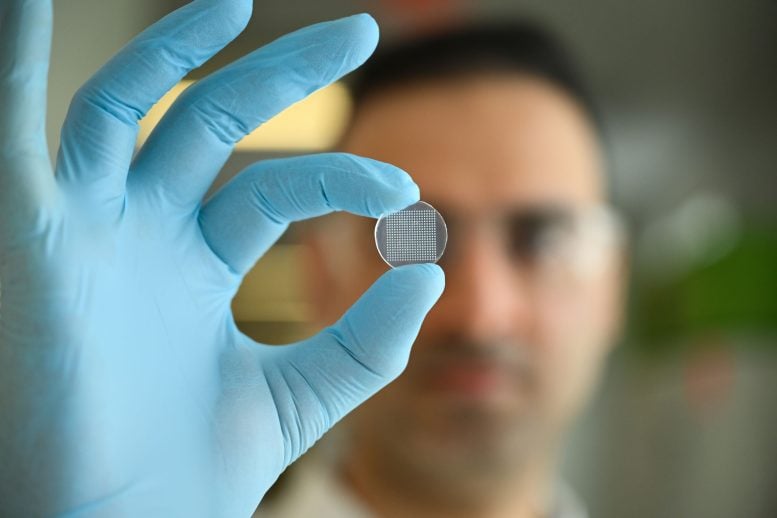
A bandage-like microneedle patch can noninvasively collect immune cells and signals from the skin within minutes to hours. Early tests suggest it could transform how immune responses are monitored.
Researchers at The Jackson Laboratory (JAX), working with the Massachusetts Institute of Technology (MIT), created the first bandage-like microneedle patch designed to sample immune activity directly from the skin. The device detects signs of inflammation within minutes and collects specialized immune cells within a few hours, all without requiring blood draws or surgical biopsies.
Scientists and clinicians are already using the patch to examine immune activity linked to aging and autoimmune skin conditions such as vitiligo and psoriasis. Over time, the technology could also help track how the body responds to vaccines, infections, and cancer treatments. It may serve as a complementary tool alongside blood tests and biopsies while being far less invasive for patients.
The study appears in Nature Biomedical Engineering.
“Traditionally, studying some of the most important immune cells in the body requires a skin biopsy or blood draws. Because many of these cells live and respond in tissues like the skin, accessing them has meant invasive procedures,” said Sasan Jalili, a biomedical engineer and immunologist at JAX. “We’ve shown we can capture them painlessly and noninvasively instead. This is especially important in sensitive or visible areas like the face or neck, where people often don’t want biopsies because of scarring, as well as for older adults, frail patients, and very young children or infants.”
From MIT Research to Clinical Development
Jalili began developing the technology during his postdoctoral research at MIT. After moving to JAX, the team refined and improved the platform, advancing it from experiments in mice toward possible clinical use through collaborations with the University of Massachusetts Chan Medical School (UMass Chan).
Many methods used to track immune cells and inflammatory biomarkers rely on blood samples. However, a large portion of immune cells that recognize infections, vaccines, or autoimmune triggers are rarely found circulating in the bloodstream.

The new patch takes advantage of resident memory T cells, a group of immune sentinels that remain in the skin and other protective barrier tissues. These cells quickly react when they encounter threats they have seen before, known as antigens. When they detect a familiar antigen, such as a viral fragment or allergen, they release signals that attract additional immune cells from the bloodstream, including specialized T cells that recognize the same target.
Researchers used this natural signaling process to concentrate immune cells in the skin so they could be collected. By analyzing the captured cells and molecules, the team could measure both the number and condition of T cells along with other immune signals. This information provides insight into how strongly the immune system is responding to specific diseases or triggers.
Capturing Immune Cells and Signals From the Skin
“In this study, we used antigen-specific T cells as a proof of concept, but the patch also captures other immune cells and inflammatory biomarkers,” said Jalili, who is also a joint faculty member at UConn School of Medicine.
In vaccination experiments with mice, the patch significantly increased the number of antigen-specific T cells that could be recovered, drawing many of them from the bloodstream into the skin. A small human study conducted at UMass Chan produced similar results, with the patch collecting a diverse mix of immune cells and signaling proteins, including resident memory T cells.
“This study marks the first demonstration of live human immune cell sampling using a microneedle patch,” Jalili said. “This opens the door to a new way of monitoring immune responses that’s practical, painless, and clinically feasible.”
The device collects immune cells and signaling molecules after resident memory T cells are briefly activated with a small amount of antigen. The patch contains hundreds of microscopic needles made from an FDA-approved polymer. Each needle is coated with a hydrogel derived from seaweed that is also considered safe by the FDA. The hydrogel absorbs immune cells and molecules from skin interstitial fluid. Because the microneedles reach only the uppermost layers of skin, they cause little irritation and avoid contact with nerves or blood vessels.
Early Human Testing and Future Medical Applications
Blood tests and biopsies will continue to play an important role in medical research and diagnosis. Additional studies are now underway to evaluate how well the patch works across different diseases and patient groups. Still, the initial findings are encouraging, said study co-author Darrell Irvine, an immunologist and bioengineer at Scripps Research who began the project while at MIT.
“Not only did we run extensive preclinical experiments, we were able to carry out an initial test in humans,” Irvine said. “That’s exciting because it almost never happens with brand-new technologies. Moving new technologies from the lab to testing on patients often takes years.”
The patch may prove especially valuable for studying skin diseases because many of the immune cells responsible for conditions such as allergic dermatitis, psoriasis, and vitiligo already reside in the skin. Jalili is currently using the technology to investigate how age-related changes in the skin contribute to chronic inflammation and frailty in older adults through the Pepper Scholars Program in the UConn School of Medicine and UConn Center on Aging.
In the future, the device could allow patients to monitor their immune responses at home, particularly those with skin conditions that flare unpredictably. Researchers also believe the technology could be adapted for use in the mouth or nasal passages, making it possible to study immune responses in mucosal tissues.
“People wouldn’t need hours of sampling. Even 15 to 30 minutes can be enough to detect inflammatory signals and get a sense of what’s happening in the tissue,” Jalili said.
Reference: “Leveraging tissue-resident memory T cells for non-invasive immune monitoring via microneedle skin patches” by Sasan Jalili, Ryan R. Hosn, Wei-Che Ko, Khashayar Afshari, Ashok Kumar Dhinakaran, Namit Chaudhary, Laura Maiorino, Nazgol-Sadat Haddadi, Anusha Nathan, Matthew A. Getz, Gaurav D. Gaiha, Mehdi Rashighi, John E. Harris, Paula T. Hammond and Darrell J. Irvine, 2 March 2026, Nature Biomedical Engineering.
DOI: 10.1038/s41551-026-01617-7
This work was supported by the NIH (award U01AI176310), The Jackson Laboratory, the Ragon Institute of MGH, MIT, and Harvard, and the Koch Institute Support Grant P30-CA14051 from the National Cancer Institute.
Never miss a breakthrough: Join the SciTechDaily newsletter.
Follow us on Google and Google News.